
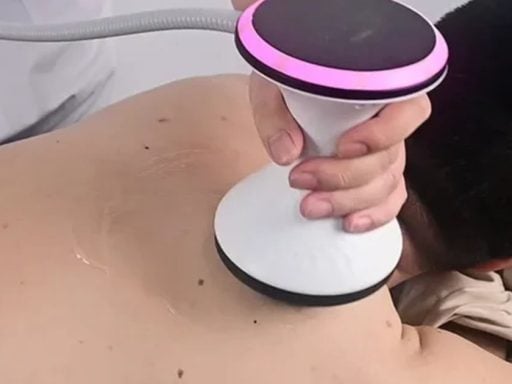
A shockwave therapy machine makes an unusual promise to a clinic: no needle, no per-session consumable, no downtime, and a slot that runs ten to fifteen minutes. That is why so many salons, physiotherapy rooms and men’s wellness studios added one over the past three years — and why a good number bought the wrong one.
The confusion is rarely about the brand. It comes down to one question two machines with near-identical marketing copy can answer in opposite ways: does the energy converge on a focal point, or spread out in a fan? That difference decides which clients you can accept, how deep you can work and how comfortable the session feels.
01 What a Shockwave Therapy Machine Actually Does
Extracorporeal shockwave therapy (ESWT) delivers a short, high-pressure acoustic pulse into tissue from outside the body. The pulse crosses the skin, releases its energy at a target depth and is gone in microseconds. Nothing is injected and nothing is cut.
Three abbreviations appear constantly in supplier documentation. ESWT is the general term for shockwave therapy applied from outside the body. F-ESWT is used by many manufacturers to specify the focused variant, where the wave converges on a defined point. ESWL is a different procedure — lithotripsy, where shockwaves break up stones.
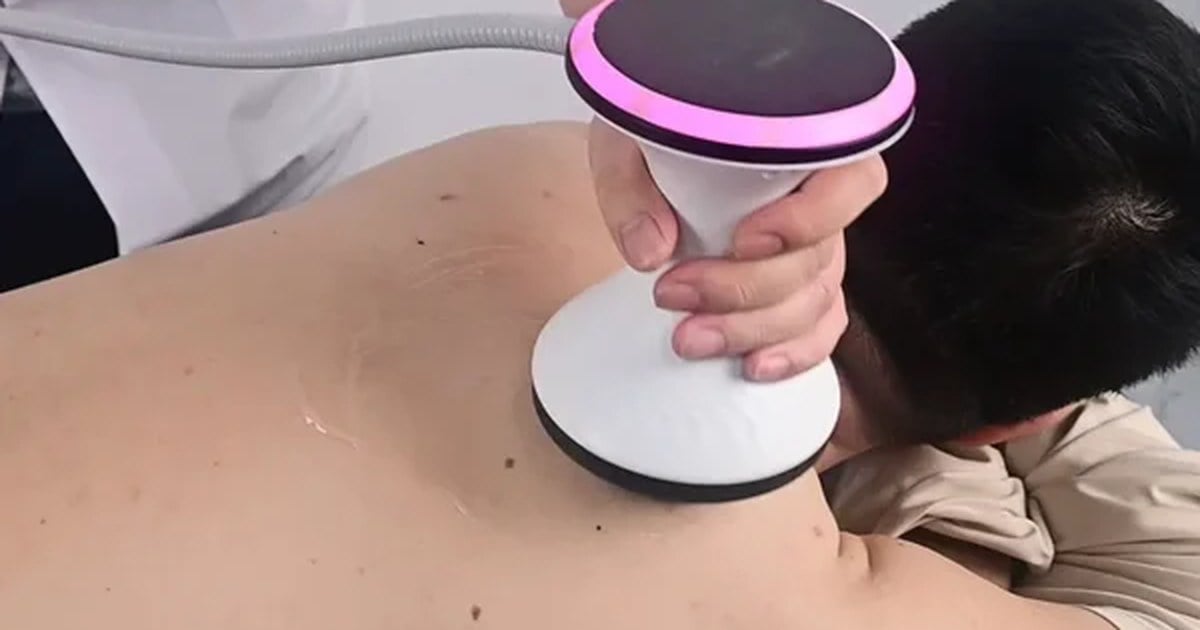
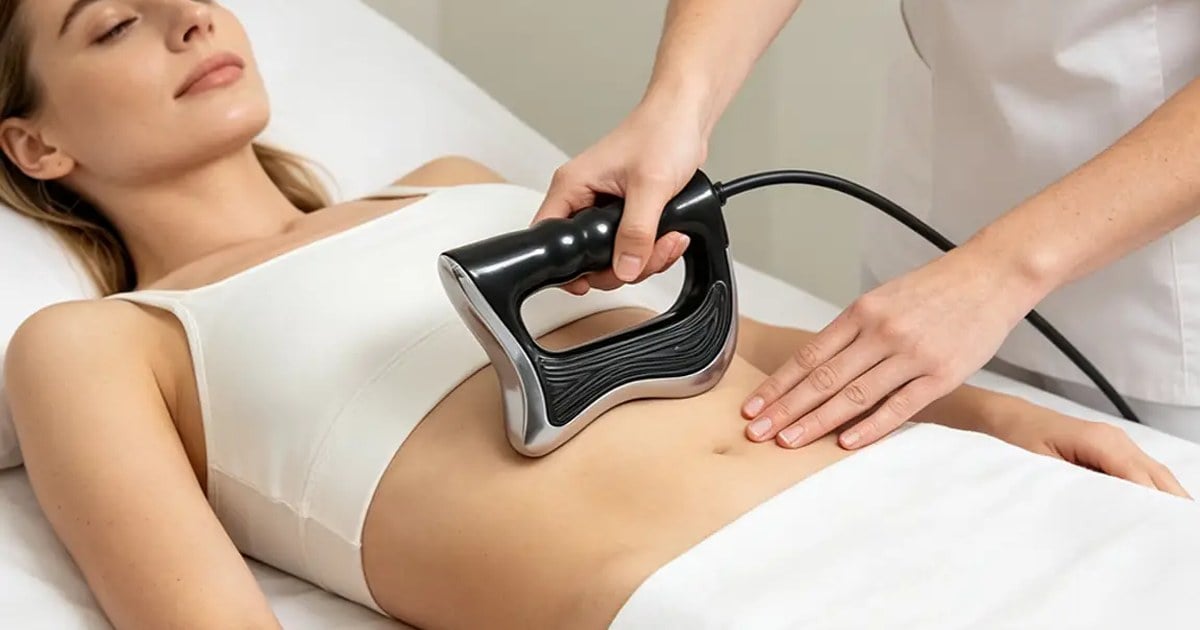
In practice the technology serves three client groups. The largest is musculoskeletal pain and soft-tissue recovery: shoulder, elbow, wrist, knee, plantar fascia, Achilles and lower back. The second is sports and post-training recovery, where the goal is muscle relaxation and circulation rather than rehabilitation. The third — smaller but growing quickly in private clinics — is men’s wellness, covered in section 07. It sits naturally beside the vibration massage machines many body-focused clinics already own: same client, same room.
02 Focused vs Radial: The Two Energy Distribution Types
Every shockwave machine belongs to one of two families, and the family decides almost everything else.
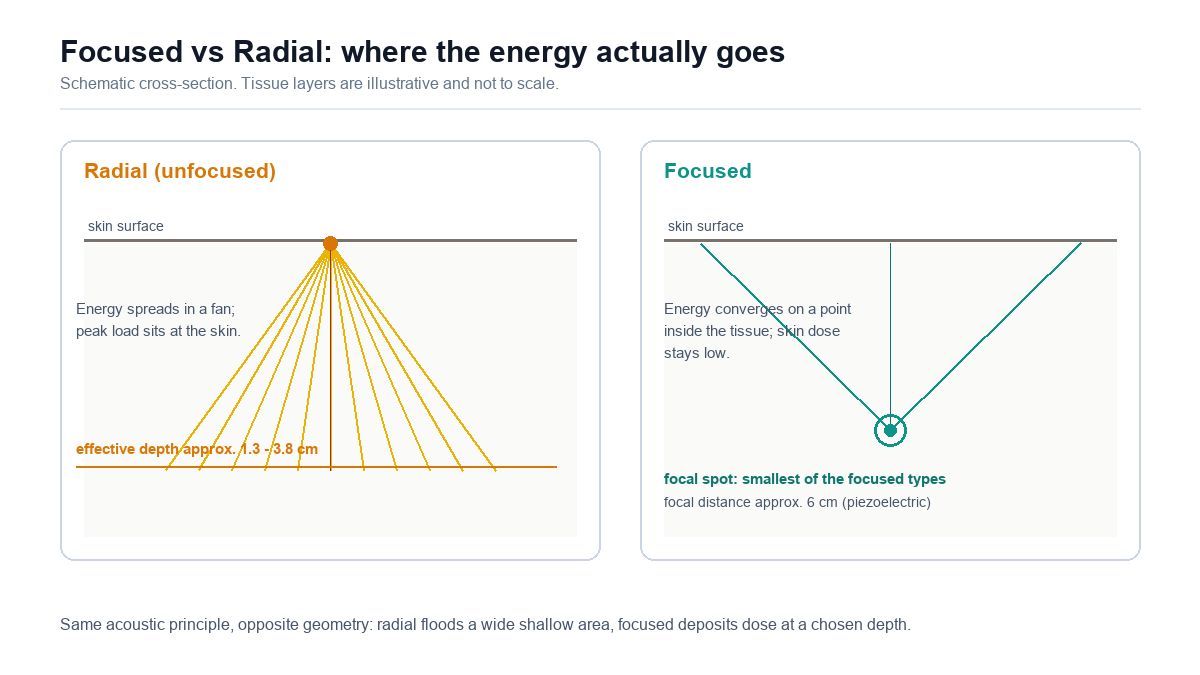
A radial wave (also called unfocused, or pneumatic) spreads outward from the applicator in a fan or umbrella shape. There is no defined focal point, peak energy sits at the skin surface and falls off quickly with depth — published figures put effective penetration at roughly 1.3 to 3.8 cm. Because the wave covers a wide area and needs no precise positioning, radial machines forgive an imprecise hand.
A focused wave concentrates its energy onto a defined point some distance inside the tissue. Energy density at the focal spot is far higher than at the skin: the target receives a strong dose while the surface receives a weak one.
| Artikel | Radial (unfocused) | Focused |
|---|---|---|
| Energy shape | Fan / umbrella, no defined focal point | Converges on a defined focal spot |
| Peak energy location | Skin surface | At the focal point, inside the tissue |
| Effective depth | Approx. 1.3 – 3.8 cm | Deep; adjustable by applicator |
| Surface sensation | Higher — energy is concentrated at the skin | Lower — surface energy density is small |
| Positioning demand | Low; large areas covered quickly | Higher; the focal point must be aimed |
| Typical best fit | Superficial, wide-area soft tissue; muscle spasm; post-training relaxation | Small, deep or point lesions; chronic tendon attachments |
If your list is dominated by broad, superficial muscle work, radial does the job at a lower entry point. If you intend to work on chronic tendon attachments, small deep lesions or men’s wellness protocols, the focal point is not a luxury — it is the mechanism you are selling.
03 Pneumatic, Electromagnetic and Piezoelectric: Three Ways to Generate the Wave
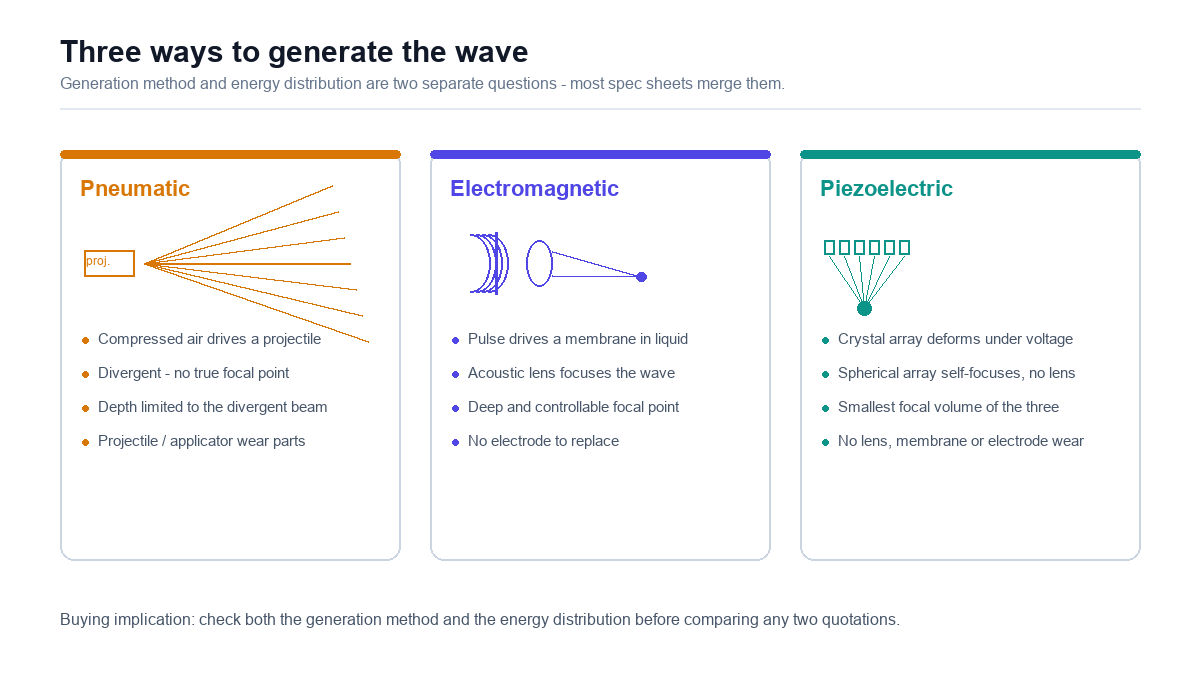
Most buyer guides merge these two questions together; they are separate: how the wave is generatedund how the energy is distributed.
Pneumatic (ballistic). Compressed air drives a metal projectile inside the handpiece into the applicator head, producing a scattered mechanical wave. The design is simple, durable and cheap to maintain, which is why it dominates the entry tier. Because the wave is divergent, energy decays quickly with depth.
Electromagnetic. A high-voltage pulse creates a transient magnetic field that drives a metal membrane, compressing a liquid medium to generate the wave; an acoustic lens then focuses it. Output is stable, the focal point is controllable, running noise is low and no electrode needs replacing. This design sits behind many professional focused machines.
Piezoelectric. A water-filled applicator holds an array of piezoelectric ceramic elements. Under voltage the crystals deform in unison and generate the wave directly inside the water; the spherical geometry of the array focuses it, with no lens or reflector.
| Generation method | Focal behaviour | Depth reach | Verbrauchsmaterial | Relative cost |
|---|---|---|---|---|
| Pneumatic (ballistic) | Divergent, no true focus | Limited (approx. 1.3 – 3.8 cm effective) | Projectile / applicator wear | Lowest |
| Elektromagnetische | Focused via acoustic lens | Deep, controllable | No electrode replacement needed | Mid to high |
| Piezoelectric | Self-focusing crystal array; smallest focal volume of the three | Deep; focal distance changed by swapping applicators | No electrode or membrane wear | Highest |
04 What a Piezoelectric Focused Source Changes for the Operator
Four consequences matter more than the spec sheet suggests.
The focal spot is very small. The focal volume of a piezoelectric array is a fine needle-shaped cone — the tightest of the three focused designs, with a focal distance of roughly 6 cm and focal deviation reported within about 1 mm. Energy is deposited at the target rather than spread along the path.
Surface sensation is lower. Because the applicator aperture is wide, energy density at the skin is low. Operators report that clients tolerate piezoelectric sessions with less discomfort than pneumatic or electrohydraulic alternatives, in many cases without analgesia. For a private clinic selling comfort alongside results, that is a commercial advantage as much as a clinical one. You can see how this is configured on the piezoelectric focused shockwave machine we build.
There is no wear part to replace. No electrodes, no membranes, no projectiles. Output stays consistent across the life of the handpiece, which flattens the long-run cost curve — worth weighing against a low purchase price and years of consumable spend.
The small focal spot cuts both ways. A large lesion must be covered by moving the handpiece repeatedly. If most of your work is broad-area muscle relaxation, the precision you are paying for will never be used.
05 The Buying Checklist: Specifications That Decide the Machine
Quotations arrive in mixed units, which makes comparison harder than it should be. Work through this list in order.
| Spezifikation | What to look for | Why it matters |
|---|---|---|
| Pressure / energy range | Stated in Bar or in mJ — know which | Determines whether deep structures are reachable |
| Frequency range | Hz, and whether it is continuously adjustable | Frequency and depth trade off against each other |
| Eindringtiefe | mm, and whether it is fixed or selectable | The single clearest difference between radial and focused |
| Applicator / treatment head count | How many, and what each one is for | Decides how many service lines you can sell |
| Depth probes | Range in mm, number of steps | Lets one handpiece serve shallow and deep targets |
| Working modes | Preset count and whether they are body-part based | Shortens the operator learning curve |
| Schnittstelle | Screen size, and whether the handpiece has its own display | Affects treatment speed and operator fatigue |
| Spannung | Whether it accepts both 110 V and 220 V | Avoids a transformer on site |
| Packing size and weight | cm and kg, quoted separately | Freight cost and room-to-room mobility |
Two entries deserve a note. On frequency, the relationship is counter-intuitive: lower settings generally reach deeper, while higher frequencies suit superficial work and trigger points. A machine that stops at 10 Hz is perfectly capable of deep work; one reaching 16 Hz simply gives more room at the superficial end. On voltage, dual-range input is not a marketing line — it is the difference between plugging in and sourcing a step-up transformer, which matters if you ship to more than one market.
06 Handles, Heads and Depth Probes: Reading a Configuration
The configuration line of a quotation says more about capability than any single specification.
A treatment head is the interchangeable applicator that touches the skin. Entry-level focused machines often ship with five to seven; the count maps to body regions, not power. A seven-head set usually covers elbow, knee, shoulder, hip, hand and wrist, lumbar region, and foot and ankle — plus, on machines built for men’s wellness, a dedicated applicator. The GN1002 portable unit is a good example: seven heads and ten working modes, preset by body region so the operator selects “shoulder” rather than dialling parameters from scratch.
A depth probe — often a silicone or gel pad fitted over the applicator — shifts the focal distance, which is how one handpiece serves both a shallow wrist target and a deep gluteal one. On the GN1005 the pad set steps from 4 mm to 66 mm across several sizes, covering a range that would otherwise need two applicators.
Two checks before you order. Ask whether the gel pads count as a consumable and at what interval — they are sacrificial parts and should be priced as such. Then confirm the head-to-mode mapping is automatic: on a preset machine the correct head is recommended for the selected body region, on a manual one the operator must remember the pairing — where most treatment errors start in a busy clinic.
07 Two Service Lines on One Machine: Pain Relief and Men’s Wellness
A focused shockwave machine earns its place for a reason most supplier pages underplay: it carries two separate client groups without a second capital purchase.
Die pain and recovery line is the established one. Protocols are short — roughly ten to fifteen minutes per session, spaced a few days apart, several sessions to a course. No dedicated room or special power is needed, so an existing treatment bed and a free diary slot are enough to launch it.
Die men’s wellness line is newer and, in many markets, faster-growing. Focused shockwave energy is now a standard fixture in men’s health programmes, delivered with a dedicated applicator rather than the general-purpose heads. Two things make it commercially attractive: sessions are short, and clients return on a schedule — the repeatable booking pattern a menu built on one-off facials struggles to generate. Studios already running body contouring technologies are the natural audience: the client relationship and the room are already in place.
Focused shockwave is not the only physical modality aimed at pain. A magnetic stimulation pain relief machine und eine micro-current heating pain relief machine cover adjacent ground with different mechanisms, and some clinics run more than one so a client who does not respond to the first has a second option on site.
08 Comparing the Konmison Shockwave Range: GN1005, GN1002 and GN740
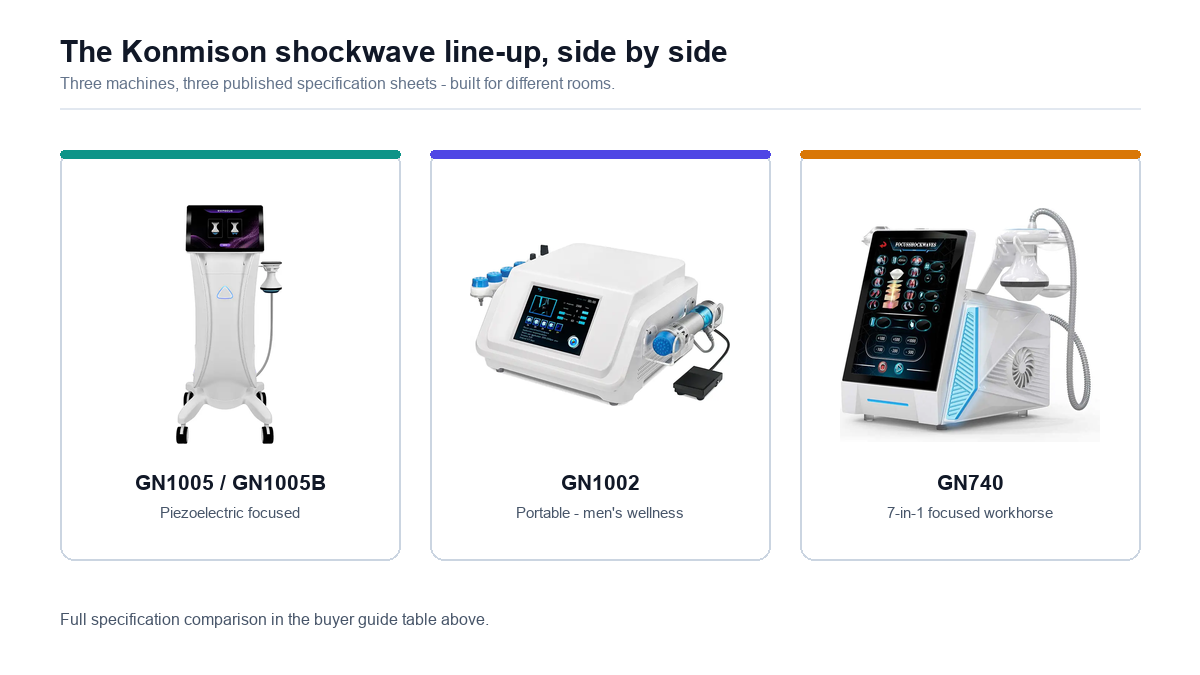
We build three shockwave machines, designed for different rooms rather than different price points.
| GN1005 / GN1005B | Allgemeine Ernährungslehre 1002 | GN740 | |
|---|---|---|---|
| Positionierung | Flagship focused station | Portable, men’s wellness in mind | Established focused workhorse |
| Technologie | Piezoelectric focused shockwave | Stoßwellentherapie | Focus shockwaves |
| Griffe | 1 | 1 | 1 |
| Behandlungsköpfe | 8 (7 general + 1 dedicated) | 7 | 7 silicone pads |
| Pressure / energy | 1 – 10 Bar | 50 – 200 mJ | 1 – 8 Bar |
| Frequenz | 1 – 10 Hz | 1 – 16 Hz | 1 – 10 Hz |
| Eindringtiefe | 4 – 66 mm, selectable | - | 4 – 66 mm |
| Working modes | Body-region presets | 10 modes | 7 body-region pads |
| Schnittstelle | 15″ main screen + 1.8″ handle screen | Touchscreen-Steuerung | 15″ screen |
| Spannung | AC 110 – 220 V ±15%, 50/60 Hz | - | AC 100 – 240 V, 50/60 Hz |
| Größe des Produkts | 51 × 45 × 112 cm | - | - |
| Packing size / weight | 61 × 51 × 120 cm / 43 kg | 55 × 48 × 31 cm / 6.5 kg | 53 × 50 × 60 cm / 23 kg |
— = Not published for this model. All values shown are factory specifications; custom configurations are available on request.
Choose GN1005 if the machine will anchor a fixed treatment room and you want the tightest focal precision plus the widest depth range. It is the only one of the three built on a piezoelectric array, and the dual-screen interface is the fastest to operate in a busy diary.
Choose GN1002 if the equipment needs to travel — a small room, a trolley, several sites. At 6.5 kg packed it goes anywhere, and the ten region-based modes make it the quickest to hand to a new operator. Its 16 Hz ceiling gives the most control at the superficial end.
Choose GN740 if you are adding focused shockwave to an existing physiotherapy or massage business and want a proven, self-contained unit in an aluminium case. The 7 in 1 focus shockwaves pain relief machine has been in our range longest and remains the most straightforward to service.
For rooms that move between modalities rather than specialising in shockwave, the wider portable handheld range covers complementary equipment for the same trolley and the same operator skill set.
09 Setting Up the Service: Room, Consumables and Operator Training
Shockwave is one of the least demanding modalities to add to an existing room.
The room. No shielding, no plumbing, no dedicated power supply. A treatment bed, a chair for the operator and about a square metre of free floor is enough. Mobility is worth deciding up front: a 6.5 kg portable behaves very differently from a 43 kg floor-standing unit.
The consumables. A session needs a coupling medium — gel applied to the skin so the wave crosses into tissue instead of reflecting off the air gap. This is the same category used in ultrasound and RF work, so most clinics already stock it. Gel pads on machines that use depth probes are the second item: inspect them for cracks and replace when damaged, because a compromised pad changes the focal distance.
Operator training. The skill is not in setting parameters — preset modes handle most of that. It is in locating the target: palpating the area to find the tender point, then moving the handpiece in a slow circular or linear motion without dwelling over one spot. Suppliers who treat training as a one-hour handover are the ones whose clients complain.
The surrounding paperwork. A new service line is a small business project, not only an equipment purchase. Our guides on wie man ein Heilbad eröffnetdie medical aesthetics business plan und die Businessplan für Schönheitssalons cover the structure, while the Kosmetikerin - Liste von Zubehör und Ausrüstung und Kosmetikerin liefert Liste are the practical counterparts. If you are launching in a new market, wie man ein Unternehmen für Ästhetik gründet sets out the sequence, and the beauty machines catalogue is where the full equipment range sits.
10 Frequently Asked Questions
Is a focused shockwave machine better than a radial one?
Neither is better in the abstract; they solve different problems. Radial covers a wide, shallow area and tolerates imprecise positioning, which suits general muscle work. Focused deposits energy at a defined depth — what you need for chronic tendon attachments, small deep lesions and men’s wellness protocols. Many established clinics eventually run one of each.
How deep can a shockwave machine work?
It depends on the type, not the brand. Radial waves are typically quoted at roughly 1.3 to 3.8 cm of effective penetration, because the energy diverges and decays quickly. Focused machines reach considerably deeper, with exact depth set by the applicator or depth probe — GN1005 and GN740 both adjust across 4 mm to 66 mm using different pads.
What does piezoelectric mean, and does it matter?
It describes how the wave is generated. An array of ceramic crystals deforms under voltage and produces the pulse inside a water-filled applicator, with no compressor, projectile or acoustic lens. It delivers the smallest focal volume of the three mainstream designs and removes the wear parts, so output stays consistent over a long service life. Whether that matters depends on your client mix: if most of your work is broad-area relaxation, a pneumatic or electromagnetic machine will do the job for less.
What room and licensing setup does it need?
Room requirements are modest: a clean treatment space, standard mains power and a coupling gel. Licensing and permit rules for the service itself vary by market, so confirm them locally before you advertise.
How long is a session, and how many will a client need?
Ten to fifteen minutes typically, with intervals of a few days and several sessions forming a course. Protocols are usually reassessed after the first course rather than committing a client to a fixed schedule.
Is it comfortable for the client?
Piezoelectric designs are generally reported as the most comfortable, because the wide aperture keeps energy density at the skin low; radial concentrates more at the surface. Operators adjust by lowering intensity and raising frequency if a setting feels too strong, and reversing that if too mild.
Can one machine serve both pain relief and men’s wellness?
Yes, and that is the commercial argument for a focused machine. The general-purpose heads cover the pain and recovery work; a dedicated applicator handles the men’s wellness protocol. The GN1005 ships with eight heads for exactly this reason, and portable units such as the GN1002 build the same range into a smaller footprint.
11 Conclusion
The decision is not about brand, price tier or screen size. Two questions settle it, in order: does the energy converge on a focal point, or spread in a fan? And is the wave pneumatic, electromagnetic or piezoelectric?
Once those are settled, the rest of the spec sheet reads as consequences: focal machines reach small deep targets, radial machines cover wide shallow areas cheaply, and piezoelectric arrays add precision and remove wear parts at a higher build cost. Head count, depth probes, portability and voltage all follow from how the room will be used.
Match those characteristics to the clients you actually have — not the ones you hope to have — and the quotation will tell you whether the machine belongs in your clinic.


 EN
EN  RU
RU  ES
ES  IT
IT  AR
AR  FR
FR  DE
DE  JA
JA  KO
KO  NL
NL