
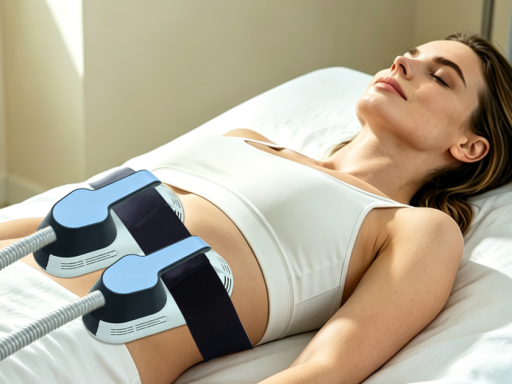
If you are sourcing an emslim machine for a clinic, a distributor catalog, or a new body sculpting service line, the purchasing question is rarely “which brand looks best on paper.” It is “which supplier can ship a consistent, certified, supportable unit, at a price that leaves room for your margin, on a timeline your clients will wait for.” This guide is written for that decision. It walks through how the technology works, what separates a machine that holds up under daily clinical load from one that fails within a year, how to verify a supplier’s actual production depth, and what the true cost of ownership looks like once shipping, customs, training, and warranty service are added in.
What Is an Emslim Machine and How the Technology Actually Works
An emslim machine is a non-invasive body contouring platform that uses high-intensity electromagnetic energy to trigger supramaximal muscle contractions — the kind of contraction a body cannot produce voluntarily during exercise. A single 30-minute session can deliver thousands of contractions across a treatment area, which forces the muscle tissue to adapt by building fibers (hypertrophy) and releasing free fatty acids from nearby fat cells (lipolysis). The combined effect is what clinics market as “muscle toning and fat reduction in the same session.”
This class of device is built around high-intensity electromagnetic fields — often abbreviated as HIEMT on spec sheets.
- Magnetic field intensity — measured in Tesla. Most clinical-grade units list 1.5 to 7 T at the surface of the applicator. Higher intensity does not automatically mean better results; it means shorter sessions are possible and larger muscle groups can be engaged.
- Handle count and configuration — entry-level units ship with two handles (one large pair); high-throughput units ship with four (two large for abdomen and buttocks, two small for arms and legs). Independent handle control matters because it lets the operator adjust energy per area in the same session.
- Pulse frequency and contraction pattern — the range that matters is roughly 1 to 150 Hz, because below 1 Hz the contraction feels weak and above 150 Hz the muscle fatigues before the session reaches its effective duration. Modern units program alternating contraction and relaxation phases automatically.
Optional integrated RF (radiofrequency) heating is often bundled with HIEMT systems to address skin laxity and superficial fat in the same session. RF is useful for clinics that want to position a single platform as a “complete body sculpting solution,” but it is not a universal requirement — a clinic focused purely on muscle stimulation can run profitably without it.
Not all radio frequency behaves the same way, which matters when you are comparing bundles. Conventional bipolar and tripole handpieces concentrate heat in the dermis and upper fat, while monopolar 448 kHz reaches considerably deeper because the current returns through a plate rather than between electrodes on the same handle. Our 448 kHz technology comparison breaks the two apart on published depth and working temperature.
Note on efficacy claims: Specific muscle-building and fat-reduction percentages that appear in some marketing materials are based on third-party clinical studies of electromagnetic body contouring in general, not on any specific Konmison unit. Your results depend on treatment protocol, client adherence, baseline body composition, and follow-up schedule. Always present these figures to your clients with that context.
How Magnetic Body Sculpting Maps to Different Clinic Business Models
The most common sourcing mistake is buying a machine you are excited about, rather than a machine your clients will actually pay for. Before you look at any spec sheet, audit your existing booking data: what are the top three body-sculpting treatments your clients already request, and what do they ask about that you cannot currently offer?
The table below maps common client demand profiles to the configuration that earns back the investment fastest for each model.
| Clinic profile | Primary client demand | Recommended configuration | Why this config fits |
|---|---|---|---|
| New aesthetic clinic, single treatment room | Abdomen toning, entry-level body contouring | 2 EMS Handles electromagnetic muscle-toning unit, no RF | Lowest capital outlay, fastest break-even, can be upgraded later |
| Established skin clinic adding body services | Toning + skin tightening on the same area | 4 EMS Handles electromagnetic muscle-toning unit with integrated RF | One platform covers two revenue lines without buying a separate RF device |
| High-volume body contouring clinic | Parallel treatments on multiple clients | 4-handle unit with independent channel control | Larger handles and independent channels allow two areas to be treated at full intensity at once |
| Distributor / reseller | Catalog coverage across price tiers | Both 2-handle and 4-handle SKUs, optional RF | Covers entry buyers and premium buyers in the same territory |
| Wellness / fitness-adjacent studio | Muscle recovery and toning, not fat reduction | 2 EMS Handles electromagnetic muscle-toning unit, compact form factor | Smaller footprint, lower cost, matches the recovery-focused clientele |
A simple rule of thumb: if your average client is booking three or more body sculpting sessions per week, a 4-handle unit pays for itself roughly 30 to 40 percent faster than a 2-handle unit because of the parallel treatment capacity. Below that volume, a 2-handle unit is the more rational capital decision.
If you are starting with a smaller service menu, the 4-in-1 EMSlim RF body contouring machine combines muscle stimulation and radio frequency in one unit.
What to Look for in an Emslim Machine — The Non-Negotiables
You know which configuration fits your client base. Now you need to evaluate individual machines — and the gap between a device that looks good in a brochure and one that holds up under daily clinical load is where most purchasing mistakes happen. The real value of an emslim machine rests on four interdependent pillars.
Energy Output and Treatment Handle Configuration
Ask the supplier for the actual magnetic field intensity in Tesla at the surface of the applicator, not just the power consumption in watts. A unit can draw 6,500 W and still deliver a poorly focused field that scatters into surrounding tissue. The relevant number is intensity at the treatment depth, typically 1.5 to 7 T for clinical-grade platforms.
Verify that the four-handle units you evaluate support independent channel control — meaning the operator can set different energy levels and treatment times for each handle in the same session. Some budget units advertise “four handles” but drive all four from a single channel, which makes per-area adjustment impossible and limits the clinical value of the extra handles.
For clinics that need maximum coverage, the 16-in-1 EMS body sculpting machine supports up to 8 treatment areas at once.
Integrated RF and Multi-Modality Support
If you are sourcing a unit with RF, ask for the RF frequency (most common: 1 MHz, 3 MHz, or bipolar multipolar), the maximum power output in watts, and whether the RF can be run simultaneously with HIEMT or only sequentially. Simultaneous operation is clinically preferable because it reduces total session time, but it places higher demand on the cooling system and the operator’s training.
For distributors buying for resale, confirm whether RF is a standard feature, a factory-installed option, or a field upgrade. This distinction directly affects your SKU planning, import duty classification, and after-sales warranty scope.
Software, Touchscreen, and Treatment Protocols
The interface is where low-cost units reveal themselves. Clinical-grade platforms ship with a capacitive touchscreen of at least 10 inches, pre-installed treatment protocols for the most common body areas, adjustable energy and time per handle, and a treatment history log that the operator can export for client records. If the supplier cannot demonstrate the software on a video call or send a UI manual before you pay, that is a warning sign.
Language configuration matters for distributors: ask whether the software supports the languages of every market you plan to resell into, and whether the supplier charges per-language customization. Confirm with the supplier which languages ship standard on the unit and which trigger an OEM minimum-order customization.
Calidad de construcción y normas de fabricación
Certifications document that a manufacturer has a quality system in place; they do not by themselves demonstrate that any specific unit will perform reliably in clinical use. Build quality is the more direct indicator of whether a unit holds up under daily clinical load. The specific, verifiable indicators of manufacturing rigor are:
- Metal vs. plastic chassis — a clinical-grade unit should have a powder-coated metal housing, not ABS plastic. The weight difference is immediately obvious: a real 4-handle unit weighs 45 to 70 kg, not 18 to 25 kg.
- Sistema de refrigeración — air cooling is standard for intermittent-use units; water cooling is required for high-throughput units that run back-to-back sessions. Ask which cooling the unit uses and what the duty cycle is (how many consecutive sessions before it needs to cool down).
- Handle strain relief — the cable-to-handle junction is the most common failure point on electromagnetic body sculpting units. Ask for a photo of the strain relief boot and whether the cable is user-replaceable.
- Serial number traceability — every unit should have a serial number that the manufacturer can use to pull the production batch, test report, and component lot. If the supplier cannot trace a unit back to its production batch, warranty service will be impossible.
Choosing a Supplier That Won’t Let You Down
This is the section most buyer guides skip, and it is the one that decides whether your investment survives the first year. Two suppliers can present identically on a B2B platform — same product photos, same specification sheets, same price band — and still differ sharply in their ability to support the unit over its full service life. What matters is not the label a supplier uses for itself, but the depth of production behind the unit: who actually assembles it, who controls the firmware, who stands behind the warranty when a handle fails in month ten. The signals below let you measure that depth before you commit.
How to Verify a Supplier’s Production Depth
The signals that actually indicate production depth are not the storefront claims — they are the specific, verifiable responses you get when you ask the three questions below.
| Dimensión | What to ask | What a credible answer looks like |
|---|---|---|
| Production capacity | “Can you walk me through your production line on a live video call — showing where the electromagnetic coils are wound and the handles are assembled?” | The supplier schedules the call on request and walks you through the assembly floor, testing benches, and QC stations in real time. |
| OEM and ODM capability | “Can you produce custom branding, custom firmware, custom packaging, and custom handle configurations? What is the OEM minimum order?” | The supplier accepts OEM and ODM on its core lines, with a defined MOQ, a defined lead time, and samples of previous OEM work. Suppliers offering only fixed shelf configurations have limited control over the product roadmap. |
| Lead time and sample policy | “What is the lead time on a standard unit, on an OEM unit, and on a single-unit sample order?” | A supplier producing from its own line typically quotes 15–30 days for standard configurations and adds 15–20 days for OEM, with single-unit sample orders available for qualified buyers. Uniform 3–7 day quotes across all configurations usually indicate the supplier is shipping from existing warehouse stock. |
One step surfaces production depth in a single email: ask the supplier to send a 5-minute live video walk-through of their production line, shot on a smartphone, showing the assembly floor where the electromagnetic coils are wound and the handles are assembled. A supplier with production depth can produce this on request within a reasonable timeframe. Suppliers who are unable to provide this on request may have limited production visibility.
Certificaciones y cumplimiento normativo
Certifications are a useful starting reference when evaluating a manufacturer, but they are not a substitute for the buyer’s own regulatory due diligence. The most commonly cited documents in this category are the international quality management standard for medical-device manufacturers and the EU Declaration of Conformity framework. For some markets, US premarket regulatory clearance or a national medical-device registration is also relevant. A certificate held by the manufacturer describes its own quality system or its own declaration of conformity; whether a specific device can be legally imported, sold, and operated in your particular market is a separate question that is the buyer’s responsibility to confirm with the local regulator or a qualified local compliance consultant before any purchase decision.
Here is what each actually means and how to verify it:
- Quality management system for medical-device manufacturers — the international QMS standard most often referenced in this category. It covers design controls, risk management, traceability, and post-market surveillance. Ask for the certificate number and the name of the issuing body, then verify it on the issuer’s website. A certificate from an IAF-accredited body is meaningfully stronger than one from a non-accredited body.
- EU Declaration of Conformity — required for sale in the European Economic Area. The conformity mark on the housing must be accompanied by a Declaration of Conformity that lists the applicable standards; ask for the DoC, not just the mark on the housing.
- US regulatory clearance — required for sale in the United States. Most electromagnetic body contouring devices enter the US market through a premarket notification, demonstrating substantial equivalence to a legally marketed predicate device. Ask for the submission number and verify it in the regulator’s public database.
Practical acid test: Ask the supplier to send you PDF copies of all certificates they hold before you discuss pricing, and review them yourself or with a qualified local consultant. If only internal inspection reports are available, ask whether third-party audits can be arranged.
Asistencia posventa y garantía
The emslim machine is a high-utilization capital asset. A handle failure, a touchscreen fault, or a cooling system leak will stop your revenue the day it happens. Before you pay, confirm the answers to these five questions:
- What is the standard warranty period, and what components does it cover? (A serious warranty covers the main unit, the electromagnetic handles, and the cooling system for at least 12 months, with a clearly priced extended option.)
- Who pays for replacement parts and shipping during the warranty period?
- What is the typical response time for a technical support request, and in what time zone?
- Does the supplier maintain a spare parts inventory in your region, or will every replacement part be shipped from the factory in Asia?
- Is remote diagnostics available — meaning the supplier can log into the unit’s controller to read fault codes, or do you have to describe symptoms by email?
Manufacturers that ship internationally with serious after-sales support — Konmison included — typically publish a spare parts list with prices in the quotation, maintain a multilingual technical support desk, and offer remote diagnostics for any unit with a serial number registered in their service database.
Cálculo del coste real de propiedad y del plazo de amortización
The unit price is the smallest number in the total cost of ownership. The full picture for an imported emslim machine looks like this:
| Cost component | Typical range (4-handle unit) | Notas |
|---|---|---|
| Unit price (supplier-direct, EXW or FOB) | $3,500 – $7,500 | Depends on configuration, certifications, and OEM branding |
| Freight (sea, port-to-port) | $400 – $900 | Air freight adds $1,500 to $3,000 but cuts 30 days off the timeline |
| Customs duty and import taxes | 0% – 12% | Varies by destination country’s HS code classification |
| Local delivery and installation | $150 – $400 | Higher if a certified technician is required |
| Operator training (online) | $0 – $300 | Remote live video sessions and written operation manuals are standard; budget for extra practitioner hours if you want in-house staff fully certified |
| Spare parts inventory (year 1) | $200 – $500 | At minimum: one replacement handle, fuses, cooling pump seal kit |
| Marketing and launch | $500 – $2,000 | Before-and-after photography, social media, client launch offers |
| True landed cost (year 1) | $4,750 – $12,100 | All-in, before any revenue |
For break-even, the standard model for a 4-handle HIEMT unit priced at $6,000 (supplier-direct) with a $50 per-session price looks like this:
- True landed cost (year 1): ~$8,200
- Average sessions per week: 12
- Average revenue per session: $50
- Weekly revenue: $600
- Weeks to break-even: ~14 weeks (about 3.5 months)
Reduce the per-session price to $35 and the timeline stretches to about 20 weeks. Increase the per-session price to $80, and break-even drops to about 9 weeks. The unit price is the same in all three scenarios — what changes the timeline is your pricing strategy and your session volume, which is why the audit of your existing client demand (above) has to come before the equipment decision.
Why Konmison Fits the B2B Buyer’s Checklist
Konmison is a Chinese aesthetic equipment supplier with an in-house production line for its core electromagnetic body sculpting equipment. The points below apply the same production-depth signals from the section above to Konmison, so you can verify them directly rather than taking the article at its word.
| B2B verification signal | What Konmison provides |
|---|---|
| Factory background and experience | Established manufacturing facility in Guangzhou with 13 years of experience in aesthetic device production, serving B2B clients worldwide |
| Factory audit reports | Available to verified B2B buyers on request; production line walk-through on live video call |
| Product range | Core electromagnetic body sculpting equipment produced in-house; complementary aesthetic device categories available through vetted manufacturing partners |
| OEM and ODM capability | Custom branding, custom firmware, custom packaging, custom language sets, and custom handle configurations on orders meeting the OEM MOQ |
| Certificaciones | Certificate PDFs covering the manufacturer’s quality management system and applicable regulatory conformity are available on request |
| Warranty and after-sales | 12-month standard warranty on main unit and handles, remote diagnostics on units with registered serial numbers, multilingual technical support desk |
| Languages supported on software | Multiple languages supported; custom language sets available on OEM orders |
| Sample order policy | Sample orders available with a minimum order quantity of 1 unit |
The body sculpting line itself covers configurations from a compact 2-handle HIEMT unit suited to a single-room clinic, through 4-handle HIEMT + RF platforms for established body contouring studios, to multi-modality units that pair electromagnetic muscle stimulation with cryolipolysis on the same chassis. Each unit ships with serial number traceability, a published spare parts list, and the option to customize branding, software, and packaging for distribution partners.
The full specifications, handle configurations, and treatment protocols for the current emslim machine lineup are available on the EMS body sculpting machine product page. For clinics evaluating complementary fat-reduction modalities, the congelación de grasa máquina de adelgazamiento line covers cryolipolysis-based platforms that pair naturally with electromagnetic toning in a multi-service clinic.
Cómo preparar a tu equipo: formación, seguridad y mantenimiento continuo
An emslim machine is only as good as the operator running it. Before the unit arrives, the clinic needs three things in place: a documented treatment protocol, a client screening checklist, and a maintenance schedule.
Client Screening and Contraindications
Electromagnetic body sculpting is non-invasive, but it is not for every client. The contraindications that every operator should screen for before the first session are:
- Pregnancy and breastfeeding
- Cardiac pacemaker, implanted defibrillator, or any electronic implant in the treatment area
- Metal implants in the treatment area (IUDs are generally not a contraindication, but confirm with the manufacturer’s protocol)
- Active cancer or recent chemotherapy / radiation therapy
- Epilepsy (the electromagnetic field can, in rare cases, trigger a response in photosensitive clients)
- Acute inflammation, open wounds, or recent surgical incisions in the treatment area
- Severe kidney or liver impairment (relevant when the treatment is intended to release fatty acids for metabolism)
Every client should sign an informed consent form that lists these contraindications, confirms none apply, and acknowledges that results vary based on body composition and adherence to the recommended session schedule.
Operator Training
Look for a supplier whose operator training is included with the machine. The minimum standard is: device operation, treatment protocol selection per body area, energy and time adjustment, contraindication screening, client positioning, and emergency stop procedures. At Konmison, the body sculpting line ships with remote online training (live video sessions with an engineer and recorded reference modules) and a written operation manual. All training and technical support is delivered remotely.
Maintenance Schedule
A simple schedule that prevents most failures:
- Daily: Wipe down the handles and the unit housing with a non-abrasive, alcohol-free disinfectant. Inspect handle cables for kinks or damage.
- Weekly: Check the cooling vents for dust buildup and clean with compressed air if necessary.
- Monthly: Run a self-diagnostic cycle if the unit supports it, and verify that all four handles deliver energy by running a 30-second test pulse on each.
- Quarterly: Inspect handle strain relief boots for cracking. Replace the handle immediately if any boot is damaged — a cracked boot lets electromagnetic energy scatter, which is both less effective and a burn risk.
- Annually: Run a remote diagnostics health check via the manufacturer’s support channel and request a written service report. The manufacturer’s engineer reviews the controller logs, handle output readings, and cooling system performance remotely.
PREGUNTAS FRECUENTES
What is the difference between a single-handle and multi-handle emslim machine?
A 2-handle unit treats one body area (typically the abdomen) at a time and is suited to low-volume clinics or focused muscle-toning services. A 4-handle unit treats two areas in parallel — for example, abdomen and buttocks, or two arms — and is the standard configuration for high-volume body contouring clinics. On 4-handle units, verify that the handles operate on independent channels so energy and time can be set separately per area.
How do I verify a supplier’s actual production depth?
Ask three questions in a single email: (1) a live video walk-through of the production line showing where the electromagnetic coils are wound and the handles are assembled, (2) OEM capability including custom branding and firmware with the minimum order quantity, and (3) lead time on a standard unit versus an OEM unit. A supplier with production depth typically responds to all three on request within a reasonable timeframe; suppliers who are unable to provide these may have limited production visibility.
What certifications should an emslim machine have for international sale?
The two categories of documents that matter most are (1) a quality management system certificate covering medical-device manufacturing and (2) a conformity assessment for the destination market — typically an EU Declaration of Conformity for Europe and a premarket regulatory submission for the United States. These certificates describe the manufacturer’s quality system and the manufacturer’s declaration that the device conforms to applicable standards, not whether a specific device is cleared for sale in any particular market. Confirming local-market compliance is the buyer’s responsibility and should be verified with the local regulator or a qualified compliance consultant before any purchase decision.
Can I get OEM branding and custom software on an emslim machine?
Yes. OEM orders typically include custom logo placement, custom boot screen, custom software language sets, custom packaging, and in some cases custom treatment protocol programming. Konmison offers OEM on the full body sculpting line, with multiple software languages supported and custom language sets available on OEM orders. Confirm whether the OEM MOQ and lead time fit your distribution plan before committing.
What is the typical lead time and warranty for a supplier-direct emslim machine?
Standard configuration units typically ship in 15 to 30 days, with OEM customization adding 15 to 20 days. The standard warranty is 12 months covering the main unit, electromagnetic handles, and cooling system, with remote diagnostics available on units with registered serial numbers. Confirm who pays for replacement parts and shipping during the warranty period before you sign the contract.
References: international medical-device QMS standards; EU Declaration of Conformity framework; US premarket notification framework; SGS / TÜV / Intertek factory audit methodology; industry pricing benchmarks for electromagnetic body sculpting platforms in 2025-2026.




 EN
EN  RU
RU  ES
ES  IT
IT  AR
AR  FR
FR  DE
DE  JA
JA  KO
KO  NL
NL