
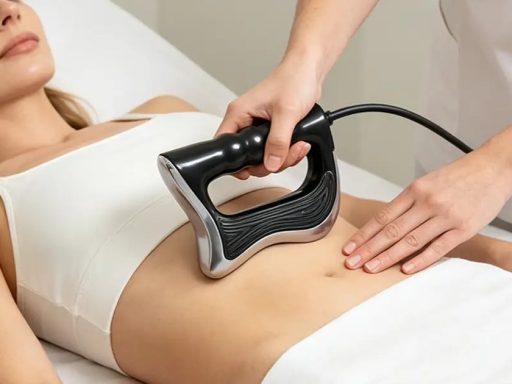
Anyone who has compared body contouring catalogues recently has met the same five acronyms on every spec sheet: CET, RET, RF, EMS and cavitation. Many supplier pages use them as if they were interchangeable. They are not. They are four different ways of putting energy into tissue, they act at different depths, and they feel different for the client on the table. Choosing between them is less about which one is “best” and more about which depth matches the service you plan to sell.
This guide compares the four from a buyer’s perspective: how each one works, how deep it acts, what the client feels during a session, and how our own 448 kHz line-up packages the technology. Every figure quoted below is a published value taken from our product pages and factory manuals — nothing is inferred, and nothing is borrowed from competitor material.
Why the frequency on the label matters
Most radio frequency machines in this market run in the megahertz band — our own 7-in-1 platform, for example, publishes its RF output at 1 MHz. A 448 kHz machine runs at roughly half that frequency, and it delivers the current in a different way: monopolar, with the current returning through a plate rather than circulating between two or more electrodes on the same handpiece.
The practical consequence is depth. With a bipolar or tripole handpiece the current takes the shortest path between electrodes, so the heating concentrates near the skin. With a monopolar 448 kHz source the current path runs through the tissue toward the return plate, which is what allows the published RET depth figure of up to 12 cm. That single number — depth — is the reason 448 kHz machines have become a category of their own rather than just another RF model.
The four technologies at a glance
| Tecnología | Cómo funciona | Where the energy acts | What the client feels | Typical service pairings |
|---|---|---|---|---|
| CET / RET 448 kHz | Monopolar radio frequency in two electrode modes: capacitive (CET) and resistive (RET) | CET: dermal collagen layer (published 45–60 °C working range). RET: deep tissue strata, published up to 12 cm | Steady, tolerable warmth | Deep-heat body programmes, lymphatic drainage, skin tightening |
| Conventional RF (tripole / sextupole) | Alternating current between several electrodes on one handpiece | Dermis and upper fat layers | Warmth plus suction massage when vacuum is fitted | Circumference programmes, firming, facial lifting |
| EMS | Electrical pulses trigger involuntary muscle contractions | Muscle layer | Strong rhythmic pulsing, no heat | Muscle tone programmes, abdominal conditioning |
| Cavitation (40K / 80K ultrasound) | Pressure waves form microbubbles in the fluid around fat cells, which collapse | Superficial to mid fat layer | Warmth, tingling, mild pressure | Circumference reduction, body contouring courses |
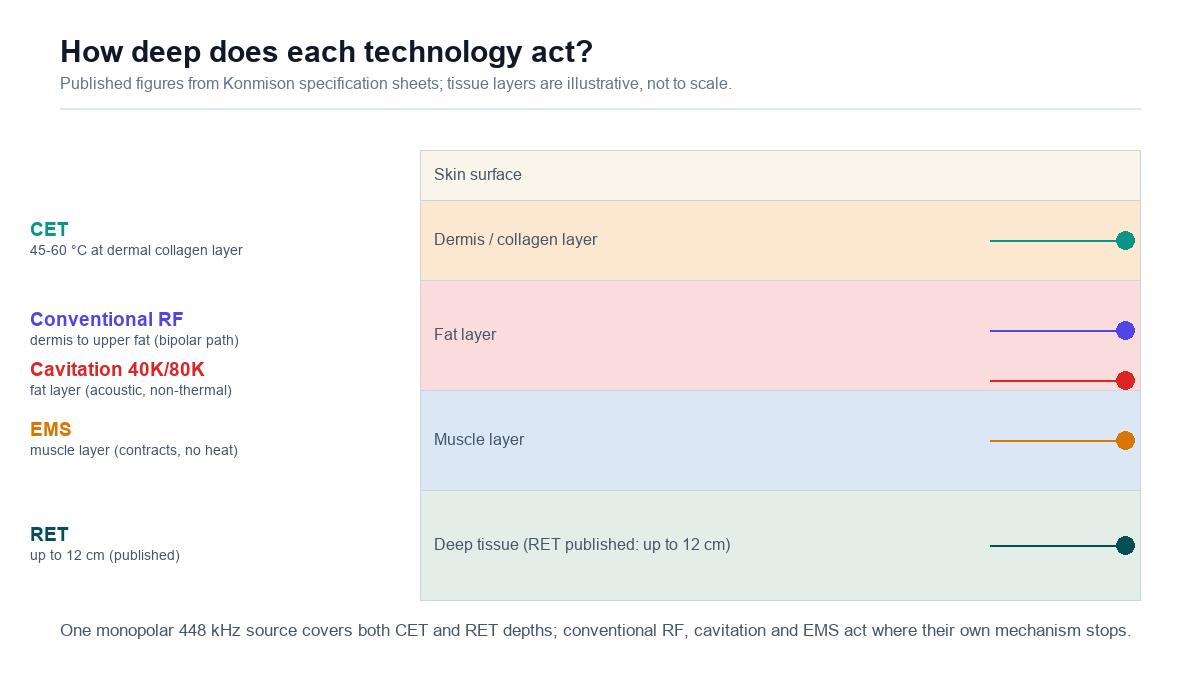
Reading the table row by row already narrows the choice. If the service you want to run is a deep-heat, relaxation-led body programme, the 448 kHz row is the only one that reaches the published 12 cm depth. If it is muscle tone, EMS is the only row that contracts muscle instead of heating tissue. If it is circumference reduction on localized fat pockets, cavitation and conventional RF remain the workhorses — which is why they are still shipped on nearly every multi-handle slimming machine.
CET and RET: two modes, one 448 kHz source
On a 448 kHz machine, CET and RET are not two separate technologies bought separately. They are two electrode modes of the same monopolar source, and understanding the split is what makes these machines versatile in a mixed-menu room.
The CET mode: capacitive, superficial
The CET handle uses a ceramic, heat-conduction electrode that is insulated toward the skin surface. Charge accumulates in the tissue nearest the electrode, so the working zone is the dermis — the collagen-bearing layer. Our published CET figure is a working temperature of 45–60 °C at the dermal collagen layer. Because the zone is superficial, CET is the mode used for facial work and for tightening-type body passes, and the four interchangeable head sizes (63 / 48 / 35 / 21×35 mm on the 3-in-1 model) let the operator match the head to a face, arm or abdominal zone.
The RET mode: resistive, deep
The RET handle uses a non-insulated metal head. Here the tissue’s own resistance generates heat along the current path, so the working zone sits deeper — down to the published 12 cm maximum. The four RET heads (63 / 53 / 38 / 33 mm) cover large body zones down to smaller areas. Deep-heat body programmes and lymphatic drainage services are built on this mode.
The return plate is part of the technology
Monopolar delivery needs a return path, and the negative plate that ships with these machines is what dissipates the returning energy evenly. Our own handle notes flag it explicitly as the component that avoids concentrated heating. When you compare quotations, check that the plate is in the box — it is easy to leave out of a stripped-down shipment and hard to explain to a client why it matters.
How conventional RF differs
A tripole or sextupole RF handpiece carries all of its electrodes on the head itself. The current circulates between them, so the heating stays in the dermis and upper fat layers — exactly where a firming or circumference treatment wants it, and exactly why it cannot match the published depth of a resistive 448 kHz mode.
What conventional RF gains is pairing. Vacuum suction lifts the tissue into the handpiece, improves contact and adds mechanical drainage, which is why a vacuum RF combination remains the most-shipped configuration for circumference programmes. Our 7-in-1 platform is built on exactly this logic: three vacuum RF handles in three diameters, a tripole RF handle, a sextupole RF handle and two CET handles, with the RF band published at 1 MHz. For a full treatment of how RF tightens skin in general, our RF skin tightening explainer covers the mechanism in detail.
Where EMS fits
EMS is the odd one out in this comparison because it does not heat tissue at all. Electrical pulses contract the muscle — the client feels strong rhythmic pulsing, not warmth. It serves muscle tone programmes, which the other three technologies cannot deliver.
That is also why EMS is usually bought as its own line rather than as a handle on a slimming machine. Some multi-handle machines add a small EMS accessory — our 11-in-1 ships a micro-current abdominal pouch with 62 silicone contact points — but that is a supplementary function. If EMS is the core service you are selling, read our EMS body sculpting buyer guide and buy a dedicated platform; if EMS is a bolt-on, the pouch on a combined machine is enough.
Where cavitation fits
Cavitation is a mechanical, non-thermal mechanism. Ultrasound at 40K or 80K creates alternating pressure in the fluid around fat cells; microbubbles form and collapse, and that collapse is understood to disrupt fat cell membranes. The body then processes the released content over the following weeks, which is why cavitation courses are sold in blocks with circumference tracking rather than as single sessions.
It is also the technology most often paired with RF in one machine: cavitation works the fat layer, RF and vacuum handle the tightening and drainage afterwards. Our site covers this technology extensively — start with what cavitation treatment isEl ten documented cavitation benefits, real 40K cavitation before-and-after guidance, and our cavitation machine selection guide if that is the line you decide to buy. Cold-based fat reduction is the other family altogether; our cryolipolysis buyer guide covers it separately.
The Konmison 448 kHz line-up, side by side
We ship three 448 kHz platforms, each packaged for a different room and a different client mix. The table below reproduces the published specification sheets — nothing added, nothing rounded.
| Spec | 3 in 1 CET RET (JF999) | 7 in 1 Vacuum RF CET (JF960) | 11 in 1 CET RET Vacuum RF (JF957) |
|---|---|---|---|
| Core technology | 448 kHz CET RET | Vacuum + tripole/sextupole RF (1 MHz) + 448 kHz CET | 448 kHz CET RET + Vacuum RF + micro-current + fascia massage |
| Cantidad de asas | 3 pcs (CET + RET + fascia knife) | 7 pcs (vacuum RF ×3, tripole RF, sextupole RF, CET ×2) | 11 pcs |
| CET / RET heads | CET 4 pcs (63/48/35/21×35 mm), RET 4 pcs (63/53/38/33 mm) | CET: 2 handles + 3 heads | CET and RET: 4 treatment heads each |
| Potencia | 450 W | Max 350 W | - |
| Tensión | 220 V ± 22 V, 50 Hz ± 1 Hz | not listed on the published sheet — confirm at order | 100–220 V, 50/60 Hz |
| Mostrar | 10.1-inch screen | Pantalla táctil de 7 pulgadas | Pantalla táctil de 10,1 pulgadas |
| Carton (size / weight) | 48×45×34 cm / 8 kg | 101×54×47 cm / 17.6 kg | 105×59×54 cm / 26.7 kg |
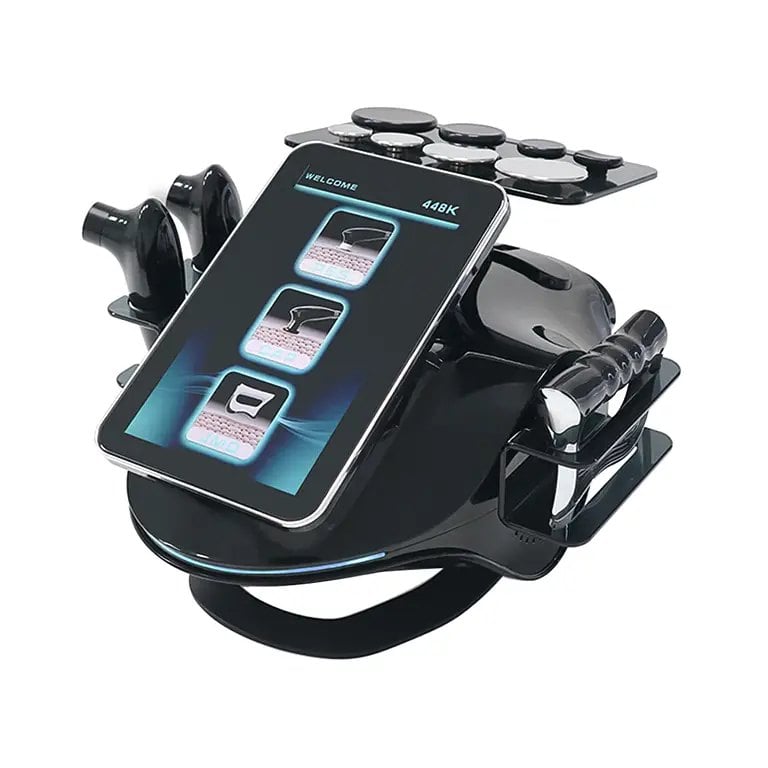
En 3-in-1 CET RET 448KHz body and facial sculpting machine is the truest expression of the technology: one CET handle, one RET handle, one fascia knife, a 10.1-inch screen and an 8 kg carton. It is the lightest published footprint in the line and the natural first unit for a small studio or a mobile practitioner.
En 7-in-1 vacuum RF body sculpting and skin tightening machine is the hybrid: a 448 kHz CET mode rides on top of a full vacuum RF stack, so a salon centred on circumference and firming gets both worlds in one 7-inch touchscreen unit.
En 11-in-1 448K CET RET vacuum RF body slimming machine is the full-room platform — eleven handles including two vacuum RF handles, a meridian brush, a rolling bar, a bio fascia knife and the micro-current abdominal pouch, on a 10.1-inch touchscreen. It is the unit to specify when one machine has to carry a multi-bed room.
Matching the technology to your service menu
The decision compresses into five lines. Pick the row that describes your room, not the one with the most handles:
- Deep-heat body and lymphatic programme, compact room → CET + RET in one unit: the 3-in-1 JF999
- Circumference and firming with a hands-on massage feel → vacuum RF plus CET: the 7-in-1 JF960
- One platform for a multi-bed room with a mixed menu → the 11-in-1 JF957
- Localized fat pockets first, tightening second → a cavitation + RF combination — see our cavitation machine selection guide
- Muscle tone as the core service → a dedicated EMS line — see the EMS body sculpting buyer guide
Three practical checks before you order
Voltage first. This is the check most buyers miss. The JF999’s published sheet reads 220 V ± 22 V at 50 Hz ± 1 Hz; the JF957’s sheet reads 100–220 V at 50/60 Hz; the JF960’s sheet does not list a voltage row at all. If your market runs 100–120 V mains, confirm the factory configuration in writing before the order — it costs one line in an email and prevents an unusable machine at the border.
Head inventory second. The published head counts are not decoration. Four CET sizes and four RET sizes on the 3-in-1 mean face-to-abdomen coverage without re-ordering; a quotation that ships fewer heads than the published sheet is a different machine. Ask which sizes are included and whether replacement heads are stocked.
Carton economics third. The published carton weights span 8 kg to 26.7 kg, and that span moves a shipment between freight classes. It also decides installation: an 8 kg carton reaches a first-floor studio without a delivery team, a 26.7 kg platform does not.
Frequently asked questions
Is CET RET 448 kHz a different technology from ordinary RF?
It is the same physical family — radio frequency — but at a lower frequency (448 kHz versus the 1 MHz band our other sheets publish) and delivered monopolar with two electrode modes. The consequence is a deeper published working depth (up to 12 cm in RET mode) than a bipolar handpiece reaches.
Do the CET and RET handles do different jobs?
Yes, by depth. CET concentrates its working temperature at the dermal collagen layer — the published range is 45–60 °C — and is the mode used for facial and tightening work. RET generates heat along the deeper current path, up to the published 12 cm. Operators typically run RET passes on body zones and CET passes on superficial zones, with the four head sizes on each handle deciding the zone match.
What does a 448 kHz session feel like for the client?
Steady warmth rather than pulses or suction. The factory manual for the platform describes roughly 30 minutes per body area, and the operation is non-invasive with no downtime in our published documentation. The return plate keeps the session comfortable — the same reason the plate must be in the box.
Can a 448 kHz machine replace my cavitation unit?
No. Cavitation is an acoustic, non-thermal mechanism and acts on the fat layer in a way RF does not replicate. A combined platform like the 11-in-1 adds vacuum RF, micro-current and fascia work to 448 kHz — but if cavitation is a core service, it stays on its own machine or its own dedicated handles.
Which model should a small studio start with?
The 3-in-1 JF999: three handles covering both CET and RET, a 10.1-inch screen, and the smallest published carton in the line at 48×45×34 cm and 8 kg. It runs a deep-heat service line without dedicating a whole room to one machine.
Which model suits a 100–120 V market?
The 11-in-1 JF957 publishes 100–220 V at 50/60 Hz, so it accepts both mains standards. For the JF999 and JF960, confirm the factory voltage configuration at order time — the published sheets list 220 V and no voltage row respectively.
Do operators need special qualification to run these machines?
Our manuals position the 448 kHz platforms as beauty-salon machines operated by trained staff, and the operation notes are explicit about movement speed and session timing. Check the operator requirements in your own market before hiring; regulations differ by country.
The bottom line
CET, RET, conventional RF, EMS and cavitation are not competitors on a spec sheet — they are four different depths of the same treatment map. Depth decides which service you can honestly sell, and the spec sheet decides whether a quoted machine can deliver it. Compare published depth figures, published temperature ranges and published voltage rows side by side, and the acronym soup resolves into a straightforward equipment decision.
If you want the four technologies combined in one room rather than one machine, our slimming machine category lists the full body contouring portfolio, and our OEM & ODM programme supports custom configuration, branding and packaging for all three 448 kHz platforms.


 EN
EN  RU
RU  ES
ES  IT
IT  AR
AR  FR
FR  DE
DE  JA
JA  KO
KO  NL
NL