
Most buyers comparing diode laser hair removal machines start with output power. That is the second question. The first is wavelength — because wavelength decides which hair and which skin the machine can treat at all, and no amount of added power compensates for a wavelength that does not match your client base.
Almost every diode laser platform on the market now comes in two builds: a single-wavelength 808nm (or 810nm) head, and a triple-wavelength 755 + 808 + 1064nm head. They can look identical on the outside and differ substantially in price. This guide explains what each build actually does, where the practical limits sit, and how to match one to the clients you treat.
Why wavelength comes before everything else
Laser hair removal works by selective photothermolysis: light is absorbed by melanin in the hair shaft and follicle, converted to heat, and the follicle’s ability to regrow is disrupted. Different wavelengths are absorbed by melanin to different degrees, and they penetrate to different depths.
That single fact produces the whole trade-off:
- Shorter wavelengths (755nm) are absorbed by melanin very strongly. That makes them efficient on finer, lighter hair — but it also means more of the energy is taken up in the epidermis, which raises the risk profile on darker skin.
- Mid wavelengths (808nm / 810nm) sit at a balance point. Absorption by melanin is still high, but penetration is deeper and epidermal uptake is lower than at 755nm. This is why 808nm became the default in professional diode platforms.
- Longer wavelengths (1064nm) are absorbed by melanin less strongly, so they leave more room to raise energy safely on deeper skin tones. The trade-off is that they need more energy to reach the same effect on fine light hair.
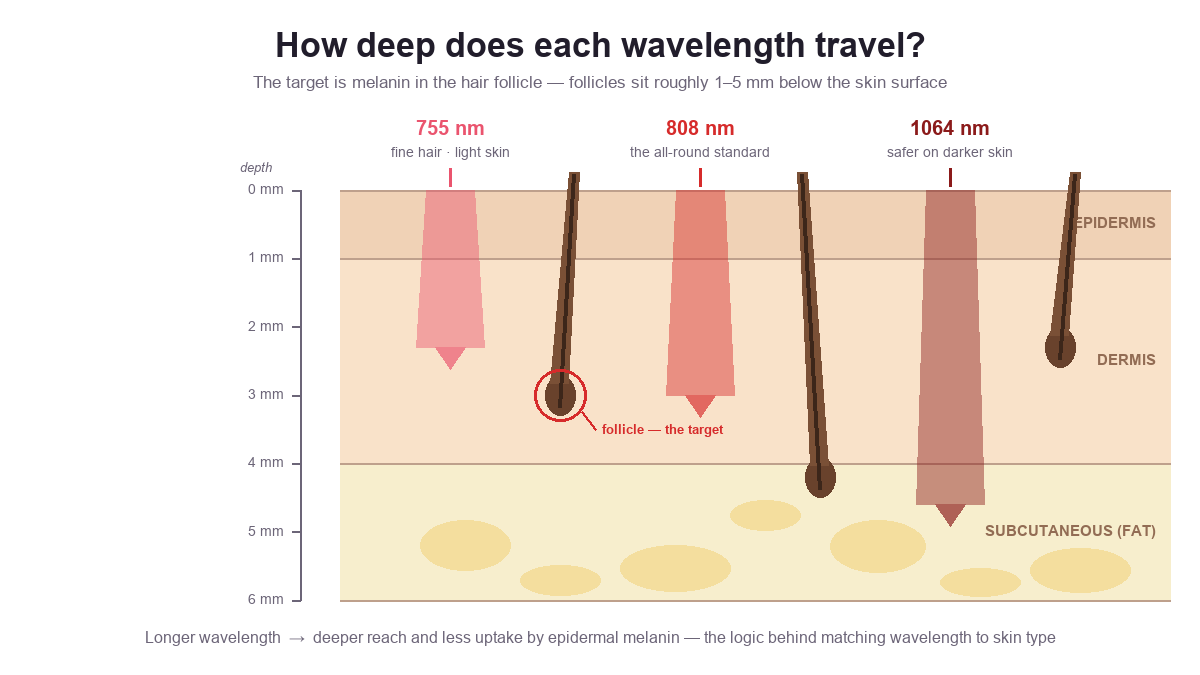
On a single-wavelength 808nm machine, you own one position on that curve. On a triple-wavelength machine, you own three.
The single-wavelength build: 808nm and 810nm
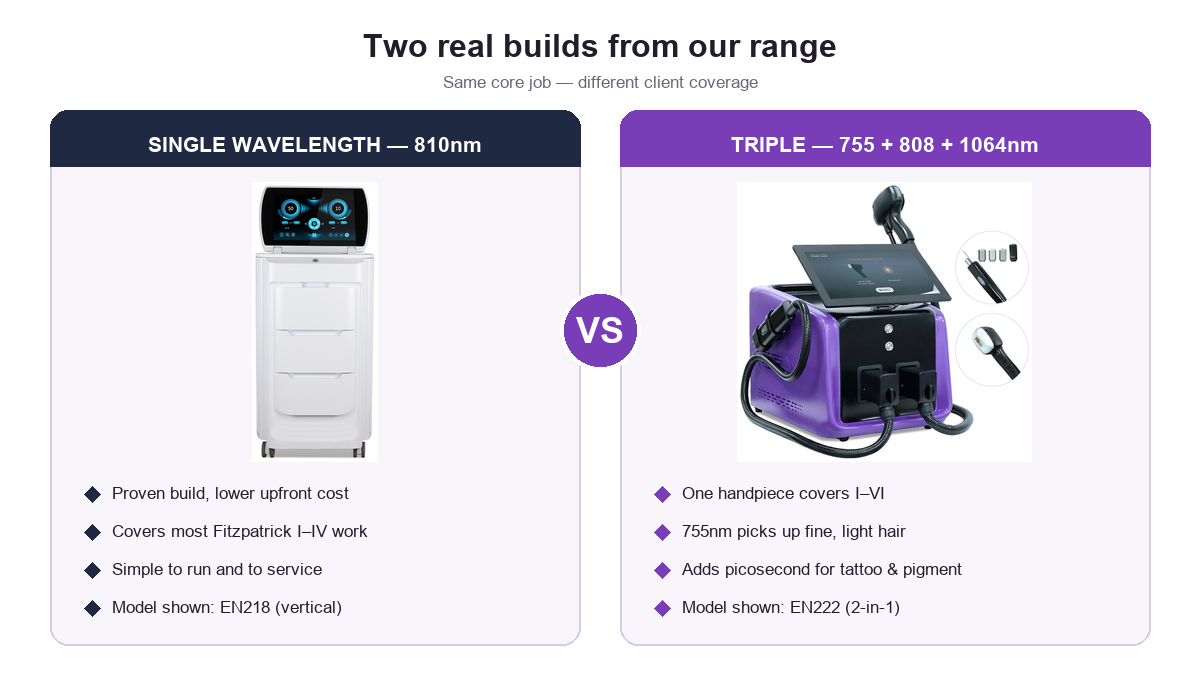
A single-handle 808nm diode machine is the most common professional configuration, and for a large share of clinics it is the correct one.
What it does well
- Clients with Fitzpatrick I–III skin and clearly pigmented hair — the majority of walk-in demand in most markets.
- Large areas: legs, arms, back, chest, abdomen. One handle, one set of consumables, one cooling circuit.
- Straightforward training. Operators learn one energy scale rather than three.
- Lower acquisition cost, and a smaller service footprint — fewer handles, fewer failure points.
Where it runs out of road
- Very dark skin (Fitzpatrick V–VI). At 808nm the epidermis absorbs a meaningful share of the energy. Safe protocols exist, but the margin is narrower and the treatment is slower.
- Fine or light hair. Light hair carries less melanin, so the target is weaker. Longer wavelengths are not the answer here either, but 755nm is measurably more efficient than 808nm.
- High-throughput clinics. A single spot size sets a hard ceiling on how fast each appointment moves.
If your clients are mostly I–III with pigmented hair, a well-built 808nm machine with a long-life handle and good cooling is not a compromise. It is the efficient choice.
The triple-wavelength build: 755 + 808 + 1064nm
A triple-wavelength platform puts three diode stacks — or a combined stack — behind one handle, selected from the screen. The point is not that three is better than one. The point is that the machine can be re-configured per client instead of being locked to one protocol.
What each wavelength is doing
| 波長 | Position | Typically used for |
|---|---|---|
| 755nm | Strongest melanin absorption, shallowest penetration | Fine and lighter hair, smaller areas, lighter skin tones |
| 808nm | 吸収と浸透のバランス | General body work, the workhorse setting for I–III skin |
| 1064nm | Weakest melanin absorption, deepest penetration, safest margin on dark skin | Fitzpatrick IV–VI, thicker or coarser hair, cases where epidermal risk has to be minimised |
What you are actually paying for
- Coverage across skin types. If you advertise to a mixed population — and most urban clinics do — a 1064nm option widens who you can accept without turning bookings away.
- Fewer “not suitable” conversations. Being able to shift wavelength rather than turn a client down is a commercial feature, not only a clinical one.
- Higher spot-size flexibility on some builds. Multi-wavelength heads often ship with a larger spot. See the table below — this matters more to throughput than the wavelength count does.
What it costs you
- Higher machine cost, and usually higher cost per handle replacement.
- More training and more protocol discipline. Three energy scales means three ways to get the settings wrong.
- On some builds, one handle serves all three wavelengths — when that handle is in service, the machine is out of service.
Side by side: three real builds from our range
The table below uses published specifications from three current models to show how the numbers move when you change wavelength strategy. All three are single-handle builds; the difference is the wavelength set and what comes with it.
| 仕様 | 808nm single | 810nm single | 755+808+1064nm triple |
|---|---|---|---|
| モデル | EN186C | EN218 | EN137D |
| 波長 | 808nm | 810nm | 755 + 808 + 1064nm |
| ハンドル数量 | 1 | 1 | 1 |
| Laser power / handle power | 250W (500W / 1000W / 2000W optional) | - | 500W (1000W / 1200W optional) |
| エネルギー密度 | 138.89 J/cm² | 0–50 J/cm² | 1–150 J/cm² |
| スポットサイズ | 12 × 18mm | 12 × 18mm | 15 × 25mm |
| 頻度 | 1-10Hz | 1-10Hz | 1-10Hz |
| パルス幅 | 10–400ms, adjustable | - | - |
| Handle / shot life | - | 50,000,000ショット | - |
| 冷却 | TEC, 12V6A | Air + semiconductor + TEC | - |
| ディスプレイ | - | 15.6インチ・タッチスクリーン | 15.6インチ・タッチスクリーン |
| 電圧 | 110–220V | 220V / 240V | AC100V or 230V, 50/60Hz |
| パッケージ重量 | 10.5kg | 52.6kg | 31.5kg |
| ポジショニング | Portable, salon and studio | Stationary, general body work | Stationary, mixed skin types |
Two things stand out. First, the triple-wavelength build carries a spot size roughly 74% larger in area (15 × 25mm vs 12 × 18mm) — which changes appointment throughput independently of wavelength. Second, the portable 808nm unit weighs 10.5kg against 31.5kg, which decides whether the machine can travel or has to be installed in a fixed room.
If you need multi-spot coverage rather than multi-wavelength, a platform such as the EN191H ships five heads — 10 × 10mm, 13 × 20mm, 13 × 30mm and 13 × 40mm plus a nose-hair head — on a triple-wavelength 755+808+1064nm handle rated at about 20 million shots and a maximum of 150 J/cm².
Six specifications that matter more than the wavelength count
Buyers tend to over-weight the wavelength list and under-weight these. In practice they decide day-to-day economics.
1. Energy density (J/cm²) and its usable range. A wider range lets one machine serve both fine facial hair and coarse body hair. Look for the range, not the headline maximum — a machine that only performs at the top of its range is a machine that runs at its thermal limit.
2. Spot size. Treatment time scales with area. Moving from 12 × 18mm to 15 × 25mm adds around 74% more coverage per pulse, which translates directly into shorter appointments or more appointments per day.
3. Pulse width and frequency. Pulse width sets how the energy is delivered to the follicle; frequency sets how fast the operator can work. Adjustable pulse width (for example 10–400ms on the EN186C) gives room to tune protocols rather than run one setting for everyone.
4. Handle life in shots. This is the least visible and most expensive specification. A 50-million-shot handle on the EN218 そして EN218B against a 20-million-shot handle elsewhere is a multi-year difference in replacement cost, and it should be weighed against the price difference of the machine itself.
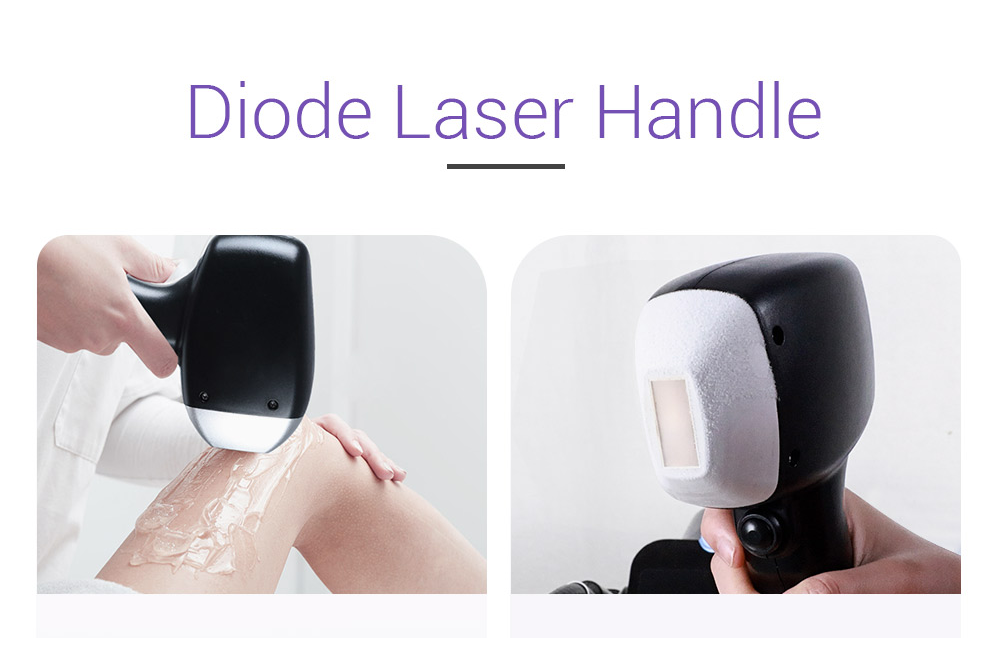
5. Cooling. TEC, sapphire contact cooling and multi-stage liquid circuits decide both client comfort and how safely operators can work at higher energy on darker skin. The EN186C runs a TEC chip at 12V6A with five adjustable cooling levels; platforms with a sapphire contact head hold a low temperature at the skin surface directly.
6. Serviceability. How many handles, how much liquid, what the water circuit looks like, and whether the manufacturer stocks consumables locally. A machine with three handles and no regional spares is a machine that idles.
Matching the build to your business
| Your situation | Build that fits | なぜ |
|---|---|---|
| Small salon or mobile/studio operator, clients mostly I–III | Single-wavelength 808nm, portable — e.g. EN186C at 10.5kg | Lowest entry cost, transportable, simple to train, adequate coverage for the client base |
| Established clinic, general body work, wants long-term cost predictability | Single-wavelength 810nm, stationary, long-life handle — e.g. EN218 with 50 million shots | Handle life dominates lifetime cost; 7L water tank and 15.6-inch screen suit daily volume |
| Mixed urban client base including Fitzpatrick IV–VI, high throughput | Triple-wavelength 755+808+1064nm — e.g. EN137D (15 × 25mm, 1–150 J/cm²) | 1064nm widens who you can accept; larger spot raises throughput |
| Multi-area work needing different spot sizes without tool changes | Triple-wavelength with multiple heads — e.g. EN191H, five heads | Nose-hair head and four spot sizes cover small and large areas on one handle |
| Want hair removal plus tattoo removal in one cabinet | 2-in-1 diode + picosecond platform — e.g. EN222 または EN218B | Non-ablative footfall; picosecond handle addresses a separate revenue line |
| High-traffic aesthetic clinic wanting several technologies in one footprint | 4-in-1 platform — e.g. EN188 (diode + picosecond + IPL/OPT + RF) | One install, four service lines, shared consumables base |
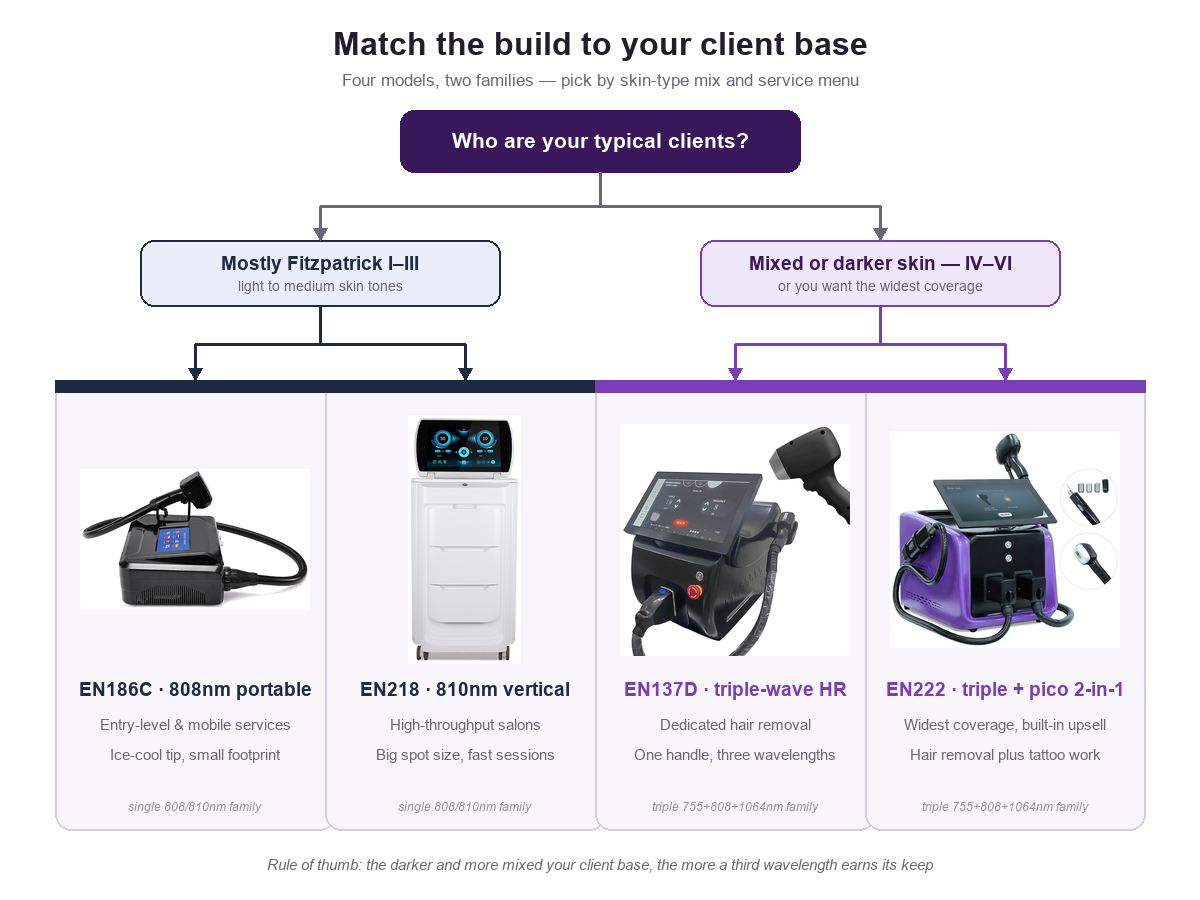
A practical filter: write down the skin types and hair colours you actually see in a typical week. If more than roughly one client in five sits at Fitzpatrick IV or above, or if you are regularly turning clients away, the triple-wavelength build tends to justify itself. If your client base is consistently I–III with pigmented hair, the extra wavelengths add cost without adding bookings. If you would rather see both builds against each other before deciding, the laser hair removal machine range lists them under one category.
What to ask a supplier before you order
- Which wavelengths, and can they be confirmed on the handle rather than in the brochure?
- Handle life in shots, and the replacement price. This single number usually decides the five-year cost of ownership.
- Spot sizes available, and whether extra sizes require a second handle.
- Cooling architecture — TEC only, or TEC plus contact cooling, and whether it holds temperature at continuous use rather than only at start-up.
- Water circuit: capacity, whether it requires pure or deionised water, and how often it needs changing.
- Spare parts and service lead time for your region.
- Whether the platform is expandable — can a picosecond or IPL handle be added later, or does the whole cabinet have to be replaced?
- Training and protocol documentation for the skin types you treat.
- OEM and ODM scope if you intend to sell under your own brand, including housing, interface language set and packaging.
For operators who want to go deeper on the technology before comparing builds, our guide to what 808nm diode laser actually does covers the underlying absorption and penetration behaviour in more detail.
Frequently asked questions
Is 808nm or 810nm better for hair removal?
Both sit in the same near-infrared band and are absorbed by melanin in a very similar way. In practice the difference between an 808nm and an 810nm machine matters far less than handle life, spot size and cooling. Treat 808nm and 810nm as one category when you compare machines, and compare the other specifications instead.
Do I need 1064nm if my clients are all light-skinned?
No. 1064nm earns its place on deeper skin tones, where its lower epidermal absorption gives a safer working margin. If you consistently treat Fitzpatrick I–III with pigmented hair, an 808nm build covers the work.
Does a triple-wavelength machine treat faster?
Not because of the wavelength count. Speed comes from spot size, frequency and pulse delivery. A triple-wavelength head with a 15 × 25mm spot will generally move faster than a single-wavelength head at 12 × 18mm — but it is the spot size doing the work, not the number of wavelengths.
How many shots should a handle be rated for?
Look at the number in the context of your volume. A handle rated at 20 million shots and one rated at 50 million shots differ by years of service for a busy clinic. Ask for the figure in writing along with the replacement price, and calculate cost per shot before comparing machine prices.
Can one handle cover all three wavelengths?
On most current builds, yes — the wavelength is selected on the screen and delivered through the same handle. That simplifies operation, but it also means a handle fault takes the entire machine offline, so spare handle availability matters more.
Is a portable diode laser machine suitable for a professional clinic?
It can be, for lighter-volume work and for operators who travel or share premises. The trade-off is usually water tank capacity and cooling headroom under continuous use. If you plan six or more treatment hours a day, a stationary platform with a larger liquid circuit is generally the better fit.
What should I check first on a demo?
Treatment speed on a large area, and how the handle temperature behaves after twenty minutes of continuous use — not the first five minutes. Cooling performance under sustained load separates platforms more reliably than any specification sheet.
Can I add hair removal to a machine I already own?
Only if the platform was designed with an expandable handle bay. Some multi-technology cabinets accept additional handles later; single-purpose diode machines generally do not. Confirm this before purchase rather than after.
Choosing between the two builds
The decision comes down to two facts you already have: the skin types and hair types in your client base, and the number of treatment hours you expect per day. Single-wavelength 808nm covers the majority of routine demand at the lowest cost and the smallest footprint. Triple-wavelength 755 + 808 + 1064nm widens who you can accept, and on most builds it also brings a larger spot size — which is often the more commercially significant difference of the two.
If you would like the full specification sheets for the models compared above, or to discuss a wholesale, OEM or ODM configuration, get in touch with our team — we will match a build to your treatment menu and client mix rather than send a generic quotation.



 EN
EN  RU
RU  ES
ES  IT
IT  AR
AR  FR
FR  DE
DE  JA
JA  KO
KO  NL
NL