
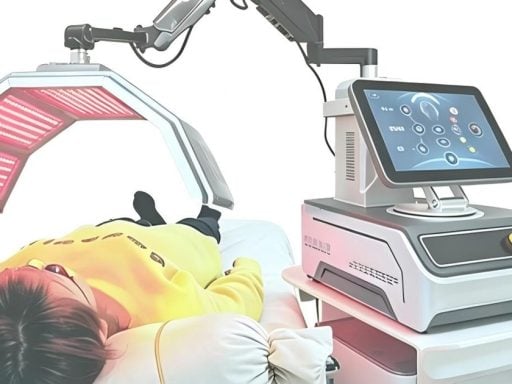
Two LED machines can carry the same “phototherapy” label and still serve completely different businesses. One is a 105-bead portable panel that moves between rooms in a flight case; the other is a 1,830-bead vertical unit that floods the face in a single pass. Both are legitimately called LED light therapy machines — and buying the wrong format for your room is an expensive mistake, because the format decides the treatment menu before anything else does.
LED phototherapy has become one of the most requested add-on services in facial clinics, and it is also one of the easiest services to run: no consumables, no operator-dependent technique, and a treatment that largely runs itself once the client is positioned. That combination is exactly why the buying decision deserves care — the machine you choose sets your session time, your pricing structure and how many clients you can push through a day.
Why LED Systems Look Similar but Perform Differently
LED phototherapy machines are harder to compare than most aesthetic equipment, for three reasons.
First, the headline specification is usually the least informative one. Marketing leads with color count — “7-color LED” sounds better than “4-color LED” — but the colors only matter if your menu needs them. A clinic running acne-care and recovery protocols can cover both with red and blue alone; seven colors add menu breadth, not treatment depth.
Second, the specification that actually drives results is rarely published. Irradiance — the light power delivered to the skin, measured in mW/cm² — varies enormously between machines at the same price point, and most listings do not state it at all. What you can check instead are the numbers that feed into it: power per LED bead, total system power, and irradiation area.
Third, format is destiny. A mask, a desktop dome, a standing 360° unit and a full-body panel are four different businesses wearing the same technology name. The next section breaks the decision into the four specifications that matter.
The Specs That Decide Your Treatment Menu
Wavelengths and What Each One Does
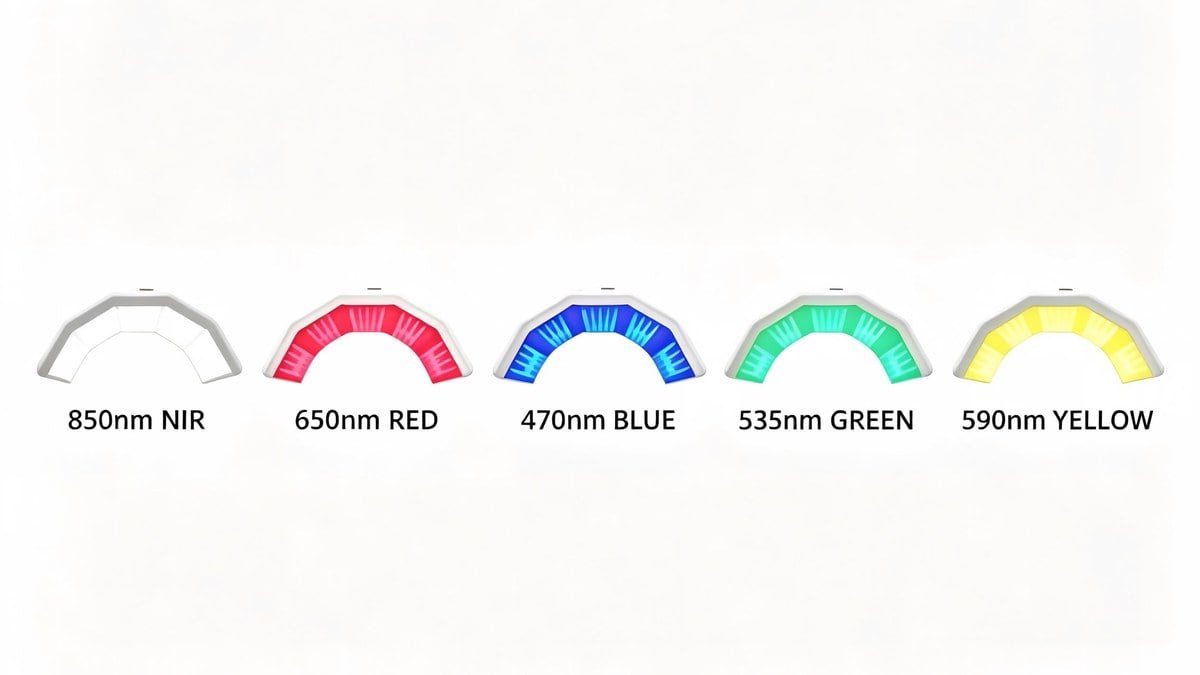
Wavelength — measured in nanometers (nm) — determines how deep the light travels and which protocols it supports. On our own platform, the five-color spectrum covers the professional range:
- Blue, ~470 nm — the standard choice in acne-care protocols; short wavelength, stays near the surface.
- Green, ~535 nm — used in calming and tone-balancing work.
- Yellow, ~590 nm — associated with brightening and soothing routines.
- Red, ~650–660 nm — the workhorse of rejuvenation and recovery protocols; penetrates further than the visible short wavelengths.
- Near-infrared (NIR), ~850 nm — the deepest-reaching band, used in recovery-focused and full-body care programs.
Two practical rules follow. If your menu centers on breakout-prone skin, blue plus red covers the core protocol on almost any system. If you want recovery and full-body programs on the menu, confirm the machine includes a true NIR band — some “8-color” machines list infrared among their colors, others substitute pink or cyan, which are visible-light variants rather than deeper-penetrating bands.
LED Count and Power Density
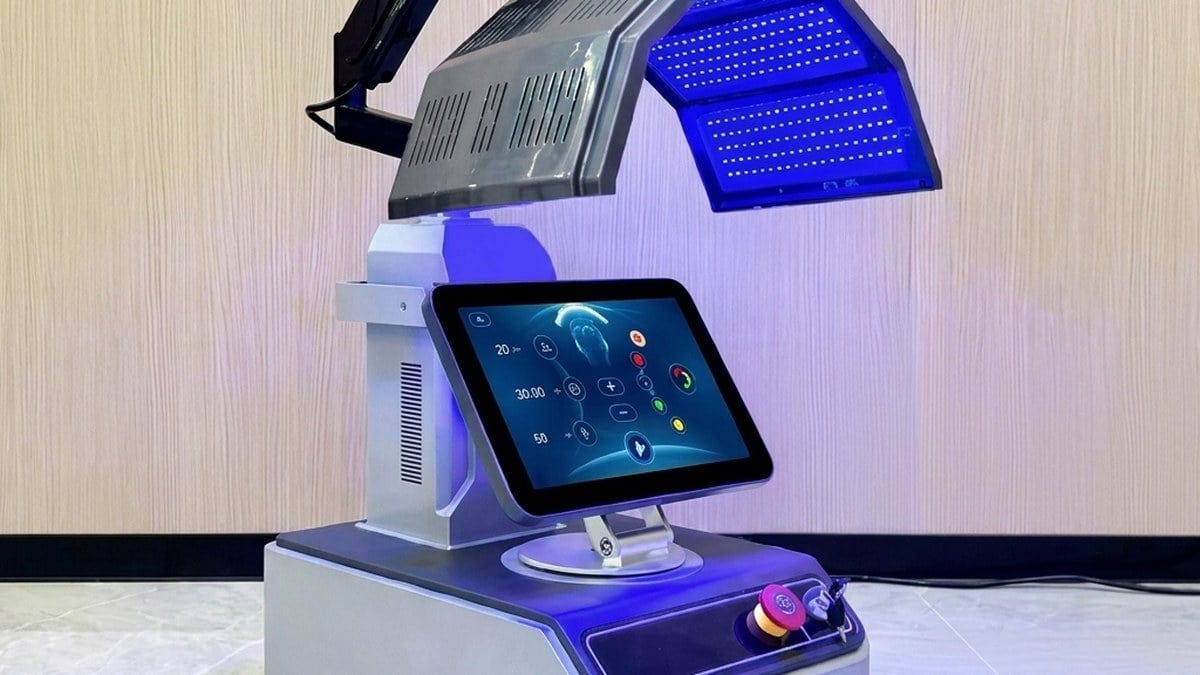
Bead count is the specification buyers quote most and understand least. Across our current range, LED counts run from 105 beads on a portable full-body panel to 1,830 beads on a vertical PDT unit — but the number only means something next to two other values: power per bead und irradiation area.
Power per bead is the cleaner quality signal. Our portable 5-color unit, for example, drives each of its 540 beads at 200 mW using 5×5 mm high-power integrated chips, at 300 W total system power — a configuration built for professional session times rather than long exposures. A unit running the same bead count at a fraction of that per-bead power is a different class of machine, however similar the brochures look.
Irradiation area decides throughput. A treatment head covering 1,200 cm² or more can address the full face and neck in one position; a smaller window means repositioning the client and stretching session times. Between bead count, per-bead power and coverage area, you can reconstruct most of what irradiance figures would tell you — which is why our comparison table lists all three.
Format: Mask, Desktop Dome, Standing Unit or Full-Body Panel
Four formats dominate the professional market, and each implies a different service model:
- Silicone masks (wired or rechargeable) wrap the face — and on extended models, the neck — in flexible panels. They free the operator completely and suit clinics that run LED as an add-on during other treatments.
- Desktop domes sit on a trolley or counter and treat a client who is lying down. They are the classic facial-room unit: fixed position, simple operation, modest footprint.
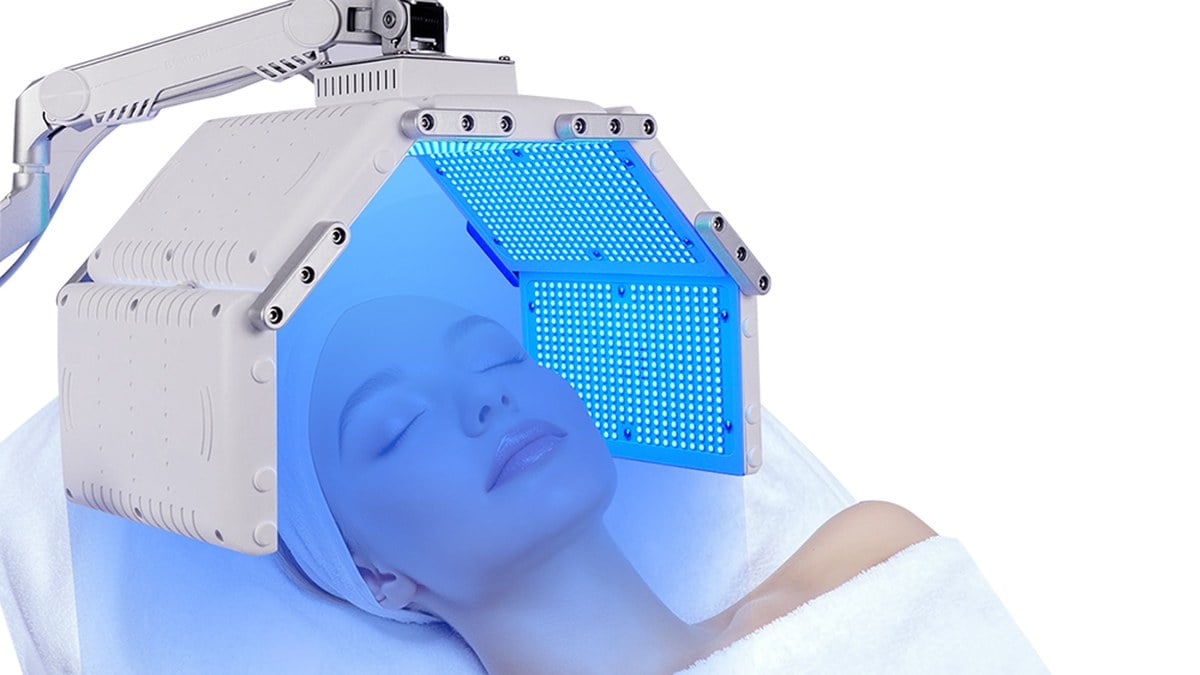
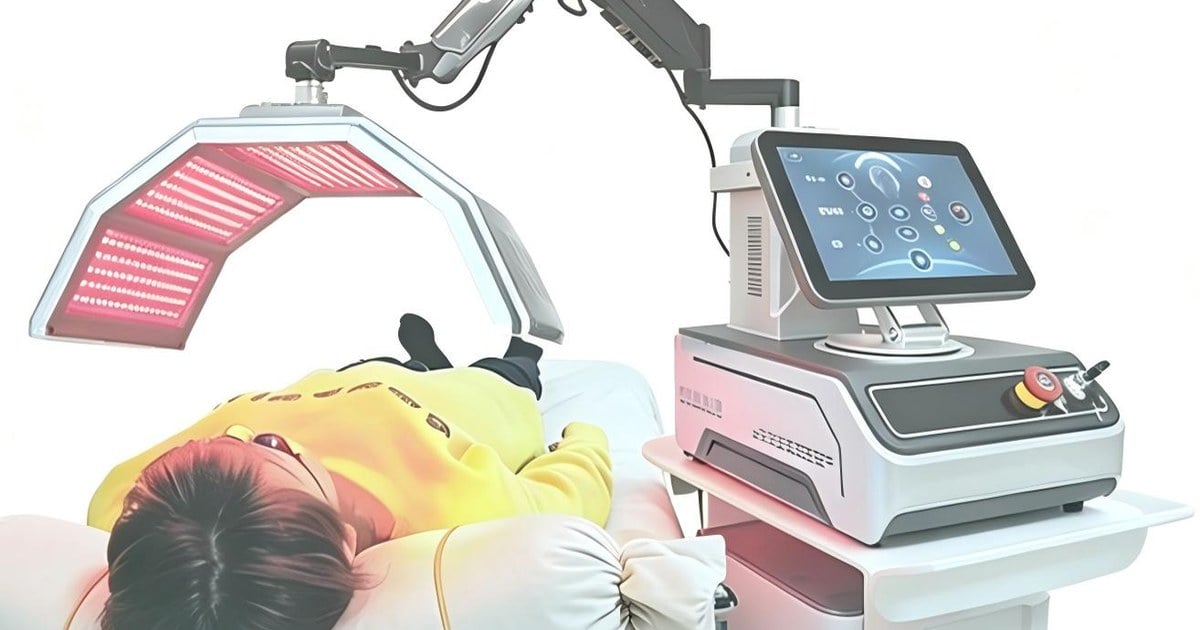
- Standing 360° units add a rotating or adjustable lamp head above a bed — the operator positions the dome once and the whole face plus neck sits inside the light field. Larger lamp heads (our standing models carry 1,098 beads, and the vertical flagship reaches 1,830) and features like AI voice control and cycle-light programs sit at the premium end here.
- Portable full-body panels trade some footprint flexibility for coverage — a flat or slightly curved array that treats larger body areas, typically in a flight-case format for clinics that move equipment between rooms.
Match the format to how the service will actually run. If LED is a fifteen-minute add-on while the esthetician works elsewhere, a mask or a set-and-forget dome wins. If LED is a standalone billed treatment with consultation time around it, the larger standing units earn their footprint.
Session Time and Room Efficiency
Published session windows on professional systems run from 10–30 minutes on rechargeable masks to 1–60 minutes of adjustable treatment time on larger units. What matters commercially is not the maximum but the default: a protocol that finishes in 15–20 minutes lets a single room turn over four to six LED sessions per hour in combination with other services.
This is also where multifunction platforms enter the picture — cabinets that pair an LED module with a second billable technology give one machine two line items on the menu. The trade-off is the same as with any combination system: more capability, more moving parts, and a bigger investment than a dedicated LED unit.
LED PDT Machine Comparison
The table below compares six current systems from our range, from a 105-bead portable panel to a 1,830-bead vertical unit. All figures come from the published product specifications.
| Modell | Format | LED beads | Light colors | Strom | Standout specification |
|---|---|---|---|---|---|
| GL078 | Standing 360° dome | 765 | 8 (incl. infrared) | - | Touchscreen; monochrome and auto-loop modes; 360° adjustable support arm |
| GL049 | Vertical PDT unit, 180° adjustable head | 1,830 | 4 (red, blue, green + mixed 420–830 nm) | - | 10 intensity levels; medical-grade beads |
| GL080 | Portable dome, flight case | 540 | 5 (NIR, Rot, Blau, Grün, Gelb) | 300 W | 200 mW per bead; irradiation area ≥1,200 cm²; 1–60 min |
| GL075 | Standing 360° dome | 1,098 | 7 | - | AI voice control; 10 energy levels |
| GL076 | Standing 360° dome | 1,098 | 7 | - | Manual single-light and cycle modes; touchscreen |
| GL073 | Portable full-body panel | 105 | Red 650–660 nm + infrared 850–860 nm | 180 W | 3 modes (red / infrared / combined) |
Reading the table by row tells the market’s structure. The two seven-color standing domes (GL075 / GL076) compete on control features rather than raw output — same bead count, different interface. GL078 widens the standing family’s spectrum to eight colors with infrared on top, while GL049 leads the range on sheer output: 1,830 medical-grade beads, ten intensity levels and a mixed-light band that spans 420–830 nm. The portable pair (GL080 / GL073) splits between maximum irradiance and maximum simplicity.
Matching the System to Your Room and Menu
Adding phototherapy to an existing facial menu. The priority is a unit that treats face and neck in one position without occupying the esthetician. A standing 360° LED machine with 1,098 beads and AI voice control fits this brief — position the dome, start the program, work on something else. Its sibling with a touchscreen and manual-plus-cycle modes covers the same menu at a simpler control scheme.
Running LED as a primary billed treatment, or serving multiple rooms. When phototherapy is the service rather than the add-on, irradiance and coverage decide client throughput. Our portable 5-color NIR-PDT unit — 540 beads at 200 mW, ≥1,200 cm² coverage, flight-case packing — is built for exactly this: clinic-grade output that still moves between rooms.
Equipping a first LED service or upgrading a dated dome. Die 360° rotating 8-color unit with 765 beads covers the widest color menu in the range from a single touchscreen — run one color per program or set the auto-loop — and the adjustable support arm lets the operator position the lamp once and move on.
Running phototherapy at treatment-room scale. When LED is a core service with back-to-back bookings, the vertical PDT unit with 1,830 medical-grade beads supplies the headroom: ten intensity levels, a 180° adjustable head and a mixed-light band that supports anti-inflammatory and recovery programs on the same menu.
Standalone Unit or Multifunction Machine?
A third path sits between the dedicated LED unit and the mask: multifunction platforms that include an LED mask among many handles. These make sense when the room’s core business is already the other technology — a hydrodermabrasion cabinet with an LED mask attached extends the treatment without a second purchase. Our guide to choosing a hydrodermabrasion machine covers that category in depth.
The honest comparison: a dedicated LED unit wins on irradiance per dollar and session simplicity, while a multifunction machine wins when floor space, not light output, is the binding constraint. Clinics that promise phototherapy as a headline service should buy a machine whose main job is phototherapy.
The Pre-Purchase Checklist
Before committing to any LED system, confirm these seven points:
- Wavelengths in writing. Ask for the nm values per color, not just the color names — 650 nm and 660 nm red are both “red,” but they are not the same protocol.
- NIR authenticity. If near-infrared matters for your menu, verify the band is a true 830–860 nm emitter rather than a visible-light stand-in.
- Power per bead and total system power. These two numbers predict irradiance better than bead count alone.
- Irradiation area. Full-face-plus-neck in one position, or repositioning required? The answer changes your session math.
- Timer and program control. Look for adjustable treatment time, preset programs per color, and cycle modes if operators will run treatments unattended.
- Power environment. Confirm 110 V / 220 V compatibility for your market before you sign.
- Compliance documents and OEM options. Request the certificates that apply in your market, and confirm logo, language and housing customization early if you sell under your own brand.
Budget Planning
LED phototherapy spans the widest price range of any category in this guide series, because the formats are genuinely different products. A portable panel, a single-arm standing dome and a 1,830-bead vertical unit can differ in price by an order of magnitude — comparing them as one category is the fastest way to a wrong purchase.
Budget by service model instead. If LED is an add-on, the machine’s cost competes with labor saved; a simple dome pays back through added ticket value on existing appointments. If LED is a primary treatment, model revenue per session against the irradiance you are buying — a 300 W system that finishes protocols in a fraction of the time of a low-power unit can out-earn a cheaper machine in the same room. Freight matters too: standing domes and flight-case units ship at roughly 18–32 kg, which changes landed cost on small trial orders.
For a current quotation matched to your market and configuration, contact our team with your intended menu and room size.
FAQ about LED Light Therapy Machines
How many colors does a professional LED machine need?
Fewer than marketing suggests. Red and blue cover the core acne-care and recovery protocols; green and yellow add calming and brightening routines; NIR extends the menu into deeper-penetrating programs. Seven or eight colors broaden the menu, but a 4-color machine with the right wavelengths beats an 8-color machine with the wrong ones.
Is a higher LED bead count always better?
No. Bead count matters alongside power per bead and irradiation area — 540 beads driven at 200 mW over a ≥1,200 cm² field outperforms a larger count at low power for professional session times. Read the three numbers together.
What is the difference between red light and near-infrared?
Red light (roughly 650–660 nm) works in the upper layers of the skin and anchors most rejuvenation and recovery protocols. Near-infrared (roughly 830–860 nm) penetrates deeper and is used in recovery-focused and full-body programs. Machines offering both — often with a combined mode — cover the widest menu.
Can LED machines run treatments without an operator present?
Yes, and this is one of the category’s commercial advantages. Standing domes and vertical units run preset timers and loop programs, so a client can be positioned and left to complete the session while the esthetician works elsewhere. Confirm the unit has program memory and a clear timer display if unattended operation is your plan.
How long is a typical LED treatment session?
Professional protocols commonly run 10–30 minutes depending on the machine class and the program. Adjustable systems allow 1–60 minute settings, which gives operators room to combine LED with other services in a single appointment.
Does LED phototherapy require consumables or gels?
No. LED phototherapy is a dry, contact-free light treatment — no gels, no disposables, and no per-session consumable cost. That is a core part of its margin story compared with technologies that require gels, tips or cartridges; eye protection for the client is the only recurring item to budget.
Schlussfolgerung
LED phototherapy is one of the simplest technologies to operate and one of the easiest to buy wrong. The label on the box — LED, PDT, phototherapy, light therapy — tells you nothing about the three specifications that decide your menu: wavelengths in real nanometers, power per bead alongside irradiation area, and a format that matches how the service will actually run in your room.
Start from the service model, not the brochure. Add-on menus suit simple domes; primary phototherapy treatments justify the irradiance of a professional NIR-PDT system; a first LED service runs happily on a 765-bead 8-color unit. Match the machine to the menu and the rest of the decision follows.


 EN
EN  RU
RU  ES
ES  IT
IT  AR
AR  FR
FR  DE
DE  JA
JA  KO
KO  NL
NL