
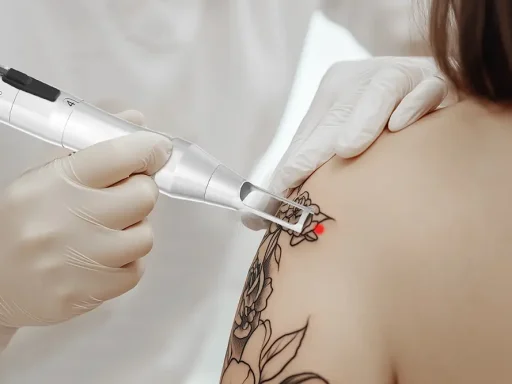
Buyers comparing tattoo removal machines usually open with power, then jump straight to price. The variable that decides most of the result sits between those two: how long each laser pulse lasts. Pulse duration decides how finely ink particles break down and how much heat spreads into the skin around them. The wavelength set decides which ink colours respond at all. Everything else — heads, spot size, cooling, screen — decides how comfortably an operator can run the platform all day.
This guide compares the three builds you will be offered: a Q-switched Nd:YAG platform, a picosecond platform, and a 2-in-1 cabinet that runs diode hair removal and picosecond ink work from the same machine. All specifications quoted below are the published values from our own product pages and manuals.
Why pulse duration comes before the wavelength count
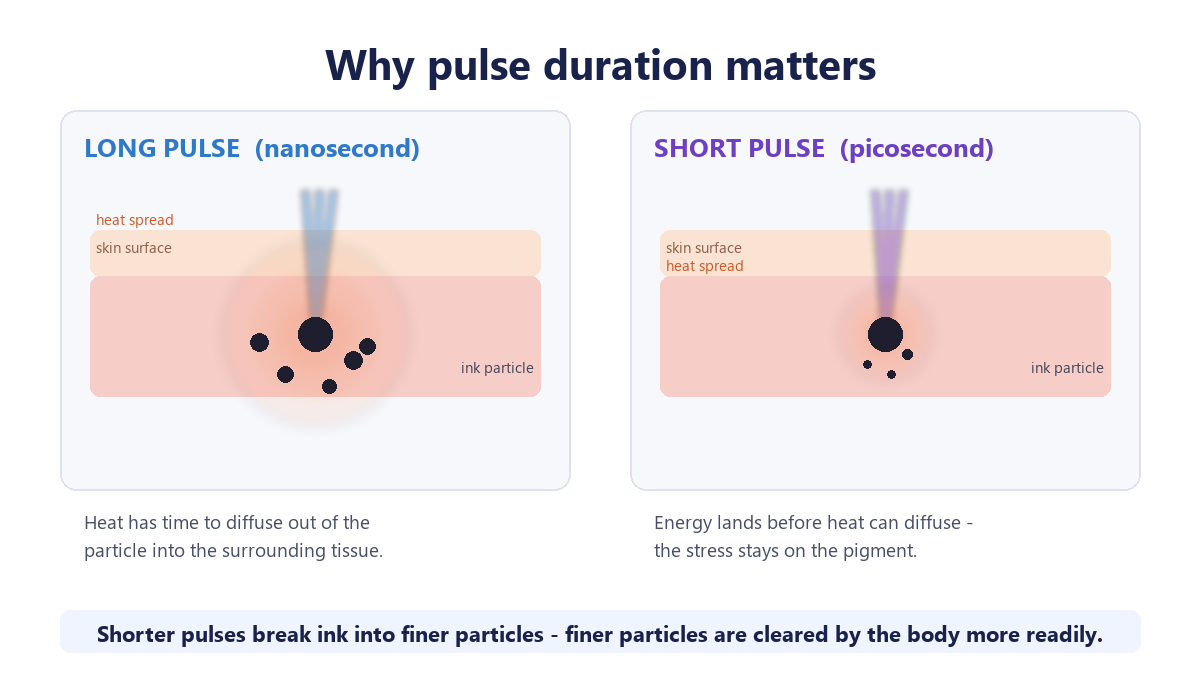
Ink particles sit inside the dermis, surrounded by tissue you want to leave alone. The principle behind laser ink clearance is selective absorption: the pigment absorbs the light, converts it into heat, and breaks apart — while the surrounding tissue, which absorbs less of that wavelength, stays cooler.
That balance depends on time. A long pulse gives heat time to diffuse out of the particle and into neighbouring tissue. A short pulse delivers the same energy before that diffusion can happen, so the stress stays concentrated on the pigment. The practical consequence is fragment size: shorter pulses tend to break ink into smaller particles, and smaller particles are cleared by the body’s own processes more readily than large ones.
Two labels get used interchangeably in this market, and they are not the same thing. Q-switched describes the release mechanism — energy is stored in the laser cavity and discharged in one very short burst rather than continuously. Picosecondo describes the duration of that burst. A platform can legitimately be both. That is why the useful question is not “pico or Q-switched”, but “what pulse duration is published, on which head, at which energy”.
The Q-switched platform: nanosecond pulses
The Q-switched Nd:YAG platform is the most established build in this category, and the one most operators have prior experience with. Published pulse durations sit in the nanosecond range — typically single digits.
Two current examples from our range show how much the same label can cover:
- EN075 — Q-switched Nd:YAG, < 10ns, three treatment heads covering 1064 / 532 / 1320nm, 10–2,000mJ, 1–10Hz, 300W output, a 4.3-inch touchscreen and a self-contained closed water cycle. Total package weight 25kg, which keeps it usable in rooms where a larger cabinet would not fit.
- GN640 — Q-switched Nd:YAG with three heads (YAG, honeycomb and black doll), 532 / 1064 / 785nm, 800mJ single-pulse output, 6ns pulse duration, a 2–10mm adjustable spot, red aiming dot, 2,000W and a three-part cooling stack of air, water and semiconductor. Handle shots are published as unlimited.
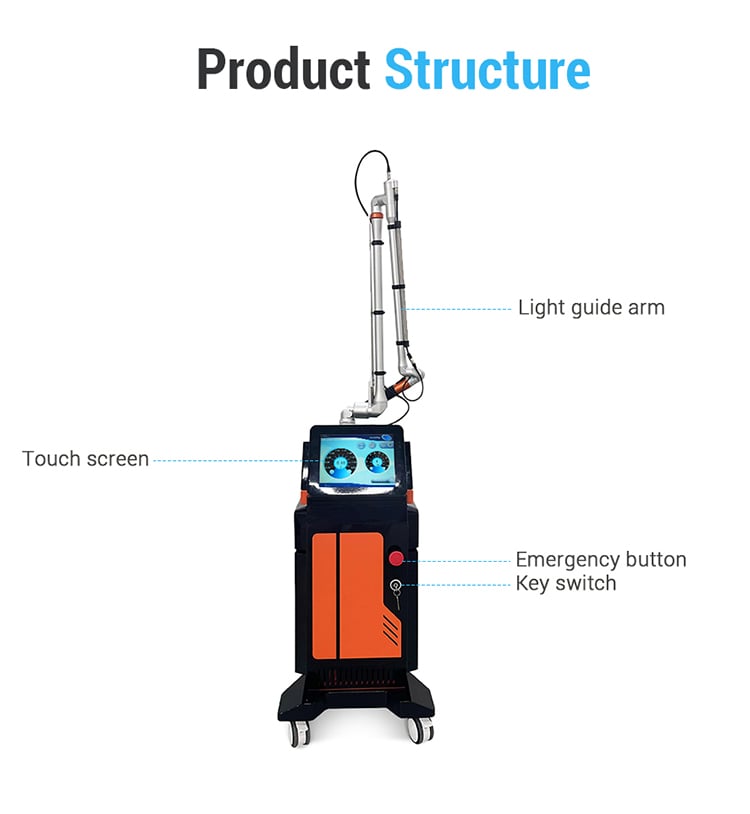
GN640: touch screen, articulated light guide arm, emergency button and key switch.If your treatment menu needs more than ink work from a single cabinet, combination builds exist in this family too — EN114 pairs a DPL handle and RF probes with a Q-switched Nd:YAG handle at 532 / 1064 / 1320nm.
The honest limitation of a nanosecond platform is fragmentation depth. For old, dense or multi-layer ink, operators typically plan longer multi-session protocols than they would on a shorter-pulse platform.
The picosecond platform: what actually changes
A picosecond platform shortens the pulse by roughly an order of magnitude, which changes two things that matter commercially.
First, the fragmentation profile. With less heat diffusion per pulse, more of the delivered energy goes into breaking pigment rather than heating tissue around it. Operators commonly report that some ink types respond in fewer sessions on a shorter-pulse platform — the number still depends on ink colour, depth, age and how the tattoo was applied.
Second, the wavelength set. Picosecond platforms in our range carry four wavelengths rather than three, and add non-invasive heads alongside the invasive ones:
- EN211 — 532 / 755 / 1064 / 1320nm across seven heads, including a zoom head plus invasive and non-invasive 532nm and 1064nm heads. Energy 300–3,000 J/cm², 1–10Hz, 2,000W, 12.1-inch screen, 63kg packaged.
- EN196 — five heads (532nm, 1064nm, non-invasive 532nm, non-invasive 1064nm and 1320nm) with an optional 755nm honeycomb head. Energy 30–2,000 J/cm², water plus semiconductor plus air cooling, 7-inch touchscreen, and a 15kg package weight that suits mobile or multi-room use.
- EN159 — a combined 532nm and 1064nm head with a 2–10mm adjustable spot diameter, maximum energy 2.0J, 1,500W and a 10.1-inch screen. This one is a good reference point for buyers who want a single-head platform with adjustable spot size rather than a head for every job.
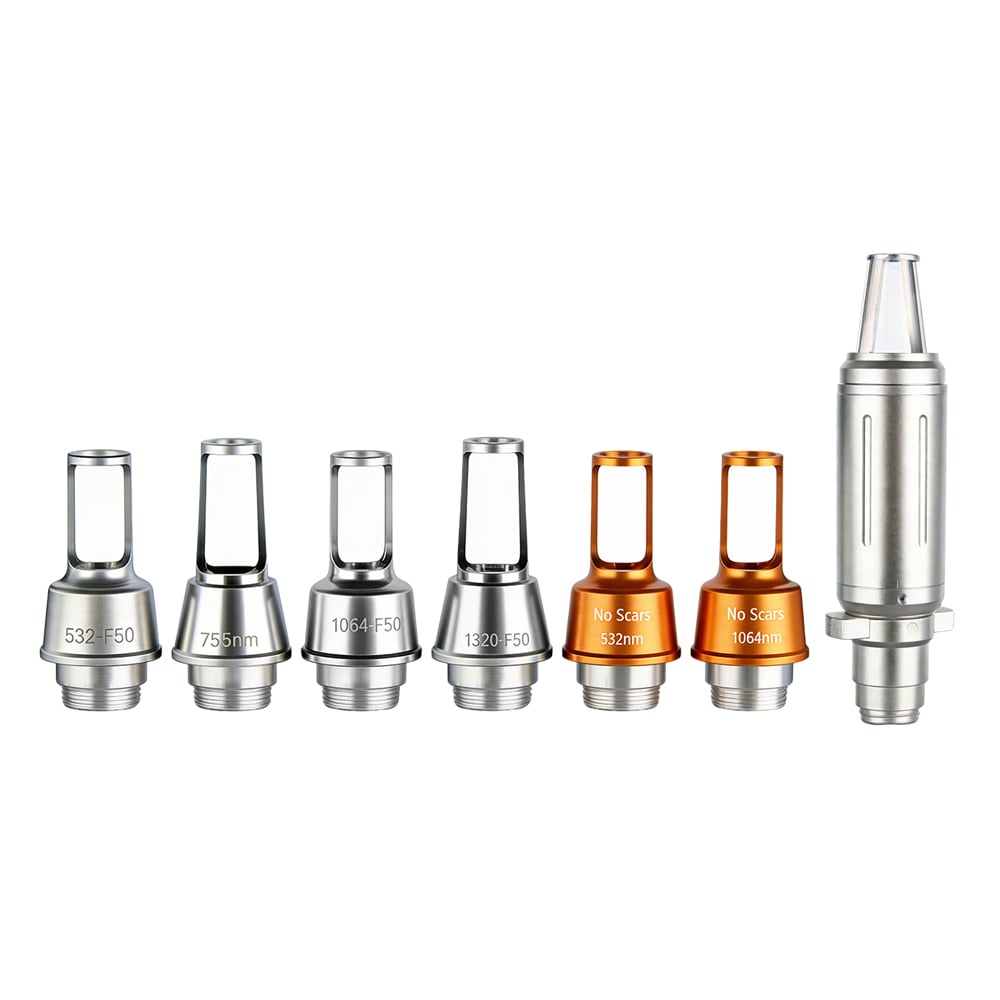
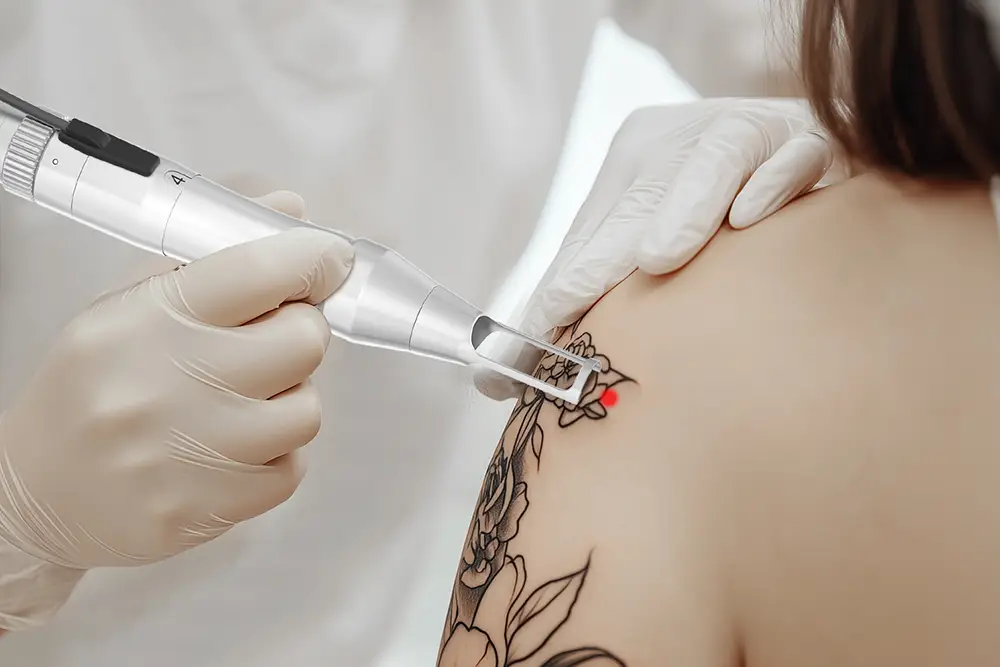
EN211 ships seven heads - each wavelength and each invasive / non-invasive pair is a separate head.Non-invasive heads are worth understanding before you compare head counts. They treat superficial pigment without breaking the skin surface, which changes the aftercare conversation for freckles, age spots and light pigmentation — as opposed to deep tattoo ink, where the invasive heads do the work.
Read the published pulse duration, not the label
Across this industry the word “picosecond” is used more loosely than the physics suggests. Some platforms marketed as picosecond publish a pulse duration in the low nanosecond range. Some platforms labelled Q-switched publish a number that overlaps. None of that is necessarily dishonest — but it means a specification comparison is only useful if you compare the actual numbers.
Published pulse durations across our current range, taken from the product pages and manuals:
| Modello | Platform label (as published) | Published pulse duration | Lunghezze d'onda |
|---|---|---|---|
| EN075 | Q-switched Nd:YAG | < 10ns | 1064 / 532 / 1320nm |
| GN640 | Q-switched Nd:YAG with honeycomb | 6ns | 532 / 1064 / 785nm |
| EN120 | Honeycomb Nd:YAG | 6ns | 1064 / 532 / 755 / 1320nm |
| EN109 | Lite Nd:YAG pico | 2000ps | 1064 / 532 / 755nm |
| EN159 | Picosecondo | 2000ps | 532 / 1064nm |
Values as published on our product pages and in the corresponding manuals. Custom configurations are available on request.
Read that table the way a buyer should: pulse duration is one axis, not the whole decision. A platform publishing < 10ns with three well-matched wavelengths and 2,000mJ of usable energy may serve your ink mix better than a shorter pulse with a narrower head set. What you should refuse to do is buy on the label alone.
The 2-in-1 platform: diode and picosecond in one cabinet
If ink work is an addition to an existing hair removal service rather than a standalone business, the 2-in-1 build removes the need for a second cabinet, a second footprint and a second set of operator protocols.
- EN222 — a diode handle at 755 / 808 / 1064nm with five laser bars, 20 million shots and a 13 × 30mm spot, plus a picosecond handle carrying four heads (755 / 532 / 1064 / 1320nm). Machine power 2,000W, 110–220V, 15.6-inch foldable touchscreen, nine interface languages, 35kg packaged.
- EN168 — three-wavelength diode handle with 12 bars at 1,200W and 20 million shots on a 15 × 25mm spot, paired with a 450W picosecond handle at 0.4–2.0 J/cm² on four heads.
- EN137B — a lighter pairing: 500W diode handle at 808 / 755 / 1064nm plus a Nd:YAG pico handle at 450W, 25kg packaged and a 15.6-inch screen.
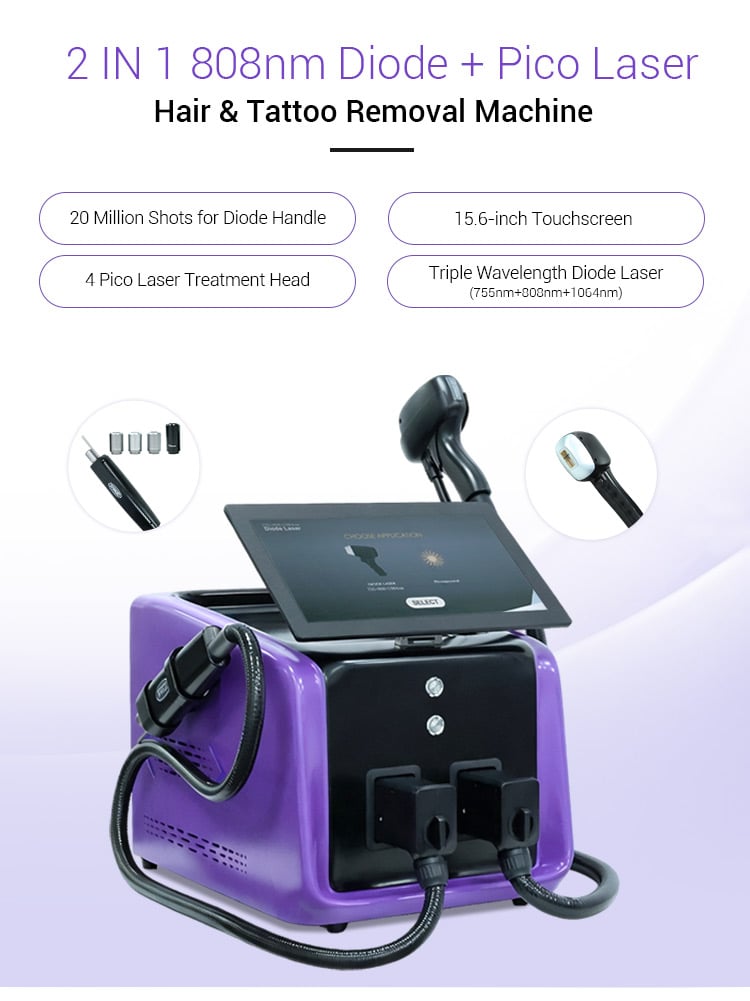
EN222: 20 million-shot diode handle and a four-head picosecond handle in one cabinet.The pattern worth noting is that in 2-in-1 builds the picosecond handle is usually the smaller of the two, at 450–500W, because ink work is delivered in short bursts across small areas rather than sweeping large panels. Check the energy density published for the pico handle specifically — on the EN168 and EN137B it is listed per head, which is the level of detail you want.
Side by side: three platforms from our range
| Specifiche | Q-switched Nd:YAG | Picosecondo | 2-in-1 diode + picosecond |
|---|---|---|---|
| Modello | EN075 | EN211 | EN222 |
| Tecnologia | Q-switched Nd:YAG | Laser a picosecondi | Diode laser + picosecond laser |
| Lunghezze d'onda | 1064 / 532 / 1320nm | 532 / 755 / 1064 / 1320nm | Diode 755 / 808 / 1064nm · Pico 755 / 532 / 1064 / 1320nm |
| Teste di trattamento | 3 | 7 (zoom + invasive and non-invasive 532/1064 + 1320) | 2 handles (1 diode + 1 pico with 4 heads) |
| Durata dell'impulso | < 10ns | - | - |
| Energia | 10–2,000mJ | 300–3,000 J/cm² | - |
| Dimensione dello spot | - | Zoom head (adjustable) | 13 × 30mm (diode handle) |
| Potenza di uscita | 300W | 2,000W | 2,000W |
| Display | 4.3-inch touchscreen | 12,1 pollici | 15.6-inch foldable touchscreen |
| Raffreddamento | Ciclo idrico chiuso e autosufficiente | - | - |
| Package size / weight | 45 × 60 × 51cm / 25kg | 61 × 47 × 126cm / 63kg | 47 × 50 × 60cm / 35kg |
| Handle life | - | - | 20,000,000 shots (diode handle) |
— = Not published for this model. All values shown are factory specifications; custom configurations are available on request.
Two things stand out. The footprint spread is wide: 25kg against 63kg, which decides whether the platform can move between rooms or has to be installed once. And the head count moves with the platform type — three heads on the Q-switched build against seven on the four-wavelength picosecond build, because each additional wavelength and each invasive/non-invasive pair is a separate head.
Six specifications that matter more than the wavelength list
1. Published pulse duration, per head. Ask whether the figure applies to the platform or to a specific head. On multi-head platforms the numbers are not always identical across heads, and the head you use most is the one that matters.
2. Energy range, and where the working setting sits. A wide range lets one platform cover both fine line work and dense panels. Read the range rather than the maximum, and check whether it is published in J/cm² or mJ — the two are not interchangeable across platforms.
3. Head types, not just head count. Invasive heads for deep ink; non-invasive heads for superficial pigment without surface trauma. A seven-head set that splits 532/1064 between invasive and non-invasive is doing a different job from a three-head set covering three wavelengths invasively.
4. Spot size range. Small spots for eyebrows, lip lines and fine detail; larger spots to move faster across panels. Where spot size is adjustable on the head itself — as on the EN159’s 2–10mm range — one head covers more of your menu.
5. Cooling architecture and duty cycle. Ink sessions are short, but a busy day is not. Look at how cooling is specified: closed water cycle on the EN075, water plus semiconductor plus air on the EN196, three-part air/water/semiconductor on the GN640. Ask how the platform behaves after an hour of continuous use, not in the first five minutes.
6. Aiming and interface. A red aiming dot and a legible screen look minor in a specification sheet and major in daily operation. Language count matters if several operators share the platform — the EN222 ships with nine interface languages, the EN211 accepts customised language sets.
Matching the platform to your business
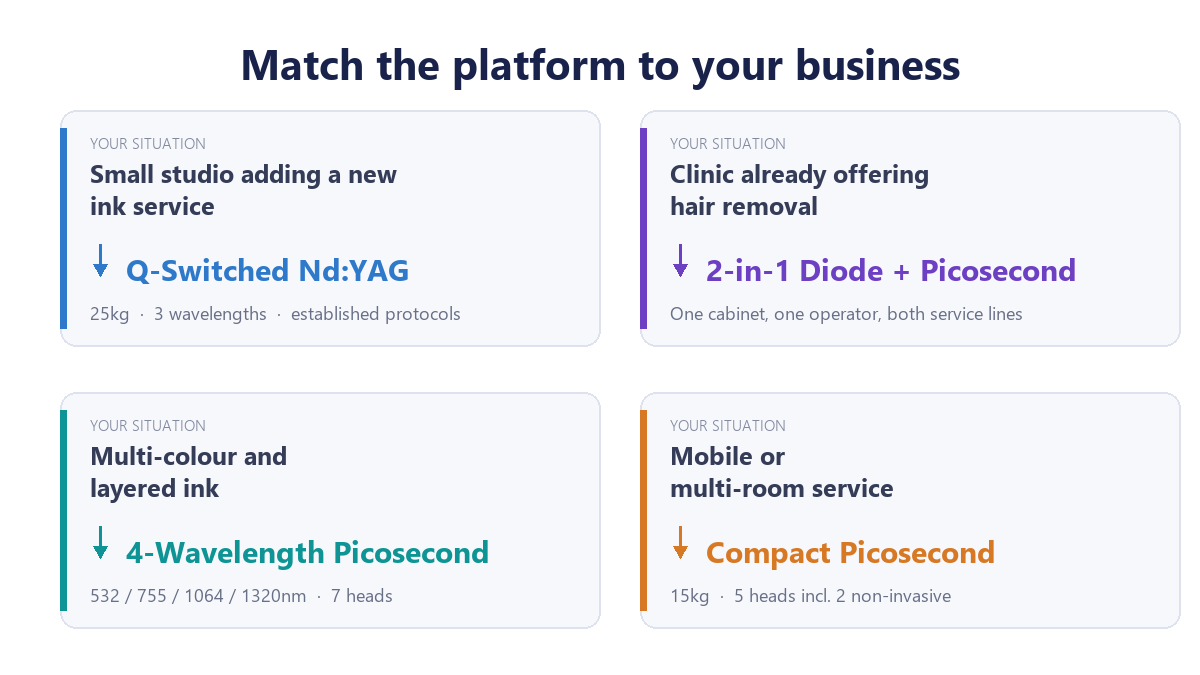
| Your situation | Build that fits | Perché |
|---|---|---|
| Small studio adding ink work as a new service | Q-switched Nd:YAG — e.g. EN075 | 25kg footprint, three wavelengths, established protocols, low operator learning curve |
| Clinic already running hair removal, adding ink | 2-in-1 diode + pico — e.g. EN222 | One cabinet, one operator, both service lines from a 15.6-inch foldable screen |
| Clinic treating multi-colour and layered ink | 4-wavelength picosecond — e.g. EN211 | 532 / 755 / 1064 / 1320nm with seven heads including non-invasive and zoom |
| Mobile or multi-room service | Compact picosecond — e.g. EN196 | 15kg package weight, 7-inch screen, five heads including two non-invasive |
| High-throughput mixed body and face menu | Honeycomb Q-switched — e.g. GN640 | 2,000W, honeycomb and black doll heads, unlimited published handle shots |
If you want to see the wider line-up including platform configuration options, the tattoo removal machine range lists current models by type.
What to ask a supplier before you order
- 1. The published pulse duration, in ns or ps, per treatment head. If a supplier cannot give you a number, you are buying a label.
- 2. A wavelength-to-ink mapping table. Which wavelength for black, blue, red, green, yellow ink — and which combinations the platform can reach without a second handle.
- 3. The full head list with replacement policy. Head count, invasive versus non-invasive, which are standard and which are optional, and how heads are replaced over the platform’s life.
- 4. Energy units and calibration. Whether the published figure is J/cm² or mJ, at which spot size, and how the platform is calibrated on arrival.
- 5. Cooling specification and duty cycle. What the cooling stack is made of, and what the manufacturer expects for back-to-back sessions.
- 6. Protocols and training material. Parameter starting points per ink colour and per head, plus our step-by-step guide to using a laser tattoo removal machine, which we include with the platform documentation.
- 7. Consumables across your existing machines. If you already run diode platforms, ask whether heads, gels and aftercare products are shared — it changes both stock and staff training.
Frequently asked questions
Is a picosecond laser better than a Q-switched laser for tattoo removal?
They are not mutually exclusive. A Q-switch is the mechanism that releases the pulse; picosecond describes how long that pulse lasts, and platforms can be both. What changes outcomes is the published pulse duration combined with wavelength, energy and head set. Compare the numbers rather than the labels.
Which ink colours respond to which wavelength?
As a working rule, longer wavelengths (1064nm) reach darker pigments, while 532nm is used for lighter and warmer tones, with 755nm and 1320nm covering other parts of the range. Multi-colour tattoos are the reason four-wavelength platforms exist — a single wavelength cannot address every ink in one piece.
Can one machine handle both hair removal and tattoo removal?
Sì. Il 2-in-1 build runs a diode handle for hair removal and a separate picosecond handle for ink and pigment work in the same cabinet. It suits clinics that already offer hair removal and want to add a second service line without adding floor space.
How many treatment heads should I look for?
It depends on your ink mix. A three-head Q-switched platform covers the three core wavelengths. A four-wavelength picosecond platform typically carries more because each wavelength and each invasive/non-invasive pair is a separate head — the EN211 carries seven.
What does a tattoo removal machine cost?
Cost tracks pulse duration, wavelength count, head count and power, which is why two platforms with the same screen size can sit in very different brackets. We break the drivers down in our laser tattoo removal machine cost analysis rather than quote a single figure that would not apply to your configuration.
Do different skin tones need different platforms?
They need different settings and wavelength choices rather than a different platform. For higher melanin skin, the practical requirements are a wavelength set that the platform can tune to, reliable contact cooling on the heads, and protocols that start conservative. Ask suppliers for their protocol range, not just the hardware specification.
Is a 2-in-1 platform harder to maintain than two separate machines?
It is usually simpler in daily use — one power supply, one cooling system, one screen, one set of operator routines. The trade-off is that if the cabinet is out of service, both service lines stop, so ask about head-level replacement so a single head issue does not idle the whole unit.
What should be on the specification sheet before I order?
Published pulse duration per head, wavelength set, head list with invasive/non-invasive split, energy range and units, spot size range, output power, cooling architecture, screen size, interface languages, voltage and package weight. If a supplier omits pulse duration and energy units, treat the quote as incomplete.
Choosing between the three platforms
If ink work is your main service and your clients bring multi-colour pieces, the four-wavelength picosecond build gives you the widest wavelength and head coverage. If you are adding ink to an established hair removal business, the 2-in-1 cabinet keeps you on one footprint and one operator routine. And if you are starting with simpler, single-layer work on a controlled budget, a Q-switched Nd:YAG platform delivers the three core wavelengths in the smallest package of the three.
Across all three, the discipline is the same: compare published pulse duration, wavelength set, energy range and head list — then match the build to the ink your clients actually bring in.
Platform configuration, OEM and ODM options are all available across these builds. Get in touch with our team with your treatment menu and client mix, and we will match a build to it rather than send a generic quotation.



 EN
EN  RU
RU  ES
ES  IT
IT  AR
AR  FR
FR  DE
DE  JA
JA  KO
KO  NL
NL