
Radio frequency is not one product. It is a family of devices that share a physical principle and differ in almost everything a buyer cares about: how deep the current reaches, what the client feels during the session, how much room the unit occupies, and which service you can honestly put on the menu afterwards.
Catalogues blur that difference. A six-handle vertical platform and a two-handle desktop unit are both listed as “RF machines”, both carry a frequency figure somewhere in the sheet, and both photograph well. Then one of them turns out to be the wrong tool for the treatment you planned to sell, and the mistake only becomes visible after the first ten clients.
This guide sorts the category into five bands and maps each band to the menu it supports. Every specification quoted below is a published figure taken from our own product pages; where a sheet does not publish something, we say so instead of filling the gap with an estimate. For the physics behind radio frequency, and for how RF compares with CET, RET, EMS and cavitation as technologies, our CET RET 448kHz vs RF vs EMS vs cavitation buyer guide covers that ground. This article stays on the purchasing question: which band, for which menu.
1. Five bands, five depths, five things you can sell
Sort candidates by depth before you look at handle count. Depth is what decides the treatment, and the treatment is what decides whether the machine earns its floor space.
| Band | Published depth | What the client feels | Project it supports | Models in this range |
|---|---|---|---|---|
| 40.68MHz monopolar | Shallow working zone; depth not published on our sheets | Localised warmth, slight prickling near bone and around the eye | Face, eye area and neck firming as a course | LB667 / LB667B, LB426 |
| 1MHz multi-polar (tripole, sextupole) | Dermis and upper fat layer; depth not published | Warmth plus suction and rolling when vacuum is fitted | Circumference, firming, back and limb work | JF960 / JF960B |
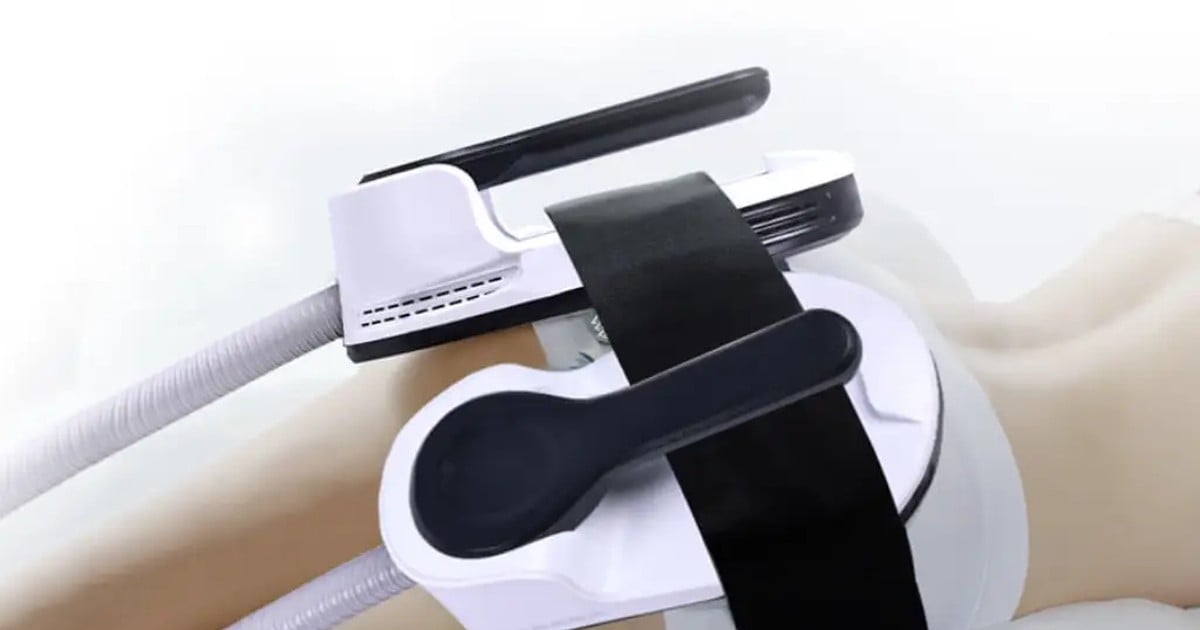
| 448kHz CET + RET (monopolar) | CET 3–5 cm; RET 9–12 cm (JF955 published sheet) | Steady deep heat, no pulse, return plate under the client | Deep-heat body programmes, lymphatic work, firming | JF955, JF888, JF957 |
| Fractional RF (microneedle) | 0.5–7 mm needle depth, RF energy to 8 mm (LB736) | Pinprick plus heat; topical numbing routine | Visible texture and pore work, sold as a block | LB736, SC1363 |
| Cavitation + RF combo | 80K ultrasound on the fat layer; RF via vacuum handles | Strong, busy session: suction, vibration, warmth | First-visit wow sessions and body packages | LB317C |
Read the table by column, not by row. The first column tells you what the machine can reach. The fourth column tells you what you can invoice. If a band’s project column contains nothing your clients already ask for, the machine is a specification you would be buying for the catalogue rather than for the room.
Two of the five bands deserve a note before we go further. The 40.68MHz band is the one buyers most often dismiss as “entry level”, and the combo band is the one they most often mistake for a treatment platform. Both judgements cost money, in opposite directions.
2. 40.68MHz: the shallow band, and why it is not a downgrade
Shallow is a design decision, not a limitation. Around the eye, over the temple and along the neck, the tissue you want to heat sits close to the surface, and the margin for error is small. A device built for that zone can use a smaller active area, deliver energy in controlled passes, and stay comfortable without a return plate the size of a back pad. A deep-heating platform asked to do the same job has to be turned down so far that the session stops being worth booking.
That is the honest case for keeping one shallow band in a face-led menu. It is also why the band is packaged as desktop units: the LB667 / LB667B runs two handles, one shaped for the eye area and one for the face, in a 7 kg chassis measuring 56 × 41 × 34 cm with a touchscreen and no separate trolley. The LB426 packages the same 40.68MHz source differently: one handle, two interchangeable probes of 0.25 cm² and 4.0 cm², a 150 W supply, eight energy steps and a working area listed as face, neck and eye, in a 9 kg unit.
The probe difference is the part buyers underestimate. A 0.25 cm² probe concentrates energy into a small footprint, which is what lets an operator work the orbital rim and the lines beside the mouth without dragging heat into the cheek. A 4.0 cm² probe covers the cheek, jawline and neck in fewer passes. Because the probe area sets how many passes a full face takes, it also sets the session length, and session length is what you divide the treatment price by when you work out what the room earns per hour. Two units with the same frequency figure can therefore sit in different price bands once the probe set is counted.
Structure matters for scheduling as much as for energy. Two handles on one unit means the eye handle and the face handle can be worked in sequence without unplugging anything, which suits a single therapist running back-to-back appointments. One handle with two probes means a swap between zones; that costs seconds per client, but it also means fewer connection points to fail and a smaller footprint to store.
Weight and voltage decide whether the unit travels. At 7 kg and 9 kg both platforms can be carried up a staircase by one person, which is the difference between a fixed room and a mobile or multi-site practice. On voltage, the LB426 sheet publishes both 110 V / 60 Hz and 220 V / 50 Hz configurations; the LB667 sheet does not list a voltage row at all, so if your market runs 100–120 V mains, that line has to be confirmed in writing before the order ships.
If you are comparing shallow-band units across brands rather than choosing a band, our face-focused radio frequency machine comparison is the better starting point, because it compares specific face units rather than bands. Use this section to decide whether the band belongs in your menu at all. If it does, the LB426 with its two-probe set is the configuration most clinics specify for face, neck and eye work in one room — see the published specification and probe dimensions before you compare it with anything else.
3. 448kHz CET + RET: the deep band, and three things to confirm before you order
This is the band that turns a face-led menu into a body-led one, and it is also the band where a quotation can look complete and still arrive unusable. The mechanism is covered in detail in the buyer guide linked above, so here we stay on the three items that decide whether the unit you receive can actually run.
First, the return plate. A 448kHz monopolar system sends current through the tissue and collects it on a plate under or against the client. Without that plate and its cable, the circuit has no return path and the machine does not treat. Our published sheets for the 448kHz platforms list handle quantities, head counts and power, but none of them lists the return plate as a separate line. Ask for it in writing as part of the quotation, and check it is in the crate on arrival. It is the single most common missing item in this category, and it is not something a local electrician can improvise.
Second, the head inventory, by size. Head count is not a marketing number; it is the coverage map. The JF955 publishes four CET heads at 70, 60, 30 mm and 35 × 20 mm, plus RET heads, which is what allows one unit to move from jawline to abdomen without ordering parts. The JF888 publishes four CET and RET heads across three handles, including a fascia knife handle. The JF957 publishes eight CET and RET treatment heads across eleven handles, with 100–220 V input. A quotation that ships fewer sizes than the published sheet describes is a different machine, and the difference only shows up when a client asks for a zone the missing head was meant to cover.
Third, carton weight and where the unit has to go. The published cartons in this range span 10.3 kg for the JF888 to 17.6 kg for the JF960, with the JF957 platform in the same heavy class as a vertical unit. That span decides installation: a 10 kg carton reaches a first-floor studio in one person’s arms, a 17 kg vertical unit does not, and neither reaches a treatment room up a narrow service stair without being planned for. It also decides freight class, which is a cost the quotation rarely mentions and the invoice always does.
Two practical notes on configuration. Voltage is published per model — the JF888 lists AC 110–240 V, the JF955 lists 110 V / 220 V, the JF957 lists 100–220 V — so a 110 V market should start from those sheets rather than assume. And if your menu also sells muscle work, RF is not a substitute: our EMS versus radio frequency comparison explains where the two stop overlapping.
For most single-room businesses entering this band, a three-handle platform is the sane first purchase: the JF955 pairs CET and RET with a fascia handle, publishes 350 W and both depths, and runs from an eight-inch screen. Check the head sizes against the zones you plan to sell before you decide between it and the JF888.
4. Fractional RF: add it only when the client pool does not overlap
Fractional radio frequency is the band that creates a channel rather than heating a volume, and it is the one where the purchase decision is least about the machine. Needle geometry, insulated versus non-insulated tips, cartridge cost over three years and break-even by session volume are all covered in our RF microneedling machine buyer guide; read that before you compare models, because it will change which specification you care about.
The question this article answers is narrower: does the band belong in a menu that already runs a 448kHz platform? Three checks settle it.
Check one: who is the client. A deep-heat 448kHz programme sells comfort, repeat visits and a low entry step. Fractional RF sells a visible change in texture, requires topical numbing and carries a recovery window that the client has to plan around. The same person can buy both, but not at the same moment in their treatment history. If your 448kHz book is mostly clients who want a relaxing monthly session, fractional conversion will be thin.
Check two: can it sit in the front of the menu. A band with a recovery window cannot be the treatment you use to convert a first-time enquiry, because the client has to leave the building looking a certain way. It belongs at the premium step, sold after the first result is visible, and priced for fewer sessions rather than more.
Check three: fixed room or travelling case. The LB736 is a 12.1-inch desktop platform with four handles, two of them microneedle-RF, four cartridge formats (12-pin, 24-pin, 40-pin and nano), adjustable depth from 0.5 to 7 mm and a published output frequency of 2 MHz. The SC1363 is the opposite packaging: a handheld unit of roughly 1 kg that publishes 1 MHz, 2 MHz and a combined 1 + 2 MHz mode, 0.1–2.5 mm depth in 0.1 mm steps, and nano, 12-pin and 25-pin cartridges. A fixed treatment room takes the desktop for throughput; a therapist working across two sites takes the handheld and accepts a smaller treatment area per pass.
If the answer to all three checks is yes, the desktop platform is the one to specify: the LB736 specification lists all four handle and cartridge formats, so you can confirm the depth range matches the protocols you intend to sell.
5. Four questions that pick the band for you
Buyers usually start from a model they saw at a trade fair. Start from these four questions instead, and the shortlist builds itself.
| Vraag | What it decides | If the answer is yes |
|---|---|---|
| Where does your highest-priced project act: surface, dermis, fat or muscle? | The band | Surface → 40.68MHz. Dermis and fat → 1MHz multi-polar or 448kHz. Fat layer → cavitation or a combo. Muscle → EMS, not RF. |
| Can the session fit inside 30–45 minutes, including setup and cleanup? | Whether a multi-handle platform earns its space | A platform pays for itself; a single-band unit with one job may not fill a day |
| Can your client accept a recovery window? | Whether fractional goes on the menu at all | Fractional moves to the premium step; it does not open the menu |
| Can the room, the power and the stair take the unit? | Desktop or vertical | 7–10 kg desktop if the room is upstairs; plan for 17–20 kg if you buy vertical |
The combo band needs its own line here, because it is the one buyers misread most often. The LB317C is a six-handle vertical unit that packages 80K cavitation at 65 W, three vacuum RF handles at 23, 25 and 30 W with blue, green and red LED, plus vibration and micro-current handles, in a 20 kg cabinet measuring 104.5 × 46 × 49 cm. It is a first-visit machine: a client who has never had a body treatment feels suction, warmth and movement in the first session, which is exactly what a package sale needs. What it is not is a deep-heat platform or a fractional device. If your menu needs those, the combo sits beside them, not in place of them.
One rule survives all four questions: buy the band that fills the bookings you already have, not the band with the longest specification. The machine that sits idle is always the more expensive one, whatever the quotation says.
For a multi-room business running a mixed menu — some deep heat, some circumference work, some facial — the practical answer is usually a platform that carries two bands at once. The JF960 does that with seven handles: three vacuum RF handles at 75, 55 and 25 mm, a tripole handle, a sextupole handle and two CET handles, with RF published at 1 MHz alongside 448 kHz CET and 350 W of power. See the handle layout and published parameters to check it against your room count.
6. Four checks on the unit you actually receive
Acceptance testing is where a purchase is either closed or discovered. Run these four checks in the first hour, photograph each one, and keep the file with the packing list.
| Check | What to compare | How it fails quietly |
|---|---|---|
| Frequency on the plate and in the menu | Nameplate and the system’s own energy screen against the quotation | Quotation says one band, control board is configured for another; nobody notices until results disappoint |
| Return plate and earth lead | Physical presence in the crate, plus continuity | Monopolar unit cannot run; replacement takes weeks |
| Handle and head inventory | Count and sizes against the published sheet, item by item | One size missing turns a face-to-abdomen unit into a face unit |
| Voltage and plug standard | Nameplate rating against your mains, plus plug type | Unit arrives rated for a supply your building does not have |
One item we deliberately leave out of the table, because it cannot be checked from a published number: temperature control. Whether a unit holds its working temperature through contact sensing or through an infrared feedback loop is not a row on any of our published sheets, and it is not reliably stated on most competitor sheets either. Ask the question in writing, get the answer in writing, and put it in the order confirmation. The answer changes how much operator training the unit needs and how much of the safety margin sits with the therapist rather than with the machine.
Run the four checks before the unit is used on a client, not after. A missing plate or a wrong voltage is a supplier conversation that is easy to have in week one and very hard to have in month three.
7. FAQ
Is 40.68MHz the same thing as a 448kHz machine?
No. Both are radio frequency, but they are built for different working zones. A 40.68MHz unit is a shallow, face-and-eye device, usually desktop, with small probes for orbital and jawline work. A 448kHz system is monopolar and deep: the JF955 sheet publishes 3–5 cm in CET mode and 9–12 cm in RET mode. Buying one to do the other’s job means running it far below its design point.
Can a 448kHz machine be used on the face?
Yes, in CET mode. The capacitive mode concentrates its working temperature at the dermal collagen layer — our published range is 45–60 °C — and the head sizes on the JF955 start at 30 mm and 35 × 20 mm, which is what makes facial passes practical. What it is not is an eye-area device: the probes are too large for orbital work, and that is what the shallow band exists for.
Do I need both fractional RF and a 448kHz platform?
Only if you sell two different kinds of promise: a comfortable repeat-visit programme and a visible texture rebuild with a recovery window. If both sit on your menu, they support each other, because the first builds the client base that books the second. If you only sell one, buy the one, and put the budget into the band you will actually use every week.
Which radio frequency machine should a small studio buy first?
The band that matches the highest-priced service you can already sell. A single-room studio doing face, neck and eye work should start with a 40.68MHz two-handle unit such as the LB667 at 7 kg, because it covers the room’s main service without a return plate or a treatment bed layout change. A studio whose clients already ask for body work should start in the 448kHz band with a three-handle platform, and accept that it needs more floor space and a proper installation plan.




 EN
 RU
 ES
 IT
 AR
 FR
 DE
 JA
 KO
 NL