
Aesthetic Equipment Sourcing Guide: 9 Device Categories Compared
Most first-time buyers start with a machine they liked at a trade show and work backwards to a price list. That order is why so many new clinics end up with equipment that fills a room and never fills a schedule.
The sequence that survives contact with real bookings runs the other way: fix the price band your catchment will actually pay, decide which treatments fill that band, and only then choose hardware. This guide works through nine aesthetic equipment categories at that level — what each one has to earn per day to justify its footprint, where a multi-handle platform genuinely competes with a dedicated unit, and the five site facts you need in hand before you ask anyone for a quote.
Two boundaries up front. Price, throughput and payback figures below are planning assumptions derived from the formula given in section 2 — they are not quotations and not specifications. Only five models in this guide carry verified parameter sets, and they are listed together in section 5; every other model code is an example of its category rather than a recommendation.
1. Two Buyers, Two Different Routes
The split between a starter clinic and an expanding clinic is not about budget. It is about schedule density, and it changes the correct purchase in opposite directions.
A starter clinic — one or two rooms, under roughly 25 bookings a week — has empty slots and needs menu breadth. One console that covers cleansing, exfoliation, infusion, lifting and a body add-on lets a single operator sell eight or ten menu items from one footprint. Breadth is the asset here: it lets you discover which two treatments your catchment actually rebooks, using money you already spent.
An expanding clinic — two or more rooms, 60-plus bookings a week, a waiting list on at least one service — has the opposite problem. Every minute a shared console sits in one room, the other room is dead capacity. At that point a 14-handle platform becomes a bottleneck: the handles are not the constraint, the single operator and the single chassis are.
The practical test is your own booking log. If one device has to serve more than three unrelated menu items on the same day and you are stacking appointments or turning people away, split it. If your schedule still has holes at 4pm, a second machine will not fill them — a wider menu and better follow-up will.
| Starter route — validate demand | Expanding route — protect throughput | |
|---|---|---|
| Objective | Test which treatments rebook | Remove the bottleneck on proven services |
| Menu breadth | 8–14 items from one console | 3–5 items, one dedicated unit each |
| Typical first purchase | 14–18 handle facial and hydra platform | A second unit in the highest-margin category |
| Room requirement | One room, roughly 1.2 × 0.6 m | One room per modality |
| Failure exposure | One fault stops the entire menu | Failure is isolated to one service line |
| Exit trigger | Six or more bookings per day per unit | Utilisation above 70% on the new unit |
2. The Nine Categories, Side by Side
Aesthetic equipment pricing is where most shortlists fall apart, because a machine is quoted as a number and earns as a rate. The table below is the part worth printing for clinic equipment decisions. Read the middle columns as the decision — sessions per day, cost against payback, footprint — because those are what a room actually has to deliver. Price bands are shown as ranges on purpose; a single figure would be wrong in most markets.
Payback is calculated as machine cost ÷ (average ticket × sessions per day × 22 operating days × net contribution margin). Net contribution means what a treatment leaves after consumables, room cost, staff time, card fees and marketing — 0.35 to 0.50 is the realistic band — and the figures assume 25% of the throughput you can book in year one, which is what an opening quarter usually delivers. Each row uses the midpoint of its own price and volume band, so the payback shown is the midpoint case rather than the best or worst case. Substitute your own three numbers and the table rebuilds itself.
| Категория | Session price | Sessions/day | Cost → payback | Footprint & power |
|---|---|---|---|---|
| Hydra / multi-handle facial | $70–250 | 3-6 | $2.5k–12k → 2–7 months | 1.2 × 0.6 m, 110–240V 10A |
| EMS muscle sculpting | Один-два-три-четыре-пять-шесть-семь-восемь-девять-десять-сто | 2–5 | $4k–16k → 3–10 months | 1.5 × 0.8 m plus couch, 220V 16A |
| RF — facial and body | $80–300 | 2–5 | $2k–12k → 1–8 months | 1.0 × 0.6 m, 220V 10–16A |
| Криолиполиз | от одного до четырех раз по двести–шестьсот | 1–3 | $6k–22k → 3–12 months | 1.6 × 0.9 m, 220V 16A, heat load matters |
| Cavitation / ultrasound | $60–180 | 3-6 | $1.5k–6k → 1–5 months | 1.0 × 0.6 m, 110–240V 10A |
| Diode hair removal | $100–450 | 4–10 | $5k–28k → 1–6 months | 2.0 × 1.0 m, 220V 16–20A, dedicated circuit |
| Pico tattoo removal | $150–600 | 1–4 | $8k–30k → 4–14 months | 1.2 × 0.7 m, 220V 16A |
| Fractional CO2 | $200–800 | 1–3 | $6k–26k → 3–11 months | 1.2 × 0.7 m, 220V 16A, smoke evacuation |
| AI skin & scalp analysis | $30–120, often bundled | 6–15 | $1.5k–8k → 1–4 months | 0.5 × 0.5 m, ~100W, no plumbing |
Three things fall out of that table that are easy to miss when you shop by machine instead of by category.
The highest-ticket categories are the slowest to pay back. Pico, CO2 and cryolipolysis all sit at the top of the price column and at the long end of the payback column, because session volume is low and the machine cost is high. They are the right first purchase only if your catchment already has demand for them.
The cheapest category converts fastest. Analysis equipment pays back in one to four months on volume alone, and it does something the other eight cannot: it produces the consultation that sells them. A scan at the start of a visit turns “what do you recommend” into a documented plan with a before image attached.
Footprint disqualifies more equipment than budget does. A 2.0 × 1.0 m diode platform on a 20A dedicated circuit will not fit in a room built for a beauty bed and a lamp, and no discount fixes that after the crate arrives.
If your shortlist is a facial platform rather than a laser, the 14 in 1 hydra diamond dermabrasion platform is the configuration most starter clinics land on — and the hydra facial machine specification that matters most in a small clinic is not handle count but the tips and the vacuum. This build ships with 14 handles, 8 hydra tips, 9 diamond tips, 5 MHz radio frequency, 1 MHz ultrasound, 100 kPa vacuum, a 15-inch interface, and 110–240V input in a 101 × 47 × 55 cm, 27 kg package.
3. Multi-Function vs Dedicated: Where the 17-in-1 Actually Stops
Multi-handle platforms are not a compromise product, but they are sold with a compromise hidden in the spec sheet. Four limits decide whether one belongs in your room.
Handle power is pooled, not multiplied. A 14-handle console drives one handpiece at a time from one generator. A shared 5 MHz RF stage is not the same instrument as a dedicated 448 kHz CET/RET unit — different frequency, different depth, different clinical claim. The handle count tells you menu breadth; it does not tell you treatment equivalence.
Consumables are shared across the menu. Hydra tips, filters and solution bottles are common to every treatment that runs through the console. One consumable shortage stops several services at once, and in a busy week that is a scheduling problem rather than a stock problem.
A single fault takes the whole menu offline. One pump, one board, one screen. In a clinic selling eight services from that chassis, a two-week repair is a two-week gap in revenue, not a two-week gap in one treatment.
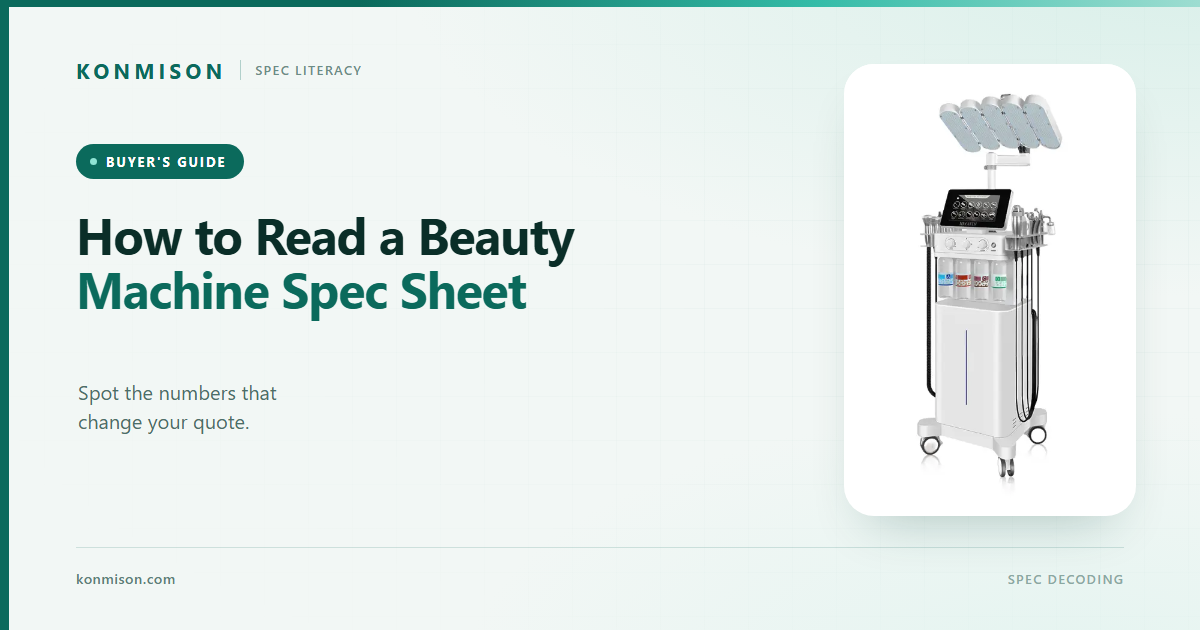
Spec sheets read as a menu, not as performance. “14 in 1” is a count of handpieces. It says nothing about energy density per pass, spot size consistency, or duty cycle under continuous use — the three figures that determine whether a treatment is repeatable. If you want a method for reading those sheets, see how to read a beauty machine specification sheet.
Three platforms currently in production show how the same category splits into different builds:
- LB536G — 14 in 1: 14 handles, 8 hydra tips, 9 diamond tips, 5 MHz RF, 1 MHz ultrasound, 100 kPa vacuum, 15-inch screen, 101 × 47 × 55 cm at 27 kg, AC110V–240V. The widest documented voltage tolerance of the three, which matters if you sell into both 110V and 220V markets.
- LB637D — 18 in 1: 18 handles including H2O2 bubble, 5 MHz RF, 1 MHz ultrasound, 90 kPa vacuum, 180 W, 15-inch screen, 54 × 49 × 92 cm. Note the tall crate — 92 cm will not pass a typical 80 cm studio door without unpacking, so confirm the route before shipping. And it is AC220V only, so a 110V site needs a step-up transformer specified before departure, not after arrival.
- LB654 — 17 in 1: CO2 bubble, EMS with LED mask, hydra and diamond dermabrasion across 17 handles, 11 hydra heads (3 soft, 8 hard) and 9 diamond heads, 12.1-inch screen, 120 × 50 × 45 cm at 42 kg. It is specified at ≤100 W — below the 180 W documented for LB637D — which makes it the easier unit to place in a room that is already close to its circuit limit.
Three operating signals tell you the platform has done its job and it is time to buy a dedicated unit:
- One service passes 40% of treatment revenue. At that point the console is a single-purpose machine with thirteen spare handles, and a dedicated unit will outperform it on the thing that pays the rent.
- You are booking the device, not the treatment. When the front desk says “the machine is free at three” instead of “the hydra room is free at three”, capacity is being managed around hardware.
- A client asks for parameters you cannot document. Medical referral, insurance paperwork or a corporate client will ask for energy density, wavelength and treatment interval. A menu of fourteen handle names is not an answer.
4. Three Price Bands, Reverse-Engineered
Buyers usually set a budget and then look for aesthetic equipment inside it. The workable version is to set the ticket, derive the menu from the ticket, and let the equipment list fall out. Three bands cover most openings.
| Band | Average ticket | Menu that fits | First two purchases | What breaks first |
|---|---|---|---|---|
| A — neighbourhood studio | $50–100 | Cleansing, exfoliation, infusion, relaxation, add-on body | One multi-handle facial platform, then a low-power cavitation or RF unit | Operator time, then room count |
| B — city clinic | $120–250 | Facial platform plus one energy device with documented parameters | A 14–18 handle facial console, then a diode or RF platform | Second treatment room |
| C — specialty | $300+ | One flagship modality with defensible clinical claims, plus analysis | Analysis unit first, then the flagship laser | Consultation capacity, not treatment capacity |
The order inside Band C is deliberate. At a $300-plus ticket, the constraint is not “can we deliver the treatment” — it is “can we justify the price in a consultation”. Analysis equipment is the cheapest way to make that argument repeatable, and it is also the fastest to pay back, so buying it first funds the wait for the flagship unit.
Band A buyers get the opposite advice for the same reason. At a $70 ticket, a top-band diode platform needs roughly 950 sessions of net contribution to recover its purchase price — before room cost, staff and marketing are counted. That is not a hardware problem; it is a mismatch between the ticket and the machine.
5. Five Site Facts to Have Before You Ask for a Quote
Every aesthetic equipment quotation starts with the same five questions, and the buyers who answer them in the first reply get accurate numbers instead of a brochure and a request for a video call.
1. Door width, lift dimensions and stair turns. Ask for the packed size in centimetres before you compare anything else. LB536G ships at 101 × 47 × 55 cm, LB637D at 54 × 49 × 92 cm and LB654 at 120 × 50 × 45 cm; documented weights are 27 kg and 42 kg for the first and third, and LB637D’s weight is not stated in its current documentation. A 92 cm crate against an 80 cm door means unpacking in a corridor; a 42 kg carton up two flights without a lift is a staffing question, not a delivery question.
2. Voltage, phase and circuit capacity. State your site voltage in the first message, because beauty machine voltage requirements differ by build within the same category. LB536G accepts 110–240V; LB637D is AC220V only. Then ask for amp draw and whether the unit needs a dedicated circuit — diode and cryolipolysis platforms typically pull enough to trip a shared ring main, and adding a circuit after installation costs more than the transformer you skipped.
3. Room count and treatment flow. Consultation and treatment in one room caps you at one client at a time and makes the analysis pitch feel like a sales tactic. Scan, consult, treat and compare are four moments that want at least two rooms.
4. Realistic throughput, not peak. Multiply treatment duration by rooms by opening hours, then cut it by a third for cleaning, turning and late arrivals. Quote the resulting number to the supplier: it changes which configuration they recommend more than your budget does.
5. Target ticket and package structure. Whether you sell single sessions, six-session courses or annual memberships determines whether you need a device that finishes a treatment in 20 minutes or one that can run 60 minutes without a duty-cycle problem. Suppliers price bundles differently depending on which you are building.
One more document is worth reading before this conversation: how to vet a beauty equipment manufacturer, which covers the certificates and inspection points that separate a factory from a trading desk. And if you are still at the stage of costing the whole opening rather than one machine, the cost to start an aesthetics business breaks down the non-equipment lines that usually get underestimated.
Verified model shortlist
These five are the models in this guide with a parameter set checked against their production documentation. Model codes elsewhere in this article illustrate a category; they are not a shortlist.
| Модель | Построить | Best fit |
|---|---|---|
| LB536G | 14 in 1 facial platform, 5 MHz RF, 100 kPa vacuum, AC110V–240V | Band A and B starter who needs menu breadth and voltage flexibility |
| LB637D | 18 in 1 with H2O2 bubble, 180 W, AC220V only | 220V clinic adding an oxygen and H2O2 protocol to an existing menu |
| LB654 | 17 in 1 with CO2 bubble, EMS and LED mask, ≤100 W | Room with limited circuit capacity that still needs a body add-on |
| LB617E-A | 18 in 1 oxygen peel with 360° rotatable screen | Operator working from either side of the couch |
| EN221B | 3 in 1: AI skin analysis, diode laser and Nd:YAG, 808 / 755 / 1064 nm | Band C opening that wants analysis and two laser services on one chassis |
Two of the five have a complete parameter archive covering every field on this page. Where a field is genuinely blank — LB654’s input voltage, LB637D’s packed weight — ask for it in writing rather than assuming the series default, and get the answer attached to the order confirmation rather than a chat message.
6. Questions Buyers Ask Before Signing
Is a 14-in-1 machine enough to open a clinic?
Enough to open and test demand, yes — assuming your ticket sits in Band A or B and your booking log has holes to fill. It is not enough once one service passes 40% of revenue, because at that point you are running a single-purpose business through a thirteen-handle console.
How long before equipment pays for itself?
Use the formula rather than a rule of thumb: cost ÷ (ticket × sessions per day × 22 × net contribution). At a $150 ticket, four sessions a day and a 0.42 contribution, a $12,000 platform returns in about nine months. At a $90 ticket and three sessions a day, the same machine takes nineteen. The machine did not change; the ticket did.
Do I need a dedicated circuit?
For diode, cryolipolysis and CO2 platforms, plan on it. For a multi-handle facial console between 100 W and 180 W, usually not. Ask the supplier for amp draw in writing — it takes one email and prevents a service interruption on opening week.
Should the analyzer be the first or last purchase?
First, in Band B and C. It is the cheapest category per unit, the fastest to pay back, and it produces the consultation that sells the other eight categories. In Band A, where the ticket is already low, add it once the facial menu is rebooking.
What is the one number people forget?
Sessions per day, not machine price. Two buyers with identical budgets and identical machines get paybacks four months apart because one books two sessions a day and the other books five. Everything in this guide reduces to that figure.
If you have the five site facts and a ticket band, the aesthetic equipment conversation gets short. Send the door width, the voltage, the room count, your realistic daily throughput, the target ticket and the two treatments you expect to sell most, and we will come back with a configuration and a packed size rather than a catalogue.



 EN
 RU
 ES
 IT
 AR
 FR
 DE
 JA
 KO
 NL