
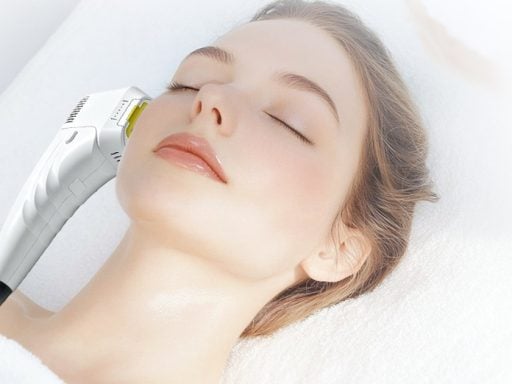
Two HIFU machines can carry almost identical descriptions and still treat completely different things. Both say “HIFU” — but one reaches the SMAS layer while the other only works in the shallow dermis, and one carries a recurring cartridge cost that eats into every treatment you sell.
HIFU is one of the few non-invasive technologies that works on the same structural layer surgeons address when they lift a face. That is also why the wrong configuration is expensive to undo.
Why HIFU Systems Look Similar but Perform Differently
Almost every HIFU system works the same way: a transducer fires focused ultrasound through the skin, and the energy converges at a chosen depth to create thermal coagulation points. The specifications wrapped around that core vary enormously.
Three variables do most of the work — the depths the machine can reach, how many lines each shot deliversy how many shots each cartridge holds. A system limited to shallow depths belongs to a different product class than one reaching 4.5 mm: shallow work addresses texture and fine lines, deeper work addresses the fibromuscular layer that gives a face its structural support.
A fourth variable is what rides on top of the ultrasound. Entry systems run HIFU alone; mid-range and premium platforms stack HIFU with RF heating and microcurrent in one unit, so lifting, tightening and muscle-tone work share a single machine — a difference that changes the price bracket, the training burden and the treatment menu at once.
Then there is the commercial layer. Cartridges are consumables, so a generous shot count lowers your cost per treatment, while a low one forces you to raise prices or absorb thinner margins.
The Specs That Decide Your Treatment Menu
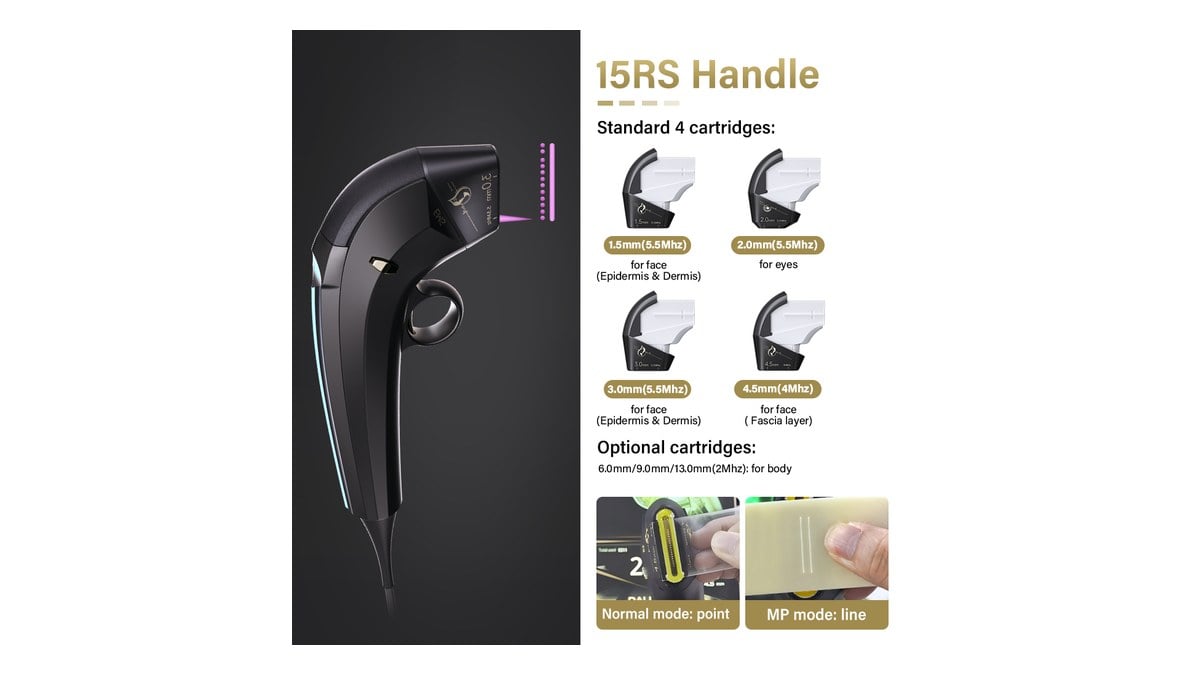
Treatment Depth: What 1.5 mm, 3.0 mm and 4.5 mm Actually Reach
Depth selection determines which treatments you can honestly offer.
| Cartridge depth | Layer targeted | Typical treatment area |
|---|---|---|
| 1.5 mm | Superficial dermis | Fine lines and skin texture, including delicate areas such as around the eyes and forehead |
| 3.0 mm | Dermis profunda | Overall skin tightening and firmness across the face and neck |
| 4.5 mm | Capa SMAS | Structural lifting of the lower face, jawline and brow area |
| 6.0 mm and deeper | Subcutaneous and deeper tissue | Body applications, where the transducer must reach beyond the facial layer |
A machine with 3.0 mm and 4.5 mm covers the standard facial lifting protocol; adding 1.5 mm gives you a genuinely different service for clients not ready for a deeper lift. On the body, cartridges at 6.0 mm and deeper target subcutaneous tissue — our own platform adjusts focal length in 5 mm steps across a 5–25 mm range. Whatever the numbering style, confirm the depths you need ship in the box rather than on an options list.
Cartridges and Shots: The Recurring Cost Centre
Each cartridge is rated for a fixed number of shots, after which energy delivery degrades and it is replaced. Configurations fall into two groups: 10.000 disparos, the market standard, and 20.000 disparos on some models.
Ask for three numbers — shots per cartridge, cartridge price per unit, and recommended shot count per treatment area. Multiplied together they give a realistic cost per treatment, which decides profitability more than the price of the unit does. Also check how cartridges map to handles: a three-handle system can carry nine standard cartridges across facial and body depths, and any shared-versus-dedicated cartridge families change how much stock you carry.
Line Count per Shot: Why “22D” or “12D” Matters Less Than You Think
Model names lean heavily on numbers — 7D, 8D, 12D, 22D. These are configuration labels, and their meaning is not standardised across the industry, so they should never decide a purchase.
What matters is the specification behind the label. On many systems the number describes how many output lines the transducer fires per shot — one current model specifies 1–12 lines as a user-adjustable output. Others skip line-count branding and sell on mode design instead: a point mode for spiral or circle placements, a multi-line mode for broader passes. Strip the label off and compare three values: maximum lines per shot, total selectable depths, and handle count.
Frequency: 2 MHz, 4 MHz and 5.5 MHz
HIFU transducers typically run at 2 MHz or 4 MHz, and hybrid systems add a third option. Lower frequencies penetrate deeper with a broader thermal zone; higher frequencies create a tighter focal point closer to the surface. In practice 5.5 MHz suits superficial facial work such as around the eyes, 4 MHz suits SMAS-level lifting, and 2 MHz suits deeper body tissue. A machine that switches between all three gives the operator that choice.
HIFU Machine Comparison: Configuration Classes Side by Side
The table below compares representative configurations using published factory specifications. Treat it as a map of the market rather than a ranking — the right class depends on your room, your menu and your team.
| Modelo | Nombre del producto | Tecnología | Asas | Depth options | Disparos | Frecuencia de salida | Potencia | Mostrar |
|---|---|---|---|---|---|---|---|---|
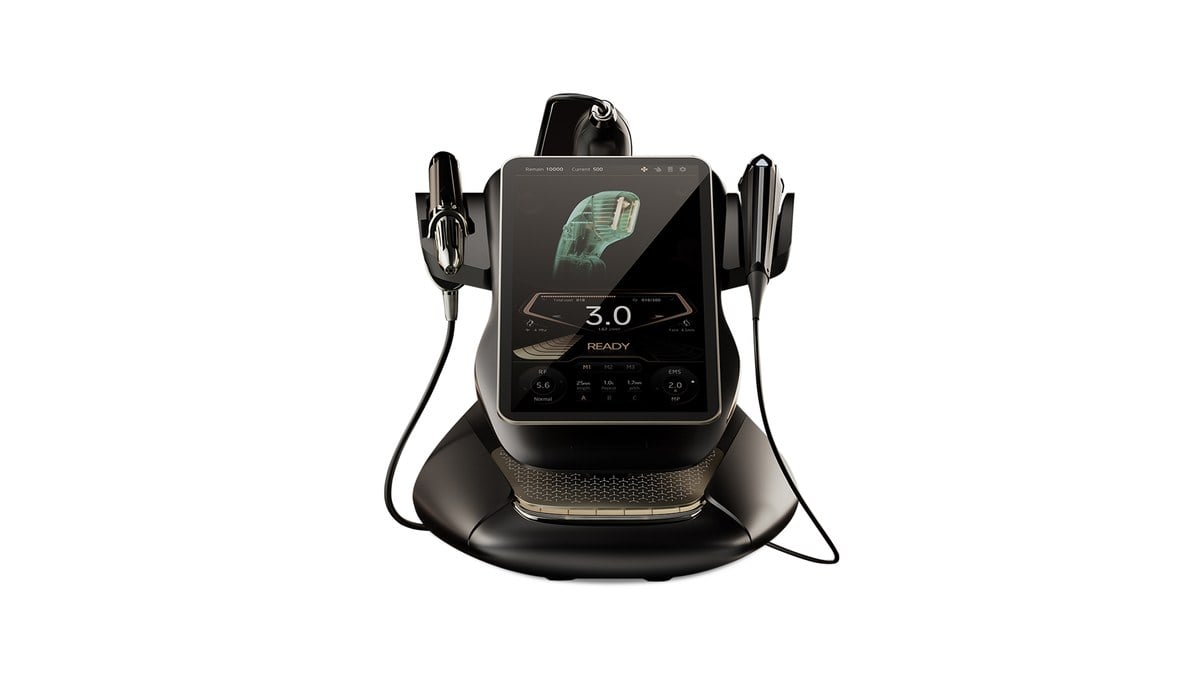
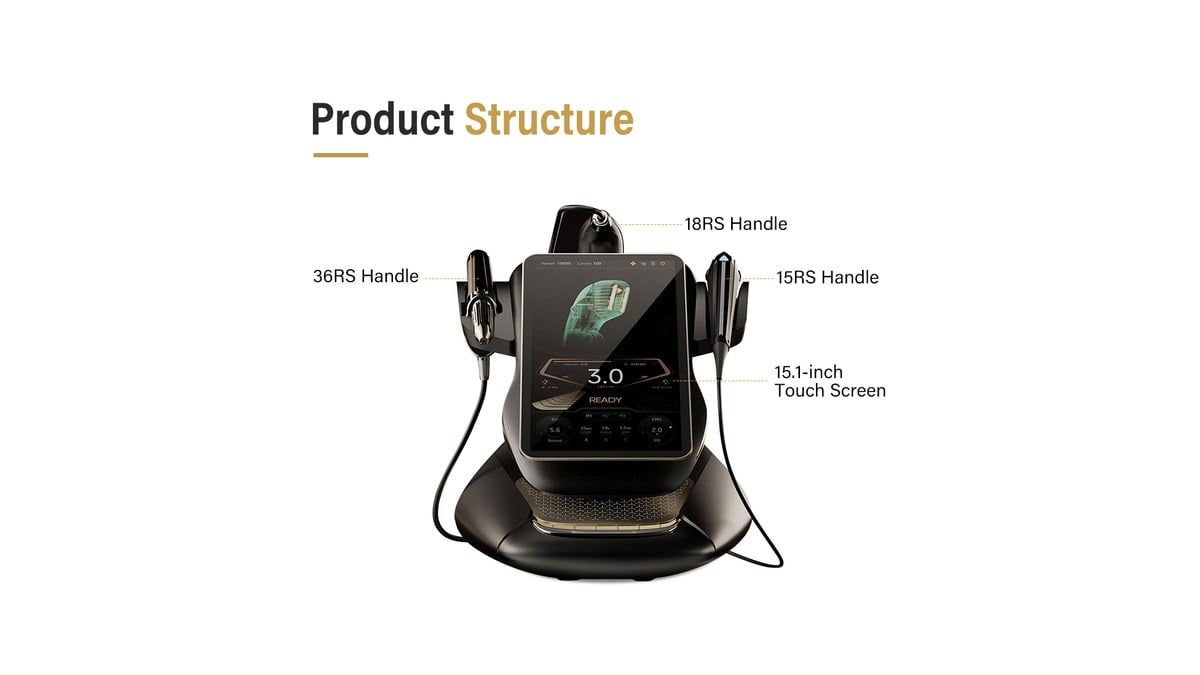
| GN779 | Máquina de belleza HIFU multifunción 3 en 1 | HIFU + RF + microcurrent | 3 pcs (15RS, 36RS, 18RS) | 1.5–4.5 mm facial; 8.0 + 13.0 mm body | ~10,000 per cartridge | 4 MHz | 1180 W | Pantalla táctil |
| GN1003 | 12D HIFU Ice Cooling Face & Body | HIFU | 1 pc | 3.0 + 4.5 mm std; 8 heads optional | 10,000 or 20,000 | 4 MHz | 200–400 VA | Pantalla táctil |
| GN765E | 5 in 1 Multi 8D HIFU | HIFU + RF | 5 piezas | - | - | - | 200 W | 15 pulgadas |
| GN793B | 3 in 1 Titanium HIFU RF | HIFU + RF | 3 piezas | 15 probes: 7 HIFU + 5 HIFU gun + 3 thermal RF | - | 2 / 4 / 5.5 MHz | 100 W | 12,1 pulgadas |
| GN727B | 3 in 1 22D HIFU Face & Body | HIFU + 6.78 MHz RF | 3 pcs (13-depth + 18-depth + 30-line) | 1.5–4.5 std; up to 18 optional | 10,000 per cartridge | 2 / 4 MHz | 1280 W | 13.3-inch |
| JF906H | 4 Handles in 1 ICE HIFU | ICE HIFU + M8 + EMRF | 4 piezas | 2–3 facial cartridges | - | - | 10–600 W | 15 pulgadas |
| LB750 | 6 in 1 Ultrasound HIFU RF Facial | Multi-platform | 6 pcs | - | - | - | - | Pantalla táctil |
*— = not published for this model. All values shown are factory specifications; custom configurations are available on request.*
Two patterns stand out. First, technology mix now divides the market more than handle count: a single-technology HIFU unit, a HIFU-plus-RF hybrid and a three-technology stack sit in different investment brackets even when the handle counts match. Second, a larger number in the model name is not automatically an advantage — the 1180 W three-technology system and the 200 W five-handle system serve different rooms.
Matching the System to Your Room and Menu
Adding a first HIFU service with face and body in mind. If you want one platform to cover both from day one, a three-handle system with dedicated facial and body handles is the balanced entry point: facial cartridges at 1.5–4.5 mm, a body handle reaching 8.0–13.0 mm, and RF plus microcurrent layered on top. Our 3-in-1 HIFU machine with RF and microcurrent is built exactly for this menu — ask us for the configuration sheet and cartridge options.
Starting with facial only. The priority is depth coverage and a predictable consumable cost. A single-handle machine with 3.0 mm and 4.5 mm as standard covers the core lifting protocol, and a portable format keeps the unit flexible — a 4 MHz single-handle system with 8 treatment heads fits this stage, with body depths available later.
Running a multi-treatment room. If the room already offers radiofrequency or microneedling, a combined platform can reduce the number of units you own. Hybrid configurations such as HIFU paired with thermal RF in one system cover lifting and tightening without two treatment slots, while a five-handle 8D platform pushes further toward body and contouring protocols. The real question is how many handles your team will actually use in a normal week.
Comfort, Cooling and Downtime — What Patients Notice
HIFU is known for a sharp, deep sensation, and comfort management has become a competitive feature. Two approaches dominate. The first is integrated cooling: some models pair the HIFU handle with a cooling head that lowers skin temperature during treatment. The second is mode and frequency control: switching between point and line modes, and matching frequency to depth, keeps energy delivery comfortable without extra hardware.
Neither approach is strictly better — cooling adds components and cost, mode-based control relies more on operator skill. What matters is that comfortable patients sit still through the full protocol, so the planned depth and coverage actually gets delivered. When testing, ask to feel a therapeutic setting on yourself rather than a demonstration setting.
HIFU vs RF Microneedling vs Radiofrequency Tightening
HIFU is rarely the only skin-tightening technology in a clinic’s plan, so it helps to be precise about where it sits.
| Tecnología | Mecanismo | Where it fits |
|---|---|---|
| HIFU | Focused ultrasound creating thermal coagulation points at a selected depth, up to the SMAS layer | Non-invasive lifting, jawline and brow definition, deeper structural work |
| Microagujas RF | Microneedles deliver radiofrequency energy into the dermis | Skin texture and firmness, scars and pores |
| Radiofrequency tightening | Bulk volumetric heating of the dermis without needles | General skin laxity and comfortable maintenance treatments, often in series |
The three are complementary rather than competing — which is exactly why hybrid platforms stack HIFU with RF heating and microcurrent in one cabinet. For the body-contouring side, our breakdown of 448 kHz CET/RET against RF, EMS and cavitation covers it in detail.
The Pre-Purchase Checklist
- Depths available, not just advertised. Confirm which cartridges ship in the box and which are options.
- Shots per cartridge, and cartridge price. Model your cost per treatment before you model your profit.
- Output frequency, and whether it is switchable. Facial precision and deeper body work favour different frequencies.
- Technology stack against your menu. HIFU alone, HIFU plus RF, or three technologies — buy for the treatments your team will run, not for the brochure.
- Lines per shot as a number, not a label. Ignore the “8D/12D/22D” naming and compare measured values.
- Comfort approach. Integrated cooling or mode-based control — ask to experience a therapeutic energy setting during a demo.
- Training, service and OEM flexibility. Multi-handle systems need consistent operator training, and any brand- or region-specific menus, screens or languages must be confirmed before production.
If you are building out a wider room at the same time, start from the full HIFU machine range and work backwards to the configuration that matches your service plan.
Budget Planning: Where the Money Actually Goes
Because HIFU pricing depends on configuration, cartridges and order quantity, a single headline figure is misleading. What you can plan around is the structure of the investment.
Three components drive the total. The platform itself — single technology or hybrid stack, single-handle or multi-handle. The consumables — cartridges, an ongoing cost for as long as you sell the service. And the soft costs on the way in: operator training, a compliant treatment room, and marketing to fill the initial diary.
Configuration is the biggest swing factor, because moving from a single-handle facial system to a multi-handle platform with body capability means buying more transducers, more cartridges and more capability. Consumables are the most common underestimate — over a year of regular treatments, cartridge replacement can approach or exceed the initial difference between a budget unit and a better-specified one, so model both together. Payback depends on treatment volume rather than on the machine.
For a tailored configuration and current pricing for your region and order volume, contact our team with your intended treatment menu.
FAQ about HIFU Machines
How much does a HIFU machine cost?
HIFU pricing varies widely with configuration — handle count, cartridge depths, stacked technologies and order quantity all change the figure, and consumable cartridges form a separate ongoing cost. For a specification and pricing matched to your menu, request a quotation rather than comparing headline prices across unrelated configurations.
How many shots does a HIFU cartridge have?
Ratings are commonly 10,000 shots, with 20,000 available as an option on some models. How far that goes depends on the protocol — a focused facial treatment consumes far fewer shots than one covering the neck, jawline and body. Divide the rating by the recommended shot count per area to estimate sessions per cartridge.
What treatment depths do I need for facial work versus body work?
For facial lifting, 3.0 mm and 4.5 mm cover the standard protocol, with 1.5 mm adding superficial work. Body applications need deeper cartridges — 6.0 mm and beyond — because the targeted tissue sits further below the surface. If body treatments are on the roadmap, confirm those depths ship in the box.
Is a single-handle HIFU machine enough for a small clinic?
For a clinic adding one premium service to an existing menu, yes — a single-handle system with 3.0 mm and 4.5 mm cartridges covers the core lifting protocol. The limitation is menu range rather than capability: body protocols or RF-based treatments later mean a multi-handle platform.
What is the difference between an 8D, 12D and 22D HIFU machine?
These are configuration labels rather than standardised specifications, and their meaning varies between manufacturers. On many systems the number relates to output lines per shot or to the total selectable depths across the handles. Two machines with similar labels can differ substantially, so compare measured values instead of the model name.
Can one HIFU system handle both facial and body treatments?
Multi-handle systems can, and this is their main advantage over single-handle units. The facial and body handles typically use different cartridge families because the required depths differ. Platforms that stack HIFU with RF heating and microcurrent go one step further, adding tightening and muscle-tone work to the same cabinet. When comparing multi-handle machines, check how cartridges are shared between handles — it affects both stock planning and cost per treatment.
Conclusión
HIFU machines differ far more than their descriptions suggest, and the differences that matter are the unglamorous ones: how deep the cartridges reach, how many shots they hold, how many handles the system offers, and which technologies ride on top of the ultrasound. Get those right and the marketing labels stop mattering.
Start from your treatment menu, work out the depths and volumes you need, then compare configurations against that list — and model the consumable cost across a full year rather than a single purchase. If you would like help mapping a specification to your room, our team can put together a configuration based on the services you plan to run.


 EN
EN  RU
RU  ES
ES  IT
IT  AR
AR  FR
FR  DE
DE  JA
JA  KO
KO  NL
NL