

If you operate a med spa, dermatology clinic, or aesthetics studio, you have likely seen the demand: clients want visible skin renewal without surgery, and they are increasingly asking for laser treatments by name. Among the options on the market, the CO2 fractional laser machine stands out as one of the most versatile platforms you can add to a treatment menu.
But “CO2 laser” is a broad term. Some machines only do skin resurfacing. Others add intimate-care capability. A few combine several functions in one system. Choosing the right one affects not just your budget, but how many services you can actually offer from a single machine, how much space it needs, how many training cycles your team has to go through, and how predictable the running costs will be over the years you own it.
This guide explains what a CO2 fractional laser machine does, the three operating modes worth knowing, the specifications that separate a capable system from a weak one, what it takes to run one in a real clinic, and a close look at the Konmison EN172 — a 3-in-1 CO2 fractional laser machine that packs fractional, vaginal, and focused modes into a single unit.
Key takeaways
- A CO2 fractional laser machine works at a 10,600 nm wavelength, where water in the skin absorbs energy strongly. That makes it an ablative platform built for resurfacing and collagen renewal rather than pigmentation-selective work.
- “Fractional” is the design that keeps downtime manageable: energy is delivered in a grid of micro-columns, leaving bridges of untreated skin between them so the treated area can recover faster.
- Three modes decide how many services one machine can support: fractional (resurfacing), vaginal / intimate, and focused (targeted precision work).
- Specification sheets look alike, but laser power, source type and rated life, spot distance, pulse width, scan area, and the articulated arm are what actually separate a clinic-grade machine from a light-duty one.
- Total cost of ownership is driven less by the purchase price than by source life, head and optics care, calibration, and how many services the machine can bill for per month.
- The Konmison EN172 combines all three modes and 7 heads in one 40W, 10,600 nm system with an RF-excited source rated for roughly 50,000 hours — one investment, one training cycle, a broader menu.
What Is a CO2 Fractional Laser Machine?
A CO2 fractional laser machine is an ablative laser platform built around a carbon dioxide laser source that emits light at a wavelength of 10,600 nm. At this wavelength, water in the skin absorbs the energy strongly, which lets the machine resurface and remodel tissue with high precision. Because the target is water rather than a specific pigment, the effect is not limited to one skin concern or one skin tone — it is a platform technology that practitioners use across a wide range of commonly requested treatments.
The word “fractional” is the key differentiator. Instead of treating the whole surface at once, the laser delivers energy in a grid of tiny, controlled micro-columns. This leaves bridges of untreated skin between the treated zones, which helps the area recover faster while still triggering the skin’s renewal response. That balance — a strong result with manageable downtime — is why fractional CO2 has stayed popular in clinics for years, even as newer technologies have arrived.
It is worth being precise about what this machine class is and is not. A CO2 fractional laser is a resurfacing and remodeling platform; it is not a pigment-specific laser, and it is not a hair or vascular platform. Clinics that already own a fractional laser category machine for one purpose often discover that a second, more flexible unit widens the menu faster than a third narrow single-purpose machine would.
How Does a CO2 Fractional Laser Work?
The principle is straightforward. When the laser energy reaches the skin, it creates microscopic thermal treatment zones — small columns of controlled thermal effect surrounded by healthy, untouched tissue. These controlled zones prompt the body to produce fresh collagen and reorganize existing collagen fibers in the treated layer. Because the surrounding tissue stays intact, the skin repairs itself while the overall structure becomes firmer and smoother.
What matters for a buyer is how much control the operator has over that interaction. Depth and intensity are not fixed by the wavelength; they are governed by a handful of settings:
- Energy per pulse decides how much effect each micro-column carries.
- Pulse width decides the balance between ablation (tissue removal) and coagulation (thermal effect that drives collagen remodeling). A wide adjustable range gives the operator room to move between shallow surface work and deeper remodeling.
- Spot distance / dot spacing decides how dense the treatment grid is. Tight spacing means more coverage per pass; wider spacing means a gentler pass with more untreated skin left as a repair reservoir.
- Number of passes decides how the effect stacks during one session.
In practice, that mechanism supports a wide range of commonly requested treatments:
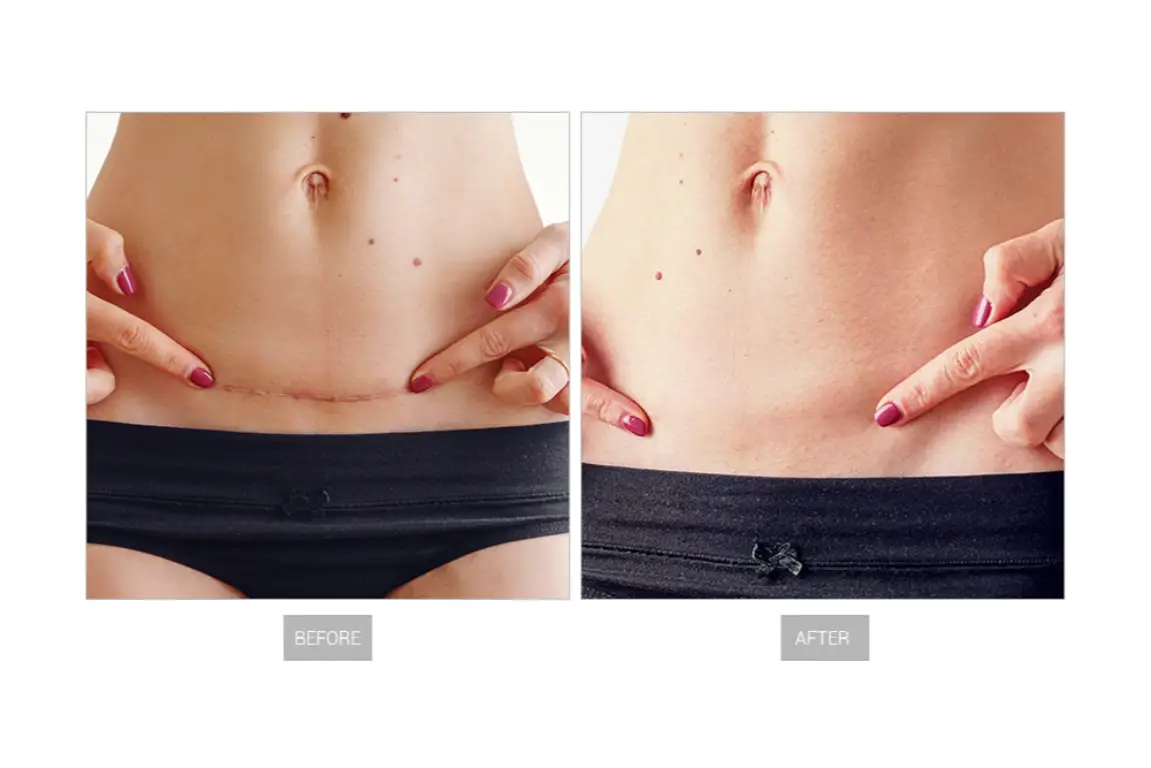
- Scar improvement — including acne scars and surgical or trauma scars.
- Stretch mark and wrinkle reduction — by encouraging collagen renewal in the treated area.
- Skin resurfacing and renewal — for rough texture, enlarged pores, and dull tone.
- Pigmentation lightening — helping even out localized discoloration.
- Intimate care — when the machine includes a dedicated vaginal mode and heads (more on this below).
Results are progressive. Most clients notice changes over several weeks as collagen builds, with continued improvement over the following months. As with any aesthetic treatment, individual outcomes vary, and a proper consultation determines suitability. For a detailed, day-by-day walkthrough of what clients experience afterwards, see the clinic guide to CO2 laser facial results and recovery timelines.
Fractional, Vaginal, and Focused: Three Modes in One Machine
Not every CO2 laser machine offers the same modes. When you compare systems, three operating modes are worth understanding, because they decide how many services one machine can support — and how many training cycles, room slots, and service contracts your clinic has to manage.
1. Fractional mode
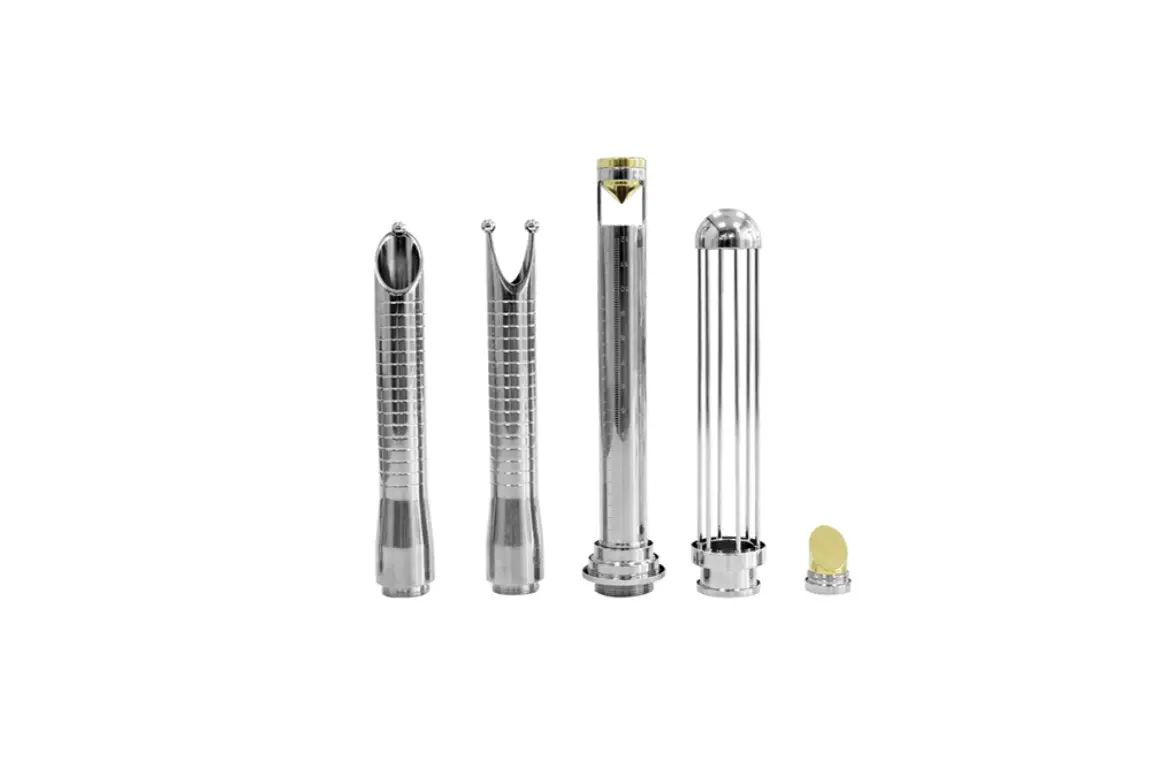
The standard resurfacing mode, and the one most buyers expect first. It is used for scars, wrinkles, pores, and overall skin renewal across the face and body. In practice, most manufacturers ship several fractional heads so the operator can choose a head according to the treatment depth and the area being treated — a smaller head for precision work around the eyes and nose, a larger head for cheeks, neck, or body areas. When you evaluate a machine, ask how many fractional heads are included and what depth range each one covers; that single question tells you more about real-world flexibility than the headline power figure.
2. Vaginal / intimate mode
A dedicated mode with specialized heads for intimate-care treatments. Clinics that serve this segment can turn one machine into a second revenue stream without buying a separate unit. Heads in this mode are intended for use by trained professionals in appropriate settings, and protocols should follow the manufacturer’s instructions and local regulatory requirements. The practical buying question here is whether the intimate mode is a genuinely engineered function — dedicated heads, dedicated settings, dedicated protocol guidance — or a marketing line on a resurfacing-only machine.
3. Focused mode
A concentrated-energy mode for targeted work where precision matters more than surface coverage. It complements the fractional mode rather than replacing it: the fractional head covers an area evenly, while the focused head concentrates effect on a defined point or line. Clinics use it for detail work that a full-face pass would not address efficiently.
A machine that combines all three is often called a 3-in-1 CO2 laser machine. For a clinic, that means one investment, one training cycle, one service relationship, and a noticeably broader menu — which is exactly where the EN172 earns its place. If the intimate segment is central to your menu rather than an add-on, a dedicated portable 3-in-1 fractional CO2 laser for vaginal care is the alternative shape to compare against a full-size vertical unit.
Specifications That Matter When You Compare CO2 Laser Machines
Two machines can both be labeled “CO2 laser” and still perform very differently. When you evaluate options, put these specifications side by side — and read the notes, because the numbers only mean something in context.
| Specification | What good looks like | Why it matters |
|---|---|---|
| Laser power | 30–40W class for clinic work | Higher power supports faster, more consistent delivery over larger areas; low-power units slow down full-face sessions |
| Wavelength | 10,600 nm | The standard for CO2 ablative work — confirm the source is a true CO2 tube, not a lookalike technology |
| Laser source type and rated life | RF-excited tube with a long rated life | Determines how predictable your running cost is and how soon you plan a major replacement |
| Spot distance / dot spacing | Adjustable, roughly 0.2–1.5 mm | Lets the operator fine-tune density for different areas, depths, and skin types |
| Pulse width | Wide adjustable range (e.g. 0.1–9.9 ms) | Gives control over the balance between ablation and thermal effect — the single most useful dial in daily practice |
| Scan shapes | Square, triangle, hexagon, circle and similar | Faster coverage and a better fit to irregular treatment zones such as the upper lip or jawline |
| Max scan area | 20 × 20 mm or larger | Larger areas mean fewer passes and shorter sessions on cheeks, neck, and body areas |
| Articulated arm | Multi-joint arm with free rotation | Reduces energy loss along the beam path and lowers operator fatigue during long sessions |
| Cooling | Forced-air cooling with a stable duty cycle | Keeps sessions consistent when you book several treatments back to back |
| Display and interface | Large touchscreen with a logical menu | Cuts staff training time and reduces setting errors in daily use |
| Voltage / power supply | AC 100–240V, 50/60Hz | Determines whether the machine can be commissioned in your market without extra hardware |
If you only have time to check four things, check these: source type and rated life (your long-term cost), pulse width range (your clinical control), head count and depth coverage (your service breadth), and the articulated arm (your operator’s endurance). A machine that wins on power but loses on all four of those will feel limiting within a few months.
Two comparisons are worth running before you settle on a configuration. First, look at how a higher-power 60W RF CO2 fractional system is priced against its output if you treat large areas frequently. Second, look at scan-pattern differences — a 3-in-1 CO2 fractional spiral laser uses a different delivery pattern, and the pattern affects how the treated grid looks and feels during healing. Neither choice is automatically better; the right one follows your case mix.
Spotlight: The EN172 3-in-1 CO2 Fractional Laser Machine
The Konmison EN172 is a vertical 3-in-1 CO2 fractional laser machine that brings fractional, vaginal, and focused modes together in one system. Here is its specification profile:
| Item | EN172 specification |
|---|---|
| Technology | CO2 fractional laser |
| Model | EN172 |
| Treatment heads | 7 pcs (3 fractional + 3 vaginal + 1 focused) |
| Power | 40W |
| Wavelength | 10,600 nm |
| Spot distance | 0.2–1.5 mm |
| Pulse width | 0.1–9.9 ms |
| Scan shapes | Square / triangle / hexagon / circle |
| Max scan area | 20 × 20 mm |
| Voltage | AC 100–240V, 50/60Hz |
| Cooling | Forced-air cooling |
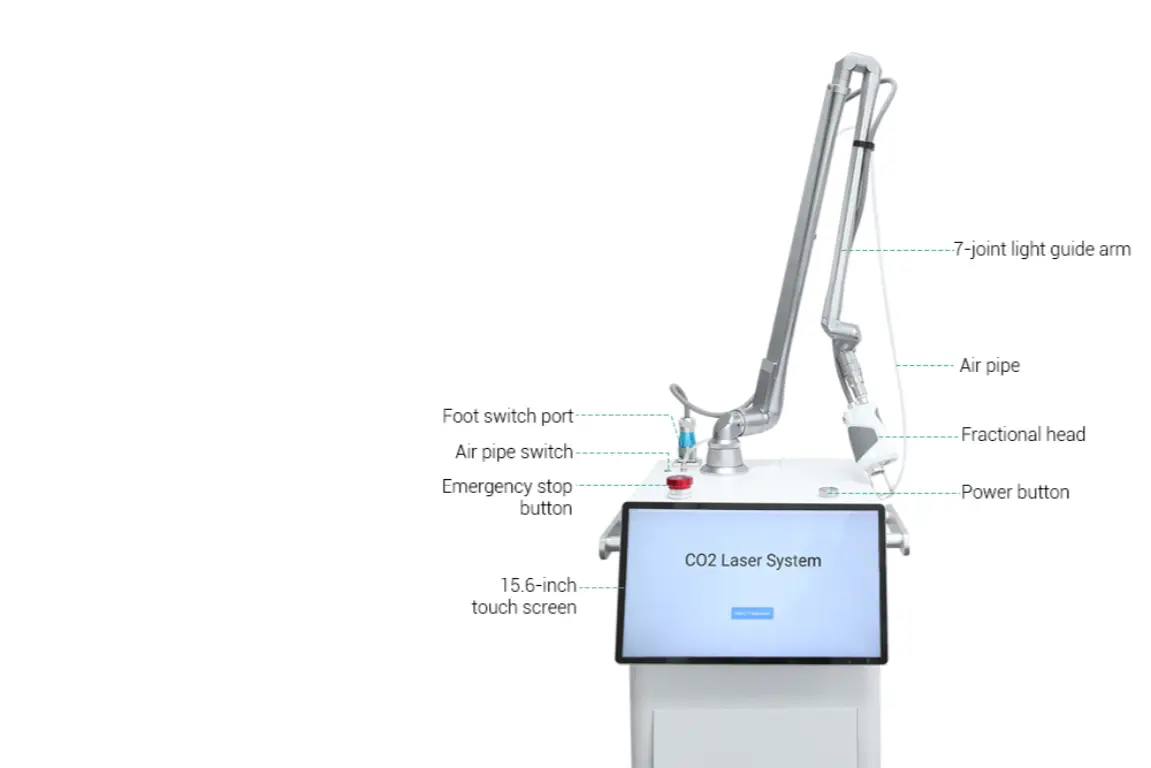
| Display | 15.6-inch touchscreen |
| Machine size | 40 × 50 × 170 cm |
Two design points make the EN172 practical for daily clinic use:
- 7-joint articulated arm with 360° rotation — minimizes energy loss along the path and gives the operator free movement during treatment, which matters when a session runs long or the client needs repositioning.
- RF-excited laser tube rated for ~50,000 hours — a long service life that helps keep running costs predictable, and one of the reasons the machine is positioned as a long-term platform rather than an entry-level unit.
Because it carries three modes and seven heads, a single EN172 can support skin resurfacing, scar and stretch-mark work, skin tightening, pigmentation lightening, and intimate care from one platform. For a clinic that wants breadth without filling a room with single-function machines, that consolidation is the main appeal. If you are comparing it against another combined unit, put the 3-in-1 CO2 fractional laser machine and the 3-in-1 resurfacing and intimate-care machine side by side with it — head count and depth coverage are the fastest way to see the differences.
EN172 3-in-1 vs Single-Function CO2 Laser: What You Gain
A quick way to see the value of a combined system is to compare it with buying single-function machines:
| Dimension | Single-function CO2 laser | Konmison EN172 3-in-1 |
|---|---|---|
| Treatment scope | Skin resurfacing only | Fractional + vaginal + focused (skin, intimate, targeted) |
| Machines needed | One per function (three units for three modes) | One unit |
| Training | Multiple cycles, one per machine | One cycle covering three modes |
| Floor space and service contracts | Higher — several units, several service relationships | Consolidated |
| Head and consumable inventory | Separate kits per machine | One shared kit with 7 heads |
| Staff scheduling | Operator must switch between platforms | One operator can move between modes on one platform |
| Best for | Dedicated resurfacing clinics with fixed demand | Med spas, dermatology clinics, and new practices wanting breadth |
The financial logic is not really about purchase price — it is about utilisation. Three narrow machines each sit idle part of the week; one versatile platform can be booked across several service types, and the staff who operate it need one training cycle instead of three. For a clinic in its first two years, that difference in utilisation is usually larger than any per-unit discount a supplier can offer.
Running Costs and Consumables: What to Budget For
Buyers often compare machines on purchase price alone and are surprised by the cost profile in year two and three. The items below are where CO2 fractional laser ownership costs actually live — and all of them are things you can ask about before you sign.
Laser source life and replacement planning
The CO2 source is the single most expensive component. A tube rated for a long service life — the EN172’s RF-excited source is rated for roughly 50,000 hours — spreads that cost across years of use. Ask for the rated life in hours, what the replacement procedure involves, and whether the replacement is done in your clinic or requires shipping the unit back.
Treatment heads and optics
Heads are handled daily, cleaned daily, and eventually replaced. Ask which heads are included, which ones are expected to wear faster, and how to order replacements. A supplier who can tell you the wear items in advance is a supplier you can plan a budget with.
Preventive maintenance and calibration
A scheduled maintenance rhythm — optics inspection, air-path and cooling checks, calibration verification — keeps output consistent. Ask what the recommended interval is and whether your own technician can perform the routine checks.
Consumables and aftercare stock
Besides machine parts, plan for the consumables attached to the treatment itself: surface gels or numbing products used per protocol, protective eyewear, disposable covers, and aftercare products you send home with clients. These are small line items that add up per session.
Downtime and staff productivity
The cost that never appears on a quotation is idle time. If a machine is out of service for two weeks waiting on a part, you lose the sessions you could have booked. This is why spare-part availability and service response time belong in the buying decision, not in the after-sales folder.
How to model total cost of ownership
Add up four numbers before you decide: source life in hours, expected head replacements per year, scheduled maintenance per year, and the number of sessions you realistically expect to deliver per month. The machine with the better fourth number almost always wins, because utilisation — not purchase price — is what pays for everything else.
Getting the Clinic Ready: Room, Power, and Staff Training
A CO2 fractional laser is a floor-standing platform, not a countertop gadget. Planning the room before delivery avoids a week of improvisation after it arrives.
Space and layout
The EN172 measures 40 × 50 × 170 cm, so plan for the machine footprint plus clearance for the articulated arm to swing freely, plus space for the treatment couch and for the operator to move around it. A treatment room that already fits a couch and a trolley usually accommodates a vertical unit, but the arm’s working radius is the dimension people forget to check.
Power and environment
Confirm the supply matches the machine’s rating — the EN172 runs on AC 100–240V, 50/60Hz — and give the laser its own circuit with proper grounding rather than sharing an overloaded ring. Stable voltage protects the source, which is the component you least want to replace early. Ablative work also produces plume, so plan ventilation or smoke evacuation appropriate to your local requirements, plus eye protection for everyone in the room.
Staff training and protocols
Multi-mode machines are only useful if your team knows how to operate each mode safely. A sensible onboarding sequence looks like this:
- Technical walkthrough of the machine, heads, settings, and safety features.
- Protocol training per mode, with written settings for each service on your menu.
- Supervised practice sessions before live client bookings.
- A competency sign-off for each operator, kept in their file.
- A review after the first month of live treatments to adjust settings and aftercare instructions.
Write your protocols down. Standard written protocols are what let you add a second operator later without re-learning everything from scratch.
Safety, Client Selection, and Aftercare Planning
Most disappointment in laser clinics comes from client selection and aftercare, not from the machine. Build the process before you advertise the service.
Consultation and skin assessment
Every client should start with a structured consultation: what they want changed, how their skin has responded to previous treatments, what medications or conditions might affect healing, and how much downtime they can realistically accept. The assessment is what turns a treatment request into a suitable plan — and it is also your record that the conversation happened.
Screening before booking
Screen for anything that makes an ablative treatment a poor fit or requires a modified plan, and document the outcome. Where there is uncertainty about how a client’s skin will respond, a test spot on a small area, observed over the following days, is a low-cost way to avoid an expensive surprise.
Aftercare as a product feature
Aftercare instructions are part of the service, not an afterthought. Give clients written guidance on cleansing, what to expect during healing, when to resume normal skincare, and how to protect the treated area from sun exposure. A clear aftercare sheet reduces anxious phone calls and improves how clients rate the result. The clinic-facing breakdown of what recovery actually looks like, day by day, is covered in the CO2 laser facial cost and recovery guide, and the mechanism-level explanation lives in the CO2 laser facial treatment guide.
Session spacing and records
Plan intervals between sessions according to your protocol rather than client demand, and keep photographic records under consistent lighting. Standardized before-and-after images are the most persuasive marketing asset a clinic can own, and they are also the most useful clinical reference — as shown in this collection of fractional CO2 before and after documentation.
What to Prepare Before Importing and Commissioning
Cross-border equipment purchase is a logistics project as much as a clinical one. Preparing these items early keeps the machine from sitting in its crate.
- Documentation your market requires. Ask the supplier which technical and regulatory documents they provide and confirm they match what your country asks for at import. Requirements differ by market, so verify locally rather than assuming.
- Electrical compatibility. Confirm voltage and plug configuration for your country before shipping, and check whether a step-up or step-down arrangement is needed.
- Packing and delivery logistics. A vertical unit needs a route into the building: door widths, lift dimensions, stairs, and whether a pallet jack or crane is needed on delivery day.
- Installation and commissioning support. Confirm who performs first installation, whether remote guidance is included, and how the machine is verified as working before payment milestones are closed.
- Initial spare parts and consumables. Order the wear items and a starter set of heads alongside the machine rather than waiting for the first failure.
- Warranty terms and the service path. Written warranty terms, response times, and who pays for shipping on a warranty repair should all be clear before you order.
Which Clinics Benefit Most from the EN172?
- Med spas and aesthetics studios adding resurfacing and skin-renewal services alongside their existing menu. The 3-in-1 configuration lets them test a new service line without committing to a second machine and a second training cycle.
- Dermatology and skin clinics that want scar and stretch-mark work in-house instead of referring it out, and that value a machine whose settings can be tuned per case rather than fixed by the manufacturer.
- Studios offering intimate-care services, who can run that segment from the same platform instead of buying a dedicated unit — with dedicated heads and dedicated settings rather than a shared handpiece.
- New practices building a treatment list on a measured budget, where one versatile machine is preferable to three narrow ones, and where the operator’s learning curve matters as much as the specification sheet.
- Clinics that already own a single-function laser and have hit its limits. The upgrade case here is menu breadth and head depth rather than more power, and the facial machine range is the right place to compare configurations.
How to Evaluate a Machine Before You Commit
Specification sheets are necessary and insufficient. Ask for a demonstration and run this sequence:
- Power up and check the interface. Navigate to each mode without help. If the menu structure confuses you in a demo, it will frustrate your staff in daily use.
- Run the fractional mode on a test surface. Look at the grid: is the dot pattern uniform across the scan area, and does changing spot distance visibly change density?
- Check the pulse width range in practice. Ask the operator to move from a shallow to a deeper setting and explain what changes clinically.
- Exercise the articulated arm. Move it through its full rotation. A stiff or drifting arm is an ergonomic cost on every session.
- Switch to each mode and count the heads. Confirm the head count on the table matches the quotation, and that each head’s purpose is explained.
- Time a simulated session. How long does a standard treatment actually take, including setup and disinfection between clients?
- Ask for clinic references. A supplier with real installations can connect you with operators who use the machine weekly.
- Confirm the documentation pack and service path in writing. Warranty terms, response times, spare parts, training scope.
If you also sell or consider light-based facial work, it is worth understanding where this platform sits next to adjacent technologies in the same room — for example a thulium laser platform that targets a different wavelength band and a different case mix.
Questions to Ask Your Supplier Before You Buy
Beyond the specification sheet, these questions protect your investment. The right-hand column is what a competent answer sounds like.
| Question | What a good answer looks like |
|---|---|
| What is the rated lifespan of the laser source, and what does a replacement involve? | A stated figure in hours (the EN172’s RF-excited source is rated around 50,000 hours), plus a clear description of the replacement procedure and where it is performed |
| Are training and protocol support included? | A structured onboarding plan covering every mode, not just a manual; ideally with written settings you can adopt on day one |
| What is the warranty, and what is the local service path? | Written warranty terms, a stated response time, and named spare parts that can be shipped rather than returning the whole unit |
| Which parts are expected to wear, and what do they cost to maintain? | A named list of wear items — heads, optics, filters — with recommended replacement intervals |
| Can the machine grow with your clinic? | Head compatibility across the range, accessory options, and clarity about firmware updates |
| Is the interface clear enough for daily use by rotating staff? | A large touchscreen with a logical, language-appropriate menu and the option to save settings per protocol |
| How many heads are included, and what depth does each cover? | A specific breakdown — the EN172 ships with 7 heads: 3 fractional, 3 vaginal, 1 focused |
| What documentation do you provide for import? | A defined document pack you can check against your local import requirements |
| What are typical lead times and shipping terms? | Committed lead time, crating details, and clarity on who handles customs documentation |
| Can you connect me with clinics already using this model? | Real references with contactable operators, ideally in a comparable market |
If you are also weighing other platforms for your menu, the same supplier-vetting logic applies across categories — it is spelled out in the Emslim machine buyer guide and the cryolipolysis machine buyer guide.
Final Thoughts
A CO2 fractional laser machine is one of the most flexible additions a clinic can make to its treatment menu. The technology is well established, the demand is steady, and the results clients look for are achievable with proper protocol — provided the machine you buy has the depth of control and the service support to match the services you intend to sell.
If your priority is covering more services from one platform, a 3-in-1 system like the Konmison EN172 — combining fractional, vaginal, and focused modes with seven heads and a 40W, 10,600 nm source — is worth a close look. It is built less as a single-purpose tool and more as a consolidated workstation for skin and intimate-care treatments, with the source life and head depth to stay useful as your menu grows.
Looking for a specification sheet or a configuration recommendation for your clinic? Explore the EN172 product page or contact the Konmison team for a configuration matched to your case mix. Common questions about ordering, shipping, and support are answered on the FAQ page.
Frequently Asked Questions
What is the difference between fractional and non-fractional CO2 laser?
Fractional CO2 delivers energy in a grid of micro-columns, leaving untreated skin between them so the area recovers faster. Non-fractional (full-surface) CO2 ablates the entire treated area at once, which typically means a stronger effect but longer downtime. Most clinic machines today are fractional.
Can one CO2 laser machine do both skin and intimate treatments?
Yes, if the machine includes a dedicated vaginal mode and the corresponding heads. The Konmison EN172 is a 3-in-1 system that combines fractional, vaginal, and focused modes, so a single unit can support both skin resurfacing and intimate care with dedicated heads and settings for each.
How many treatment heads does the EN172 have?
The Konmison EN172 comes with 7 heads: 3 fractional heads, 3 vaginal heads, and 1 focused head, covering epidermis-to-intimate treatment ranges. The multiple fractional heads let the operator match depth and area rather than working with a single fixed head.
What power and wavelength does the EN172 use?
It uses a 40W CO2 source at a 10,600 nm wavelength, with adjustable spot distance (0.2–1.5 mm), pulse width (0.1–9.9 ms), and a maximum scan area of 20 × 20 mm.
Is a CO2 laser machine suitable for a new clinic?
It can be, especially a versatile 3-in-1 system, because it consolidates several services into one machine and one training cycle. Success still depends on staff training, proper protocol, and a clear consultation process — the machine opens the menu, the process is what fills it.
How does fractional CO2 compare with RF microneedling?
They are different platforms with different mechanisms. Fractional CO2 is an ablative laser that works at 10,600 nm and creates controlled thermal zones in the skin’s surface layers, which is why downtime is part of the protocol. RF microneedling delivers radiofrequency energy through fine needles and is typically associated with shorter downtime and a different case mix. Many clinics carry both rather than choosing between them.
How long does a session take, and how much downtime should a clinic plan for?
Session length depends on the area and the settings used; a full-face pass takes longer than a localized scar or stretch-mark treatment, and the scan area of the machine affects how many passes are needed. Downtime also varies with the depth you treat and how your protocol guides aftercare. Build your booking schedule around your protocol rather than around the shortest session you have seen advertised.
What consumables and spare parts should a clinic plan for?
Plan for treatment heads (the EN172 ships with 7, with the fractional and vaginal heads seeing the most use), optics care items, cooling and air-path filters, protective eyewear, disposable covers, and the aftercare products your protocols call for. Ordering a starter set of wear items with the machine avoids a pause in service during the first months of operation.



 EN
 RU
 ES
 IT
 AR
 FR
 DE
 JA
 KO
 NL