
If you run a beauty salon, aesthetic clinic, or medspa, adding laser lipolysis to your treatment menu is one of the fastest ways to grow revenue per square foot. But before you commit, you need to answer one question: what does a laser lipo machine actually cost — and more importantly, what should you budget once you account for everything beyond the sticker price?
The short answer: anywhere from $800 to $50,000+. The useful answer — the one that helps you make a confident purchasing decision — is below.

01| Types of Laser Lipo Machines — Know What You’re Shopping For
Before discussing numbers, you need a clear picture of what’s on the market. “Laser lipo machine” covers two fundamentally different device categories, and confusing them is the fastest way to overpay or buy the wrong tool.
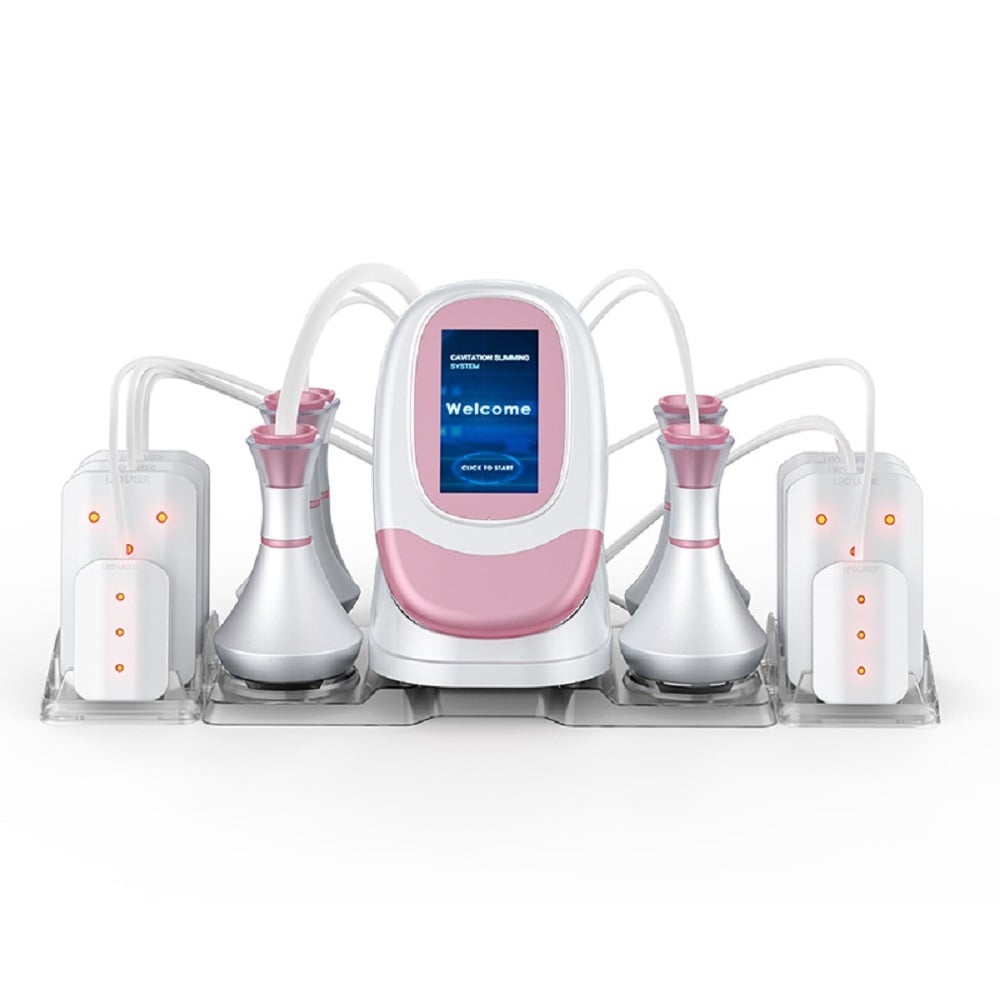
Non-invasive pad-based systems use low-level laser diodes (typically 635nm–650nm) mounted in flexible pads that wrap around the treatment area. You’ll see these sold as “5D Lipolaser,” “6D Lipo Star,” or “Strawberry Laser” — names that describe the pad configuration rather than the underlying technology. They work by delivering cold laser energy through the skin to temporarily perforate fat cell membranes, causing the cells to release their contents for natural lymphatic drainage. Treatment sessions run 20–40 minutes, require no anesthesia, and produce zero downtime. These machines are the entry point: affordable, safe, and simple to operate.
Minimally invasive diode laser systems are surgical-grade devices operating at 980nm and/or 1470nm wavelengths, delivering energy through a thin optical fiber (400μm–800μm) inserted directly under the skin. The laser thermally destroys fat cells and simultaneously tightens collagen fibers — a combination pad-based systems cannot replicate. These machines require trained operators, local anesthesia for the patient, and sterile clinical protocols. They also cost significantly more, but produce dramatically more visible results per session.
Think of it like buying a vehicle: pad-based systems are like a reliable sedan — practical, affordable, and capable of getting the job done. Diode laser systems are the performance vehicle — more power, more capability, and a correspondingly higher price tag.
02| What Determines the Price — The 4-Layer Value Stack
Laser lipo machine pricing follows a predictable logic. Each layer you add to the machine — more power, more certifications, better materials, deeper support — increases the cost in measurable increments. Once you understand these four layers, you can read any quote and know exactly what you’re paying for.
Technology Core — Power, Wavelengths, and Pad Count
The single largest cost driver is what’s inside the machine.
For non-invasive systems, pad count rules the BOM (bill of materials). Each pad contains multiple laser diodes, and diodes are not created equal. A branded 650nm diode from a Japanese or German supplier costs $3–5 per unit; a generic diode from a smaller supplier can cost under $1. The difference shows up in treatment consistency and pad lifespan — cheaper diodes burn out faster and deliver uneven energy distribution. A 12-pad starter system with generic diodes might wholesale at $500–800; the same form factor with 84 pads and branded diodes wholesales at $1,500–2,000. That’s a 3× spread for what looks like “the same machine” in photos.
For diode laser systems, the three variables are power output (15W through 60W), wavelength configuration (single 980nm vs dual 980nm+1470nm), and cooling mechanism (air vs air+water+semiconductor). Each tier up in power adds roughly $500–1,000 to the component cost. Dual-wavelength systems require twice the diode modules and a more sophisticated control board. A 15W single-wavelength machine might cost $1,500–2,200 ex-factory; a 60W dual-wavelength unit with advanced cooling runs $3,500–4,000+.
The optical fiber consumable is another cost to track: each treatment consumes one fiber ($15–50 depending on diameter and quality), and clinics performing 5–10 treatments per week will burn through fibers steadily.
Certifications and Compliance — The Trust Layer You Can’t Skip
Certifications are the most misunderstood cost layer — and the one where cutting corners creates the biggest downstream liability.
Each certification represents real money spent on testing, audits, and ongoing compliance. ISO 13485, the medical device quality management standard, costs $3,000–8,000 annually in audit and maintenance fees. CE marking under Europe’s MDR (Medical Device Regulation) now costs 3–5× more than it did under the older MDD framework due to stricter clinical evidence requirements. FDA 510(k) clearance is the most expensive single certification: $20,000–50,000+ when you factor in biocompatibility testing, clinical data preparation, and regulatory consulting fees.
Why does this matter to you as a buyer? A machine without proper certifications for your market can be seized by customs, rejected by your insurer, or — worst case — become the subject of a liability claim with no regulatory safety net under you. Certifications are not a “nice to have” checkbox. They are your legal operating license.
ISO 13485 + CE + FDA = your legal operating license. A manufacturer carrying the full certification stack has invested significantly in compliance infrastructure — don’t settle for less.
A manufacturer carrying the full stack — ISO 13485 plus CE plus FDA plus RoHS plus FCC — has invested significantly in compliance infrastructure. For example, Konmison holds all five certifications, verified through their quality assurance documentation. When a supplier can produce current certificate scans for each standard without hesitation, you’re looking at a fundamentally different tier of manufacturer than one who says “CE certified” but can’t show you the paperwork.
Build Quality and Manufacturing Standards
Two machines can list identical specs on paper — both 30W, both 980nm+1470nm, both with touch screen — and perform completely differently in daily clinical use. The difference is what happens before the machine leaves the factory.
Quality manufacturers put every PCB board through a 48-hour continuous burn-in test. They run the fully assembled machine at full power for 24–72 hours before boxing it. They subject samples to thermal cycling (-20°C to 60°C) and vibration testing that simulates international shipping. They inspect 100% of incoming components before a single screw goes into assembly.
Manufacturers that skip these steps ship machines that pass a visual once-over but fail within the first year — often within the first 90 days. A machine running 5–8 hours a day in a clinic faces far more stress than one tested for 15 minutes on a bench. The price gap between a machine built with 303-grade stainless steel and one using generic metal casings isn’t about looks. It’s a 3–5 year service life versus 1–2 years.
Customization and After-Sale Support — The Premium Stack
The top layer of the value stack covers what happens after the sale — and what flexibility you have before it.
OEM customization adds $100–1,000 per element: custom housing colors and materials, your logo on the chassis and screen, translated UI in your market’s language, branded packaging. Minimum order quantities for custom work vary from 5–10 units at flexible factories to 50–100 at larger OEM lines. If you’re building a brand rather than just running a clinic, this layer transforms a generic machine into your machine.
After-sale support is priced into the machine upfront. Buy a $2,000 machine with no warranty and no support channel, and the moment something breaks you’re on your own. Spend $4,000 on a machine with a 1–2 year warranty, remote video diagnosis, fast spare parts dispatch, and operator training videos, and your total cost of ownership over three years is actually lower — even though the sticker price is double. Warranty provisioning alone accounts for roughly 3–5% of the machine’s price per year of coverage. When you see a price gap between two otherwise similar-looking machines, check the warranty terms before concluding one is “overpriced.”
03| Laser Lipo Machine Price Tiers — What You Get at Each Level
Here is the landscape at a glance. Use this table to locate yourself, then read the tier that matches your budget and clinical ambitions.
| Tier | Price Range | Machine Type | Best For | Typical Payback |
|---|---|---|---|---|
| Entry | $800–$2,500 | Pad-based non-invasive | Startup salon, add-on service | 2–4 months |
| Mid | $2,500–$8,000 | Pro-grade non-invasive / entry diode | Established clinic, primary service | 3–6 months |
| Premium | $8,000–$50,000+ | High-power diode / FDA-cleared | Medical spa, hospital department | 6–12 months |
Entry-Level ($800–$2,500) — Pad-Based Non-Invasive Machines
This is where most first-time buyers start, and for good reason: the financial risk is modest, the learning curve is shallow, and the machine pays for itself quickly.
At the lower end ($800–1,200), you’re getting a 12–36 pad system with basic single-wavelength diodes (635nm or 650nm), a simple touch-screen controller, and typically CE certification only. Machines in this bracket include the 6-in-1 cavitation + laser combos (around $790 from retailers like RejuvaFresh) and basic 12-pad lipolaser units. They work — but the treatment effect is mild, sessions need to be frequent (8–12 per course), and patient satisfaction depends heavily on managing expectations.
At the upper end of entry-level ($1,800–2,500), you get 60–84 pads, multi-angle pad arrays for full-body coverage, and a more refined control system. The 5D Lipolaser with 84 pads on Alibaba runs $2,400–2,700 at wholesale. These units are sufficient for a salon offering laser lipo as a supplementary service alongside facials, massage, or nail treatments.
What you sacrifice at this tier: treatment intensity is limited by the low-level laser mechanism — you’re not going to match the results of a diode laser or cryolipolysis device. Build quality varies widely between manufacturers. And certification depth tends to be thin (CE only is common). If your clientele is results-driven rather than price-driven, they’ll notice the difference.
Mid-Range ($2,500–$8,000) — Professional-Grade Machines
This is the sweet spot for most independent clinics and established salons. You get enough capability to make laser lipo a flagship treatment rather than an add-on, without the capital commitment of a surgical-grade system.
Two paths exist in this tier. The first is high-end non-invasive: more pads, premium laser diodes, multi-wavelength configurations, and advanced control software — typically $3,000–5,000. The second is entry-level diode laser: a 15W–30W 980nm or 980nm+1470nm system with optical fiber delivery — typically $2,500–8,000 depending on power and wavelengths.
A representative example: GOMECY’s 20W+3W standard dual-wavelength system sells at $2,100–3,200 depending on configuration. Moving to 30W raises the price to $3,100–3,800 (Beijing Sunrise and similar manufacturers). These machines carry CE + ISO 13485 as standard, with FDA clearance less common at this price point.
What you gain at this tier: the treatment effect is clinically meaningful — patients see measurable circumference reduction in 4–6 sessions rather than 8–12. The machines are built for daily throughput. And the certification depth is sufficient for most non-US markets. Consumable costs run roughly $15–30 per treatment (optical fiber), which is negligible against the $150–400 per-session revenue these machines command.
Premium ($8,000–$50,000+) — FDA-Cleared Surgical-Grade Systems
At this tier, you’re buying more than a machine — you’re buying a complete clinical platform with regulatory coverage, brand recognition, and comprehensive support infrastructure.
Chinese-manufactured high-end diode systems (47W–60W, dual wavelength, advanced cooling, full certification stack) run $8,000–15,000. Western-branded systems from companies like Emerald Laser or Cynosure can reach $50,000–99,000+. The price gap reflects brand amortization, local in-country service teams, FDA clearance costs ($20,000–50,000 per device), clinical study funding, and marketing. The Western brand’s retail price is typically 3–5× the factory cost of a comparable Chinese-manufactured system.
Who should buy at this tier: hospital dermatology departments, high-end medical spas in regulated markets (especially the US), and clinics where the device brand name directly supports premium treatment pricing. If your patients ask “what machine do you use” and the answer affects their willingness to pay $600–1,200 per session, the brand premium is justified. If your patients are price-sensitive and care about results over branding, a high-spec Chinese-manufactured system at $8,000–12,000 delivers equivalent clinical performance for a fraction of the cost.
04| The Real Cost — Total Cost of Ownership Beyond the Price Tag
The price on the quote is not what you’ll actually spend in year one. Here is what sits between the sticker price and your true out-of-pocket cost.
| Cost Category | Typical Range | One-Time or Recurring | What to Watch For |
|---|---|---|---|
| Shipping & freight | $200–$800 (air) / $100–$300 (sea) | One-time | DDP terms include duties and door delivery; DAP leaves you handling customs |
| Import duties & tariffs | 0–25% of declared value | One-time | Depends on HS code classification in your country (beauty device vs medical device) |
| Consumables | $15–$50 per treatment | Recurring | Optical fiber per session; gel and disposables are negligible |
| Maintenance & repairs | $200–$800 per year | Recurring | No-warranty machines: 30–50% first-year failure rate. Warranted machines: near-zero repair costs for years 1–2 |
| Training & certification | $0–$2,000 | One-time | Many manufacturers include free remote video training; on-site training costs extra |
Here’s the trap: a $3,000 machine quoted DAP with no warranty and no training can easily run you $4,000–6,000 by the end of year one. A $5,000 machine quoted DDP with a 2-year warranty and included training costs exactly $5,000. Same clinical capability, two very different checks to write. Always get the all-in landed cost — the factory price alone tells you less than half the story.
05| Will It Pay for Itself? — Simple ROI Calculation
The math is straightforward, but most articles about laser lipo either show you revenue without costs (making everything look like a gold mine) or skip the numbers entirely. Here is the complete equation.
Monthly profit = (price per session × sessions per week × 4) − (consumable cost per session × sessions per week × 4) − fixed overhead allocation
Then: Payback period (months) = total machine cost (all-in, landed) ÷ monthly profit
Let’s run a realistic mid-range scenario. You buy a $4,000 machine (DDP included, 1-year warranty). You charge $150 per session — conservative for most markets. At 5 sessions per week (one a day, business days), with $20 fiber cost per session, your monthly numbers look like this:
– Monthly revenue: $150 × 5 × 4 = $3,000
– Monthly consumables: $20 × 5 × 4 = $400
– Monthly profit (before overhead allocation): $2,600
– Payback: $4,000 ÷ $2,600 ≈ 1.5 months
A more cautious scenario: your first two months are slower. You’re building awareness, training staff, and only booking 2–3 sessions per week. At 2.5 sessions per week: monthly profit drops to $1,200, and payback stretches to about 3.3 months. Even in this conservative case, you’re cash-flow positive within a quarter.
The global laser lipolysis device market was valued at approximately $6.24 billion in 2025 and is projected to grow at an 11.46% CAGR through 2032 (Market Report Analytics), which means demand for treatments is expanding — not shrinking. The machine won’t market itself, but if you can fill even a modest appointment schedule, the unit economics are among the strongest in non-invasive aesthetics.
06| Choosing the Right Manufacturer — 5 Things to Check Before You Buy
You’ve studied the technology, priced the tiers, accounted for total cost of ownership, and run the ROI numbers. The final step is the one most buyers rush: vetting the company on the other side of the transaction.
- Verify certifications — don’t take the website’s word for it. Ask for current certificate scans for every certification the manufacturer claims. Cross-check FDA clearances in the public FDA 510(k) database. ISO 13485 certificates can be verified through the issuing body’s online registry. A manufacturer who hesitates to share documentation is a manufacturer you should hesitate to pay.
- Ask to see the factory — live, not in a brochure video. Request a real-time video walkthrough of the production floor. You want to see assembly lines, testing stations, and finished goods inventory. A trading company posing as a manufacturer cannot provide this. Buying from a trader means paying a 20–40% markup for no additional quality control — and no ability to verify how your machine was built.
- Read the warranty terms line by line. How long is the main unit covered? What about accessories and consumable parts? What is the guaranteed response time for support inquiries? Is remote diagnosis included, and are replacement parts shipped at their cost or yours? A manufacturer offering a 1–2 year comprehensive warranty with 12-hour response commitments has confidence in their product. One offering 90 days and “best effort” support is signaling exactly how long they expect the machine to last.
- Request a sample test or client reference. Reliable manufacturers will arrange for you to see a machine in operation — either by sending a sample unit for evaluation or connecting you with an existing customer in your region. Testimonials on a website are easily fabricated; a live reference call with a clinic that has been using the machine for 12+ months is not.
- Compare landed cost, not factory price. A $2,500 FOB quote that requires you to arrange shipping, clear customs, and pay import duties yourself can easily become $3,500+ by the time the machine is in your treatment room. A $3,200 DDP quote that covers everything is sometimes the cheaper option. Always ask suppliers to quote both FOB and DDP so you can make an apples-to-apples comparison.
If you want to benchmark these criteria against a real supplier: Konmison — a Guangzhou-based beauty equipment manufacturer operating a 12,000 sqm owned factory with six automated production lines — meets all five checklist points. The company holds ISO 13485, CE, FDA, RoHS, and FCC certifications simultaneously; offers 1–2 year warranties with remote diagnosis, video training, and fast spare parts dispatch; supports sample machine evaluation; and provides DDP door-to-door delivery with standard model lead times of 3–7 days. Their full OEM/ODM terms and warranty details are available on their custom manufacturing page, and you can request a quote with DDP shipping directly.
References
- Market Report Analytics. “Laser Lipo Machine Market: $6.24B by 2025, 11.46% CAGR.” 2025. https://www.marketreportanalytics.com/reports/laser-lipo-machine-313662
- U.S. Food and Drug Administration. “510(k) Premarket Notification Database.” https://www.accessdata.fda.gov/scripts/cdrh/cfdocs/cfPMN/pmn.cfm
- Konmison. “Quality Assurance — Certifications & Compliance.” https://www.konmison.com/quality/
- Konmison. “OEM/ODM Custom Manufacturing & Warranty Terms.” https://www.konmison.com/oem-odm/
- Konmison. “Contact — Request a Quote.” https://www.konmison.com/contact/
- Konmison. “Custom Beauty Machine Manufacturers — Homepage.” https://www.konmison.com/


 EN
EN  RU
RU  ES
ES  IT
IT  AR
AR  FR
FR  DE
DE  JA
JA  KO
KO  NL
NL