
If you have been searching for “ultrasonic cavitation before and after thighs,” you are probably asking one question: Will this actually work on my legs? You have tried diet and exercise. The scale moves, but your thighs look the same. You want to know whether ultrasonic cavitation can make a visible difference — and what “visible” actually means.
This article gives you the honest answer. No clinic marketing promises. No exaggerated claims. Just what the clinical evidence says, what realistic before-and-after looks like, and how to know whether this treatment is right for you.

01What Is Ultrasonic Cavitation and How It Works on Thigh Fat
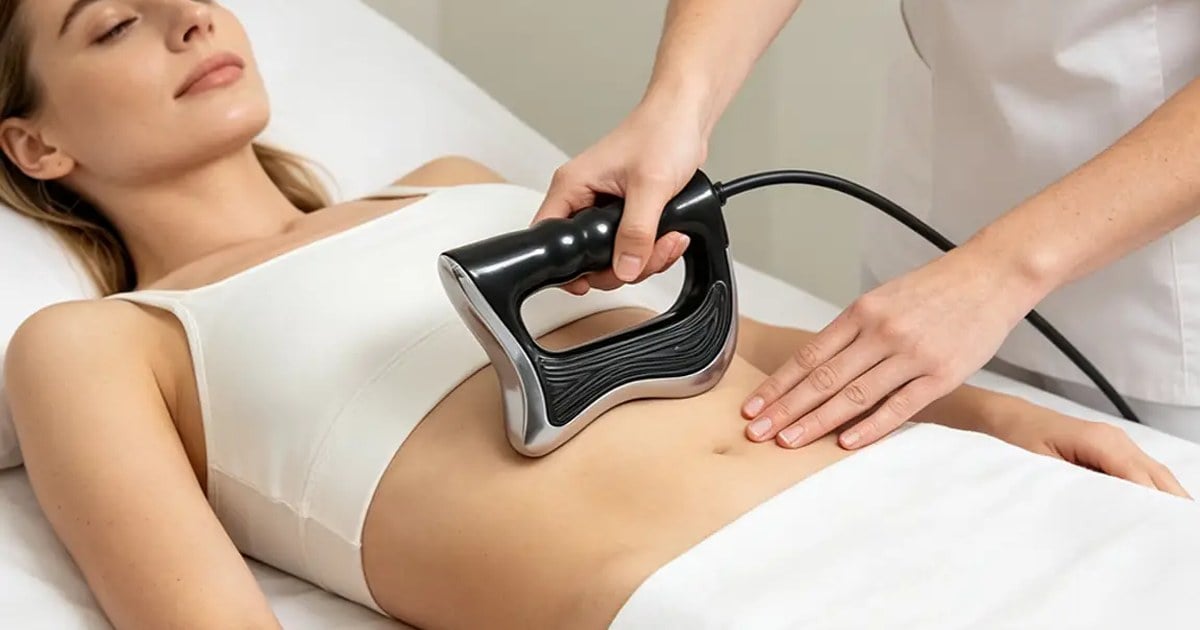
Ultrasonic cavitation is a non-invasive body contouring treatment that uses low-frequency sound waves to break down fat cells beneath the skin. Unlike liposuction, which physically suctions fat out through an incision, cavitation works entirely from the surface. A handheld probe glides over the treatment area, delivering ultrasound energy that targets the fat layer without damaging the skin, muscles, or blood vessels above it.
Here is how it works in three steps: the physical attack on fat cells, why thigh fat is uniquely suited to this treatment, and how your body clears the released fat afterward.
How Ultrasound Waves Target and Break Down Fat Cells
The science is straightforward. A 40 kHz low-frequency ultrasound probe — fundamentally different from the high-frequency ultrasound used in medical imaging (2–18 MHz) — sends sound waves through the skin into the subcutaneous fat layer, approximately 1.5–3 cm beneath the surface. These sound waves generate microscopic bubbles within the fluid surrounding fat cells. As the bubbles expand and collapse in rapid succession, the mechanical force tears open the fat cell membranes.
Think of it like shaking a bottle of soda. The bubbles form, grow, and burst. The shockwave from each burst is strong enough to rupture the fragile walls of adipocytes (fat cells). There is no heat involved, no freezing, and no chemical reaction. It is pure mechanical disruption.
Clinical research supports the mechanism. A 2022 randomized controlled trial on 40 kHz ultrasonic cavitation found statistically significant reductions in fat thickness and body circumference after a structured treatment protocol, confirming that the physical mechanism translates to measurable outcomes at the tissue level (Siam et al., International Journal of Health Sciences, 2022).
Why Thigh Fat Responds Differently to Cavitation
Not all body fat behaves the same way. Thigh fat, particularly in women, is what physiologists classify as “stubborn fat.” The scientific reason comes down to receptor biology.
Fat cells have two types of receptors that control whether they hold onto or release their contents: beta-2 receptors (which trigger fat release) and alpha-2 receptors (which block it). Thigh fat contains roughly 2–3 times more alpha-2 receptors than abdominal fat. When you diet or exercise, your body sends hormonal signals — primarily catecholamines like adrenaline — telling fat cells to open up and release stored energy. Abdominal fat cells, rich in beta-2 receptors, respond. Thigh fat cells, dominated by alpha-2 receptors, largely ignore the signal.
This is why many women lose weight from their waist and upper body first, while their thighs stay stubbornly unchanged. Ultrasonic cavitation sidesteps this entire hormonal pathway. Instead of asking fat cells politely to release their contents through receptor signaling, it physically breaks the cell membrane open. The alpha-2 receptor blockade becomes irrelevant. The fat is released mechanically, not hormonally.
How Your Body Clears the Released Fat
Once the fat cell membrane ruptures, the cell’s contents — primarily triglycerides and free fatty acids — spill into the interstitial fluid between cells. From there, your lymphatic system collects the debris and transports it to the liver for processing and eventual elimination.
This clearance process takes approximately 48–72 hours per treatment session to complete one full cycle. That is not an arbitrary number. It is the physiological reality of lymphatic drainage speed. A single session releases roughly the energy equivalent of 40–60 calories worth of triglycerides, which explains an important point you will see repeated throughout this article: you will notice changes with a measuring tape, not a bathroom scale.
02Your Cavitation Treatment Journey: Sessions, Timeline, and Realistic Thigh Results
This is the section that directly answers your “before and after” question. Every result timeline below assumes three things: you commit to a full course of 6–10 sessions, your clinic uses a properly calibrated 40 kHz medical-grade device, and you follow the aftercare instructions (hydration, light exercise, no alcohol). If any of those variables are missing, your timeline shifts to the right.
Your results depend on three variables: how many sessions you complete, the quality of the machine being used, and how efficiently your body clears the released fat. Here is what you can expect at each phase.
Sessions 1–3: The Silent Phase
The first three sessions are the hardest — not physically, but psychologically. You look in the mirror and see virtually no change. This is normal, and it is the point where most people who quit do so.
What is actually happening: the ultrasound is breaking down fat cells in your thighs with each session. Your lymphatic system has begun clearing the first wave of released fat. But visually, the difference is undetectable. The cumulative effect has not yet reached a visible threshold.
What you might notice: some women report that their thigh skin feels slightly softer or smoother to the touch after 2–3 sessions. This is not fat reduction (yet). It is the early effect of ultrasound-induced collagen stimulation. The gentle heat from the ultrasound probe activates fibroblasts, the cells responsible for collagen production. Skin tightening often begins before visible fat loss.
Bottom line for this phase: keep going. The cells are being disrupted. The clearance is happening. You just cannot see it yet. Think of this as the demolition phase — the walls are coming down inside, but from the street, the building looks unchanged.
Sessions 4–7: When Results Become Visible
Around the fourth to seventh session, the cumulative effect crosses the visibility threshold. This is when most people notice the first real change.
What to expect at this stage: your thighs will measurably decrease in circumference — typically by 1–2 cm at the mid-thigh point by session 6 or 7. You may notice your jeans fitting slightly looser through the thigh area. The outer thigh curve starts to look smoother, and the inner thigh gap may widen subtly.
The cellulite appearance also improves during this phase, independent of the fat reduction. Research explains why: the mechanical vibration from cavitation can help break up the fibrous septae, the connective tissue bands that pull skin downward and create the dimpled appearance of cellulite. Fat loss plus septae release equals a visibly smoother thigh surface.
A separate clinical trial comparing ultrasound cavitation to radiofrequency for body contouring found that cavitation produced significantly greater circumference reduction, reinforcing that the mechanical mechanism delivers measurable results beyond what heat-based treatments can achieve (Abase & El-Sayed, Fizjoterapia Polska, 2020).
Sessions 8–10: Consolidation and Final Results
By session 8–10, your body has cleared most of the fat cells that the ultrasound can effectively disrupt. The rate of circumference reduction slows. This is a plateau, not a failure. Your body is simply running out of fat cells that are vulnerable to the treatment at current settings.
The full-course cumulative result: 2–4 cm reduction in thigh circumference is the realistic range supported by clinical evidence. Not 10 cm. Not “half your thigh gone.” Two to four centimeters is visible, measurable, and worth the investment for many women, but it is not dramatic transformation. Set your expectations here and you will not be disappointed.
Final results do not fully settle until 6–12 weeks after your last session. Why the delay? Two reasons. First, the lymphatic system continues clearing the last wave of disrupted fat for weeks. Second, the collagen remodeling stimulated by the ultrasound takes 8–12 weeks to complete its full cycle. The thighs you see on the day of your last session are not the final result. They will continue to improve subtly over the following 2–3 months.
A critical biological fact: the fat cells destroyed by cavitation do not grow back. Adult humans do not generate new fat cells in significant numbers. The total number of fat cells stabilizes after puberty. However — and this is the caveat every clinic should tell you but many do not — the fat cells that survive the treatment can still expand. If you gain weight after your course, those remaining cells will enlarge, and your thigh circumference will increase again. Cavitation permanently removes some fat cells, but it does not inoculate you against future weight gain.
What Real Before-and-After Actually Looks Like

Since you searched for “before and after,” let me paint the picture as honestly as a text description can.
Viewed from the front: the inner thigh gap widens slightly. The outer thigh silhouette becomes smoother, with less of an outward bulge at the widest point. The overall leg shape looks more streamlined, but not dramatically thinner.
Viewed from the side: the forward projection of the thigh decreases modestly. The contour from hip to knee becomes straighter. The buttock-thigh junction — where the lower glute meets the upper hamstring — shows the most noticeable improvement, with a cleaner, more defined transition.
Viewed from the back: the reduction is most visible just below the gluteal fold. The “saddlebag” area, if present, flattens perceptibly.
If you are expecting your thighs to go from 58 cm to 48 cm, cavitation is the wrong treatment. That is liposuction territory. If you are expecting your thighs to go from 58 cm to 55–56 cm — with smoother skin, less pronounced cellulite, and clothes fitting better — that is a realistic outcome from a full cavitation course.
03Aftercare Essentials: How to Maximize Every Session
You have invested time and money in your treatments. The 48 hours after each session determine whether that investment pays off or goes to waste. Three rules matter more than everything else combined.
Drink 2–3 liters of water daily. Lymph fluid is 96% water. When you are dehydrated, lymphatic flow slows by an estimated 30–40%. The released fat sits in your interstitial fluid, waiting for transport that never arrives. Water is the truck that hauls the debris away. No water, no clearance. No clearance, no results.
Move your body for 20–30 minutes after each session. You do not need a gym workout. A brisk walk is enough. The goal is to activate your circulatory and lymphatic systems. Muscle contractions squeeze lymphatic vessels and push fluid toward the lymph nodes for processing. Sitting still for hours after treatment leaves the released fat stagnant.
Avoid alcohol for 48 hours post-treatment. Ethanol metabolism and triglyceride metabolism compete for the same liver enzyme pathways (the CYP450 system). When you drink alcohol, your liver prioritizes processing the ethanol — which it treats as a toxin — and the fat clearance gets parked in the queue. One glass of wine undoes the metabolic progress of a session.
Three things to avoid: extreme temperatures (saunas and hot baths dilate blood vessels and redirect circulation away from the treated area), tight clothing that compresses lymphatic channels, and skipping treatment intervals. Missing two sessions in a row allows the partially cleared fat cells to resettle, reducing the cumulative effect.
04Cavitation vs Other Thigh Contouring Methods: A Comparison
If you are researching cavitation, you have probably also encountered CoolSculpting, laser lipolysis, and radiofrequency. Here is how they compare for thigh treatment specifically.
| Ultrasonic Cavitation | CoolSculpting (Cryolipolysis) | Laser Lipolysis | Radiofrequency (RF) | |
|---|---|---|---|---|
| Mechanism | Ultrasound mechanical force breaks fat cell membranes | Controlled cooling freezes and kills fat cells | Laser heat melts fat | Radiofrequency heats and tightens skin |
| Thigh suitability | ★★★★★ Best fit — targets stubborn thigh fat | ★★★★ Good for pinchable fat bulges | ★★★ Moderate — more effective on small areas | ★★ Primarily for skin tightening |
| Session duration | 30–60 minutes | 35–60 minutes | 30–45 minutes | 20–40 minutes |
| Sessions needed | 6–10 | 1–2 | 4–6 | 6–8 |
| Circumference reduction | 2–4 cm | 3–5 cm | 2–5 cm | 1–2 cm |
| Pain level | Virtually none — mild warmth | Initial suction + intense cold (fades after 5–10 min) | Warm sensation — tolerable | Warm sensation — comfortable |
| Downtime | Zero | Zero (possible bruising) | Zero | Zero |
| Cost per session (USD) | $100–200 | $600–800 | $200–400 | $100–200 |
| Best candidate | Near goal weight, diffuse thigh fat, cellulite | Pinchable fat roll (>2 cm pinch) | Small stubborn pockets + mild skin laxity | Skin laxity primary concern, minimal fat |
How to choose: Try the “pinch test.” Pinch the area of your thigh that bothers you most. If you can grasp more than 2 cm of fat between your fingers, CoolSculpting is an option — but you will pay 3–4× more per session (though you need fewer sessions). If you can only pinch a thin layer and your main complaint is overall thickness plus cellulite, ultrasonic cavitation is likely your better fit.
One safety note worth knowing: CoolSculpting carries a rare but documented risk of paradoxical adipose hyperplasia (PAH), where treated fat cells enlarge instead of dying, at an estimated incidence of approximately 0.025%. Ultrasonic cavitation has no equivalent adverse effect.
05What Makes a Quality Cavitation Machine — And Why It Affects Your Results
Here is something most clinic websites will not tell you: the machine your provider uses directly determines the ceiling of your results. An operator can be highly skilled, but if the device itself is underpowered or poorly calibrated, the best technique in the world cannot compensate.
The global beauty equipment market produces ultrasonic cavitation devices ranging from $50 consumer gadgets to $2,000+ medical-grade platforms. If your clinic uses a machine from the lower end of that spectrum, your 6–10 session course may deliver zero measurable results — not because cavitation does not work, but because the specific device cannot generate sufficient output.

Certifications That Separate Medical Devices from Beauty Gadgets
When a cavitation machine carries ISO 13485 certification, that is not just a sticker. ISO 13485 is the international quality management standard specific to medical device manufacturing. Unlike the generic ISO 9001 (which applies to any factory making anything), ISO 13485 requires design controls, risk management per ISO 14971, full component traceability, and post-market surveillance. A manufacturer with ISO 13485 follows the same quality framework as companies making surgical instruments and implantable devices.
CE marking adds another layer — but with an important distinction. A “CE-marked beauty device” and a “CE-marked medical device under MDR (EU 2017/745)” are fundamentally different regulatory categories. The latter requires clinical evidence of safety and performance; the former is essentially self-declared. When a machine holds CE certification under the Medical Device Regulation framework, it means a notified body has reviewed evidence that the device works as claimed.
FDA 510(k) clearance for the US market means the device has been reviewed and found substantially equivalent to an already-approved predicate device. FDA registration alone — without 510(k) clearance — is just an establishment listing and does not constitute approval.
Before booking a treatment, ask your clinic: “What certifications does your cavitation machine hold?” If they cannot name a specific manufacturer and certification, that is information worth having.
Machine Specifications That Impact Your Treatment Quality
Three technical parameters separate effective machines from ineffective ones.
Frequency stability: 40 kHz ± 1 kHz. The physics of cavitation depends on creating bubbles of a specific size that collapse with sufficient force to rupture fat cell membranes. If the ultrasound frequency drifts, the bubble size changes and the mechanical disruption becomes less efficient. Medical-grade piezoelectric ceramic transducers (PZT) maintain frequency stability with 70–90% energy conversion efficiency. Cheaper metal-element transducers, common in low-cost machines, lose calibration and drop to 30–50% efficiency after sustained use.
Power density: ≥ 2 W/cm². This is the cavitation threshold. Below 2 watts per square centimeter, the ultrasound cannot reliably generate inertial cavitation — the violent bubble collapse required to tear fat cell membranes. A machine operating at 1.5 W/cm² will feel warm and produce a pleasant massage sensation, but it will not break down fat. Think of it like boiling water: at 90°C, the water is hot, but it will never boil. The threshold is absolute, not approximate.
Treatment head quality and calibration. Even a well-manufactured machine degrades with use. Probe calibration should be verified periodically. A worn or miscalibrated treatment head loses output power without any visible sign of malfunction. This is one reason why experienced clinics with consistent results invest in equipment from manufacturers that provide ongoing technical support and replacement parts, rather than disposable consumer-level devices.
Questions to Ask Before Booking a Thigh Cavitation Treatment
Take this checklist to your consultation:
- “What brand and model is your cavitation machine?” — If they deflect or give a vague answer like “it is a professional machine,” be cautious. Legitimate clinics are proud of their equipment.
- “Does the manufacturer hold ISO 13485 certification?” — This is the single most reliable quality signal for medical aesthetic devices.
- “What is the ultrasound frequency?” — The correct answer is 40 kHz. If they do not know, they have not been properly trained.
- “Do you measure and track circumference before and after each course?” — Clinics that track data are clinics that care about outcomes. If they do not measure, how will you know if it worked?
- “Has your staff received manufacturer-specific training on this device?” — Different manufacturers’ machines have different protocols for probe speed, angle, pressure, and maximum dwell time per treatment zone. Untrained operators risk undertreatment (no results) or overtreatment (skin burns from excessive dwell time — a known risk when ultrasound is applied to one spot for more than 15 minutes).
Three red flags: prices significantly below market rate (single sessions under $50 almost always mean low-cost equipment), refusal to share equipment brand or certifications, and clinics that do not perform baseline measurements.
06Is Ultrasonic Cavitation Right for Your Thighs?
You are a good candidate for thigh cavitation if you are within approximately 10 kg of your goal weight (BMI under 28), your thigh fat is stubborn rather than generalized obesity, you are willing to commit to a full 6–10 session course, and you can maintain consistent hydration, light exercise, and minimal alcohol consumption during the treatment period.
You are not a candidate if you are pregnant, breastfeeding, or trying to conceive (the effect of therapeutic ultrasound on fetal development is not studied and the precautionary principle applies); if you have a pacemaker or metal implants in the treatment area (ultrasound can interfere with electronic medical devices); if you have active liver or kidney disease (these organs process the released fat — impaired function creates metabolic risk); or if your BMI is 30 or above, in which case whole-body weight reduction should take priority over localized contouring.
The honest summary: if you want to drop multiple clothing sizes or lose 5+ cm from each thigh in a single procedure, cavitation is the wrong path — liposuction is the appropriate comparison. If you want a 2–4 cm reduction with smoother skin, less visible cellulite, and no surgery or downtime, and you are willing to complete the full course and follow the aftercare, ultrasonic cavitation is worth serious consideration.
If you are a clinic owner or aesthetic professional evaluating equipment options for your practice, the machine quality factors covered above apply directly to your purchasing decision. Manufacturers such as Guangzhou Konmison Electronic Technology — an ISO 13485-certified, CE- and FDA-registered beauty equipment producer with over a decade of OEM manufacturing experience — supply certified ultrasonic cavitation equipment to clinics across 60+ countries. Their quality certifications and manufacturing standards are publicly documented (ISO 13485 and CE certified manufacturing), providing a reference point for the certification benchmarks discussed in this article.
References
- Siam MH, Elkosery SM, Abohashim MF, Mohamed DMA. “Effect of Ultrasound Fat Cavitation Versus Faradic Stimulation on Abdominal Adiposity During Postnatal Period.” International Journal of Health Sciences, 2022. https://doi.org/10.53730/ijhs.v6nS6.10119
- Abase SAE, El-Sayed SH. “Ultrasound Cavitation versus Tripollar Radio-frequency Lipolysis on Decreasing the Waist Circumference in Pre-abdominal Surgical Patients: Randomized Clinical Trial.” Fizjoterapia Polska, 2020; 20(1):78–84. https://fizjoterapiapolska.pl/en/
- ClinicalTrials.gov. “Ultrasound Cavitation Versus Radiofrequency on Abdominal Fat.” NCT04452552. Cairo University, 2020. https://ichgcp.net/clinical-trials-registry/NCT04452552
- International Organization for Standardization. ISO 13485:2016 — Medical devices — Quality management systems. https://www.iso.org/standard/59752.html
- European Union. Regulation (EU) 2017/745 — Medical Device Regulation (MDR). https://eur-lex.europa.eu/eli/reg/2017/745
- Konmison. “Cavitation Machine.” https://www.konmison.com/cavitation-machine/
- Konmison. “Quality Control.” https://www.konmison.com/quality/
- Konmison. Homepage. https://www.konmison.com/


 EN
EN  RU
RU  ES
ES  IT
IT  AR
AR  FR
FR  DE
DE  JA
JA  KO
KO  NL
NL